
Court Denies PA Senators Right to Join Lawsuit Against DRBC
 Last May MDN told you about a group of brave landowners in Wayne County, PA who have had their property rights stolen by the Delaware River Basin Commission (see Wayne County, PA Landowner Sues DRBC Over Fracking Ban). They filed a lawsuit against the DRBC asking a judge to declare the DRBC does not have jurisdiction to prevent construction of a natural gas well. Several northeastern PA counties (unfortunately) are located in the Delaware River Basin and the DRBC has steadfastly refused to allow them to drill any shale wells, citing concerns that the Delaware River supplies fresh water to millions downstream–even though they can’t explain how that water might get contaminated. A few months later, the DRBC’s best friend and patron, THE Delaware Riverkeeper, sued to join the lawsuit to help defend the inept DRBC (see Delaware Riverkeeper “Intervenes” to Protect its Patsy – the DRBC). In November, three PA senators filed to join the lawsuit on behalf of the landowners that they represent (see PA Senators File to Join Case Against DRBC Fracking Moratorium). Predictably, THE Delaware Riverkeeper sought to prevent the senators from joining the lawsuit. You see, it’s OK for Riverkeeper to participate as an outsider, but not OK for the Senators to participate to ensure the people they represent get represented in the lawsuit. That’s how it works in the world of enviro radicalism. Unfortunately, the court where the case is being heard sided with the radicals and has ruled the Senators have no right to represent the people they were elected to represent when it comes to a court case…
Read More “Court Denies PA Senators Right to Join Lawsuit Against DRBC”
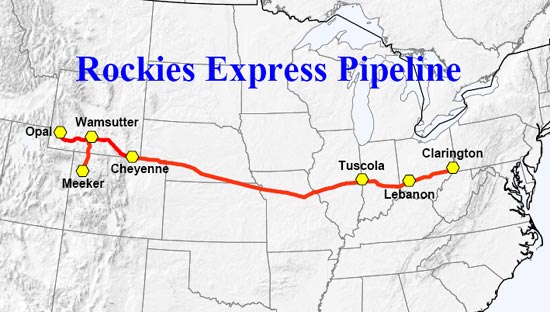 The Rockies Express Pipeline (REX), originally built from Colorado and Wyoming to Monroe County, OH to bring natural gas from west to east, last year reversed the flow for a large and important section of the pipeline. On August 1, 2015 the section of REX from Monroe County, OH to Mexico, MO reversed the flow and began to carry 1.8 billion cubic feet per day (Bcf/d) of Utica and Marcellus Shale gas to the Midwest, including to the greater Chicago area. REX has been hard at work on plans to expand capacity even more by beefing up compressor stations along portions of the pipeline. REX filed a plan with FERC to add another 800 million cubic feet per day (MMcf/d) of capacity along the same portion of the reversed pipeline–for a grand total of 2.6 billion cubic feet per day (Bcf/d). In mid-December, the first 200 MMcf/d of capacity came online (see
 As MDN reported earlier this week, on the last business day of 2016 the Federal Energy Regulatory Commission (FERC) issued a favorable draft (not final, but draft) environmental impact statement (EIS) for the $5 billion, 594-mile Dominion Atlantic Coast Pipeline project (see
 In Oct. 2015 MDN reported a story about International Paper’s Ticonderoga mill in northern New York, near the Vermont border (see
 A couple of times we’ve highlighted the great work done by the Norton Rose Fulbright law firm, most recently just last month (see
 Spitting and spouting about so-called renewables and nasty, evil, vile fossil fuels, the head of the extremist Natural Resources Defense Council is trash-talking the incoming Trump Administration even before it takes up residence in Washington. Typical. According to Rhea Suh, a Donald Trump presidency equals the end of a liveable earth. We invite Ms. Suh to relocated to Mars, or perhaps one of the moons of Jupiter. Here’s some of the insane ramblings from the NRDC earlier this week in declaring war on the Trump Administration…
 The United States is already on the cusp of energy independence, thanks to the shale revolution. What does that mean? It means when you consider how much energy we produce and export, and how much we consume and import, at the end of the day, we are producing as much energy as we consume. But it gets complicated. We still import a lot of oil from the Middle East and elsewhere. We import (and export) oil via pipelines to Canada. We also still import natural gas. But at some point the U.S. will export more than it imports. That is, we won’t only produce as much as we consume, we’ll produce extra energy–and sell it abroad to other countries. We will become a “net exporter.” When will that happen? According our favorite government agency, the U.S. Energy Information Administration (EIA), it will happen in the next 10 years–or less. The EIA has just released its “Annual Energy Outlook 2017” (full copy below). In the report the number crunchers at EIA look at multiple scenarios and conclude that under most scenarios we are a net exporter by 2026, and in some of those scenarios, it happens even sooner. That would be the first time since 1953 that our country has exported more energy than it uses. Not surprisingly, LNG (liquefied natural gas) plays a critical role in our country becoming a net exporter. Here’s what the EIA said in releasing the 2017 annual report…
 The American Petroleum Institute’s (API) president and CEO, Jack Gerard, delivered the keynote address at API’s Seventh Annual State of American Energy event in Washington, DC on Wednesday. At the same event the API released the “State of American Energy 2017” report (full copy below) highlighting the energy issues that will shape America’s economic and political news this year. Gerard says we have now fully debunked the insane ramblings of the environmental left in this country, proving that we can grow our energy use and our energy production, while at the same time creating a cleaner environment. According to the EIA, in the first six months of 2016, carbon emissions from electricity generation were at their lowest point in 25 years even as electricity demand rose–thanks to greater use of natural gas. Below are highlights of Gerard’s speech along with a copy of the newly released report…
 We are speechless (and that doesn’t happen often). Get a load of this: “A new report from transparency watchdog group Open the Books documents an explosion in the number of federal agencies with gun-toting, badge-wielding law enforcement divisions. The report, called “The Militarization of America” [full copy below] details the astonishing scope of federal police power. There are now over 200,000 federal officers with arrest and firearm authority, in a whopping 67 different federal agencies….We all understand that the EPA is tasked with enforcing environmental laws. But does it really need a full-blown military-style police force? Congress granted the EPA police powers in 1988, but not with SWAT teams in mind. Even now, the agency says its Criminal Enforcement Program ‘enforces the nation’s laws by investigating cases, collecting evidence, conducting forensic analyses, and providing legal guidance to assist in the prosecution of criminal conduct that threatens people’s health and the environment.’ Well yes, but also by midnight raids with SWAT teams and attack dogs, confiscating private property, hauling people off to jail for accidentally spilling a barrel of oil, and other ‘enforcement’ horrors”…
 To say that it was a roller coaster ride for Williams in 2016 doesn’t even come close to reality. The company received no less than two takeover/merger attempts. Energy Transfer Equity’s (ETE) billionaire CEO Kelsy Warren propositioned Williams for over six months before going public with his overtures last year (see
 In 2012, the Pennsylvania Dept. of Environmental Protection (DEP) launched an “expedited” review process for erosion and sediment control general permits that it grants when drillers or pipeline companies plan to push dirt around on more than 5 acres at a time. Which means every pipeline built and every shale well pad constructed. The expedited review process shortened the time to get a permit down to as little as 14 days–provided the paperwork was filled out correctly. The DEP conducted an internal review and found that 59% of the time they didn’t get the paperwork in a form they wanted, so they disqualified those applications. Now the DEP is revising its rules for expedited review, meaning they’re pretty much doing away with it. Welcome back to long delays in getting permits to push dirt around. This action appears to be a response to stinging criticism from the PA legislature that permits, which are supposed to be issued in 14 days, are taking over 100 days–a charge leveled by PA Sen. Camera Bartolotta who is introducing legislation to put a burr under the DEP’s saddle. So the DEP is saying fine, we’ll just change it back to the way it used to be. You can now expect long permit delays from the outset. Your state government at work, serving the people…
 American Water Management Services (AWMS) owns a wastewater injection well in Trumbull County that supposedly caused a low-level earthquake (that nobody could feel) in 2014. Two wells located at the site, both operated by AWMS, were “temporarily” shut down by the Ohio Dept. of Natural Resources following the quake (see
 In August of 2016 the Federal Energy Regulatory Commission (FERC) finally granted a certificate to Dominion to build its Leidy South Project, a $210 million to build and/or upgrade six compressor stations along the DTI pipeline system in Pennsylvania, Maryland and Virginia (see
 In 2014 we brought you the interesting story of strippers in the Marcellus–stripper wells, that is (see
 T. Boone Pickens, a Texas oil man (pronounced “aaalll man” in Texas) needs no introduction. In a post on LinkedIn, Boone offers some great advice to the incoming President-elect Donald Trump on how The Donald can make America great again, using domestic energy resources. Boone’s plan has two parts: (1) Don’t screw up what we have going for us. (2) Don’t settle for what we’ve done so far. Here’s some great insights from someone The Donald should listen to…
 A kerfuffle erupted yesterday when Chapter IV Investors, a Charlotte, NC-based investment firm with investments in EQT, Range Resources and Antero Resources, announced it had sent a letter to EQT urging the company to consider merging with either Range Resources or Antero Resources. Chapter IV, which is essentially two big-money investors (W. Barnes Hauptfuhrer, Managing Partner and Portfolio Manager, and Ryan J. Jack, Partner), does not own enough stock in any of the companies (less than 1% in each) to throw its weight around like a corporate raider. Rather, it appears to be two investors attempting to grab the attention of these companies and their shareholders by issuing a press release (full copy below) with a plan they say would create a new Marcellus/Utica driller worth more than $25 billion. Obviously the value of investments for Chapter IV would go up under such a scenario–so there is self-interest at work here. However, we don’t detect any kind of bullying on the part of Chapter IV, like that of a raider Carl Icahn (successful takeover of Chesapeake Energy & Cheniere Energy) or Keith “Mini-Me” Meister (unsuccessful attempt to takeover Williams). Rather, it appears to be a couple of investors who believe there is an honest and good case for a combination of EQT with another company, and were willing to spend $500 on a press release to make their case. Are they right?…