
FERC Not Caving to EPA Bullies – So Far
 The bullies at the rogue, out-of-control federal Environmental Protection Agency (EPA) are leaning hard on the Federal Energy Regulatory Commission (FERC) over FERC’s approval for two Marcellus/Utica projects–Leach Xpress and Rayne Xpress Expansion projects. The EPA thinks FERC should consider man-made global warming flummery as part of their evaluation process. FERC is resisting. So the EPA bullies are demanding a meeting, to help FERC get it’s head straight (see Warning: EPA Attempting to Take Over FERC’s Job in Pipe Approvals). So far FERC has let the EPA eat static, not responding. The question is, will FERC courageously resist EPA’s call to shoot down the two projects? Or will FERC cave to EPA bullies? The EPA admits this isn’t just about two pipeline projects–they want FERC to change the way it evaluates ALL projects, to consider idiotic global warming emissions as part of the process…
Read More “FERC Not Caving to EPA Bullies – So Far”
 Yesterday EQT announced a pair of deals that will net the company another 60,000 Marcellus/Utica acres including 44 Marcellus wells producing a collective 44 million cubic feet equivalent per day (MMcfe/d) of natural gas. Most of the acreage (42,600) is in three West Virginia counties, with another 17,000 acres in three Pennsylvania counties. EQT is paying a total of $683 million for the two deals. In the first deal, EQT is buying Trans Energy, Inc., which will become a wholly-owned subsidiary of EQT. EQT is also buying Trans Energy joint venture partner Republic Energy’s share in their Marcellus jv. The land is located in Marion, Wetzel and Marshall counties (WV). In the second deal, EQT is buying 17,000 acres from an unidentified third party in southwestern PA, in Washington, Westmoreland and Greene counties. EQT describes the purchases as adding acreage to their “core development area.” You may recall that EQT closed a deal in July, just three months ago, to purchase 62,500 acres from Statoil in WV for $407 million (see
 A landowner in northeastern Pennsylvania signed a lease with Southwestern Energy, leasing her property for shale gas drilling. Southwestern eventually showed up and drilled a well on her property. But the landowner then said the drilling was too loud, and lights at night too bright, and it disturbed her “peace of mind”–so she sued Southwestern for eight weeks of “peace of mind” disruption and a prescription for Xanax. Fantastically, a judge is letting the lawsuit proceed. Earth to landowners: When drillers show up, it’s an INDUSTRIAL activity. It’s loud. There’s lots of trucks. There’s lights at night. And in a month or two, it all goes away. And when the royalty checks arrive in the mail, you’ll forget all about the inconveniences. So what’s really going on in this case?…

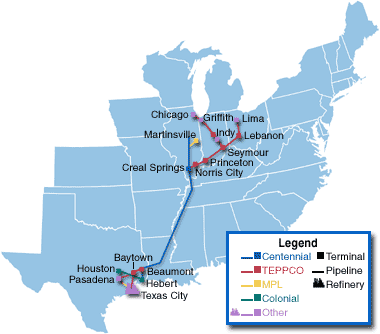 In September 2015 MDN brought you the news that two joint venture partners, MPLX (Marathon Petroleum) and Enterprise Products Partners, were actively evaluating a plan to reverse the flow of the 795-mile Centennial Pipeline to send natural gas liquids (NGLs) from the Utica/Marcellus to the Gulf Coast (see
 “What is all the fuss over Pennsylvania’s Chapter 78a drilling rules going into effect anyway? We mean, come on, those rules were hashed out over the past five years! Can’t the drilling industry just bend over and take it like a man? It can’t be all that bad, can it?” With pleasure, we bring you a response to that line of thinking–a line of thinking YOU may have thought! The writer, Colin McNickle, is a former editorial page chief for the superb Pittsburgh Tribune-Review. McNickle tackles Chapter 78a head-on in this excellent rebuttal. It is nothing short of a declared war on shale gas and oil…

 MDN editor Jim Willis recently had the pleasure of addressing the Petroleum Club at the University of Pittsburgh’s Bradford, PA campus. Not in person, but via Skype video. When Jim asked the group, most of them in their second year of a two-year petroleum technology program about future job prospects, he got the impression they are concerned. The Marcellus industry has not been immune to layoffs. Graduating with a degree in an industry that’s seen 300,000+ layoffs over the past two years might make some question the wisdom of entering the program in the first place. Jim’s message to these eager young people bursting with potential? Don’t give up–and be encouraged. At the recent Shale Insight event and Benposium East event (both held in September), Jim had a number of conversations with those who either work in or invest in the o&g industry. His conclusion after speaking with industry insiders? Things are beginning to turn around. In fact, we can’t count the number of stories that talk about the coming shortage of good workers in the o&g industry. Today we spotted a press release from Energent Group promoting new research and wanted to highlight some of the information in that release–information that may be helpful to our new young friends at Pitt-Bradford, and for others in the industry looking for work. The research highlights the fact there are many drilled but uncompleted wells (DUCs), in all shale plays–but particularly in the oily Permian and Eagle Ford shale plays. According to the Energent research, workers probably stand the best chance of getting a job with a frac crew–because companies will first work on completing the already-drilled wells by fracking them. Makes sense to us!…
 One company that has been really smart and savvy when it comes to hedging is Antero Resources. Earlier this year when the average price of natural gas was selling for under $3 per thousand cubic feet (Mcf) on the benchmark Henry Hub, Antero averaged a sale price of $4.54/Mcf–in the Marcellus/Utica! Where prices are always BELOW the Henry Hub (see

 We spotted what is, to us, a fascinating story about propane use across the country. There are those, like LP Gas magazine, that closely watch usage trends for propane. As you may know, propane is an NGL, or natural gas liquid. It is one of the hydrocarbons that comes out of a borehole drilled to extract either oil or natural gas. Along with oil and gas other hydrocarbons come out of the hole–NGLs like propane, ethane, butane, etc. One of the places propane is increasingly produced, and consumed, is in the northeast–because of Marcellus/Utica drilling. The sharp editors at LP Gas noticed an historically unusual trend–a spike way up in propane usage in one of the main regions tracked, in the northeast. The explanation for the spike up in usage? Propane is getting exported from the Marcus Hook refinery. Therefore much larger volumes of propane are being “consumed” by those exports. Which we find fascinating. We are producing AND consuming propane within the Marcellus/Utica region. That is, we’re generating wealth by exporting propane. We knew about ethane exports already happening at Marcus Hook (see
 Black & Veatch, a global engineering, consulting, construction, and operations company that is a major player in the oil and gas market, has just-released a new report: 2016 Strategic Directions: Natural Gas Industry Report (see a copy below). The new report tackles market outlooks for the upstream, midstream and downstream segments. One of the sections that caught our eye: power market opportunities, which explores how coal plant retirements and lower operating dispatch costs have moved natural gas to its place as the primary energy source in the United States. Also in the report, the attitudes of those working in the industry is optimistic. But the report authors issue a note of caution: “Yet, this optimism may be masking some substantial warning signs, particularly for upstream and midstream players. Tight controls on capital investments, tied to the low margins inherent in today’s pricing environment, have constrained new projects. Lower crude oil prices have revitalized petrochemical projects in the downstream sector, particularly in international markets, but investors still question long-term viability. This raises a key question for how organizations are, or are not, positioned to take advantage of an eventual pricing correction.” In other words, drillers and pipeline companies shouldn’t be popping the cork on the champagne bottle just yet. Here’s the fifth annual natgas update from B&V…
 A couple of legal beagles from the Fox Rothschild law firm (in NJ) are sounding the alarm that two bankruptcy court decisions in New York State are threatening to up-end the midstream industry across the country. We tend to agree with them. Earlier this year, MDN brought you the news that a NY bankrutpcy court judge had allowed Sabine Oil & Gas, going through bankruptcy, to cancel a pipeline gathering contract with Cheniere’s Nordheim Eagle Ford Gathering in Texas (see

 We’ve written a number of stories about Pennsylvania House Bill (HB) 1391 that would guarantee landowners receive a 12.5% minimum royalty on the gas extracted from their land, regardless of post-production costs. The issue has led to what MDN calls a civil war between landowners (particularly in Bradford County, PA) and the drilling industry. The clock is ticking and this week is it for this legislative session in PA. If supporters of HB 1391 don’t get the bill passed this week, it will have to be reintroduced and go through the entire process again next year. Supporters like Doug McLinko, a Bradford County commissioner, have warned of serious consequences for the industry if the bill doesn’t get passed. The industry appears to have convinced enough lawmakers to keep the bill bottled up so it doesn’t come to the floor for a vote, which riles landowners. HB 1391’s supporters in the legislature are sounding like it’s already over for this year, and that they will have to fight again next year. We’re concerned what this ongoing situation will do for what has, in the past, been good relations between landowners and drillers. That relationship appears to be souring, at least for some landowners…