
PA DEP Notifies Shell of “Technical Deficiencies” with Ethane Pipe
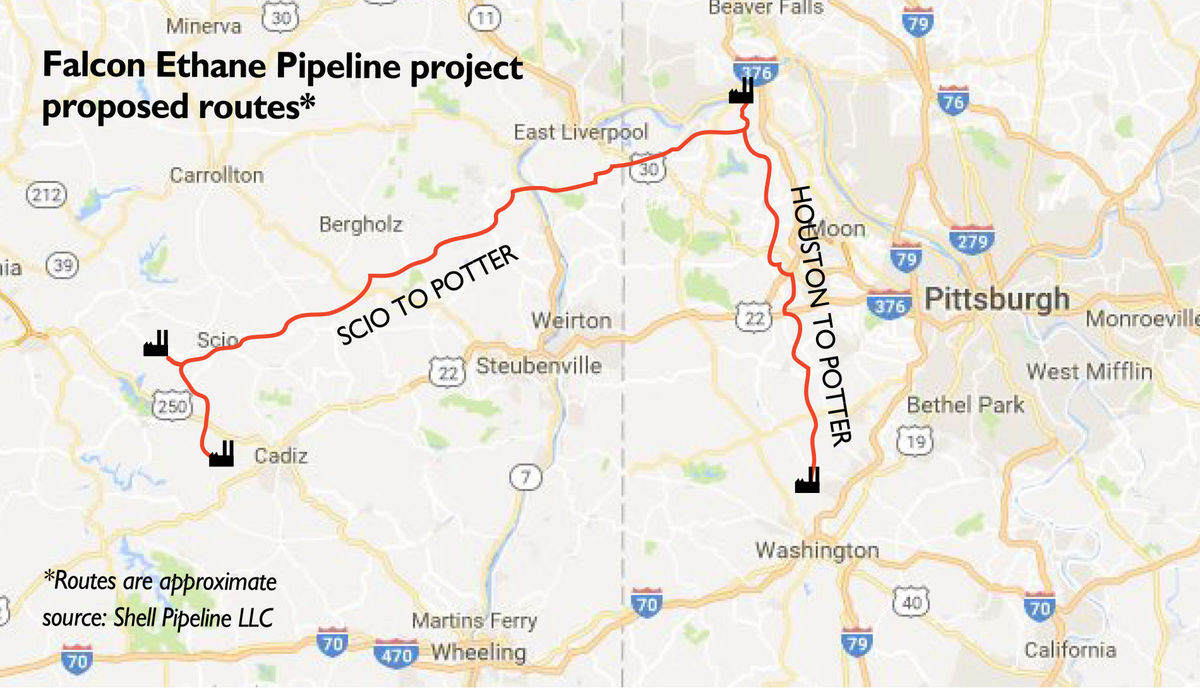
 Shell delivered some good news at last week’s Northeast U.S. Petrochemical conference in Pittsburgh: The Falcon ethane pipeline will get built next year (see Shell Says Falcon Ethane Pipeline to Get Built in 2019). The pipeline won’t actually flow ethane to the Shell cracker in Monaca until 2020 at the earliest, because the cracker plant itself won’t go online until 2020 at the earliest. The 97-mile consists of “two legs,” with about half of the pipeline located in PA, the other half in OH. The Pennsylvania Dept. of Environmental Protection (DEP) conducted three public hearings on the project earlier this year, in preparation for issuing permits. Antis came out in force and behaved badly, as they typically do (see More of the Same at Final DEP Hearing for Shell Ethane Pipeline). No matter. The pipeline will get built. But not without jumping some hurdles first. On June 1, the DEP issued three letters identifying what it calls “serious technical deficiencies” in Shell’s pipeline plan, for townships in three different counties along the pipeline’s PA route. Shell maintains this type of notification is “common” in the permitting process, and is committed to working with the DEP to address any issues of concern…
Read More “PA DEP Notifies Shell of “Technical Deficiencies” with Ethane Pipe”
 In March, MDN brought you the news that the Federal Energy Regulatory Commission (FERC) had taken “significant action” to address the Trump tax cut legislation enacted last December (see
  Seems like a week doesn’t go by that MDN isn’t asked (by someone from Pennsylvania), “Is there any hope of building the Constitution Pipeline through New York?” Our standard response is this: The only way it gets built is (a) NY elects a new governor favorable to the industry–about a 1% chance of that happening, (b) President Trump issues an Executive Order overriding Cuomo’s blockade of Constitution (and other pipeline projects)–maybe a 10% chance of that happening, or (c) the Federal Energy Regulatory Commission (FERC) reconsiders a decision to not overrule NY’s move to block the project–maybe a 15% chance. The U.S. Supreme Court in April refused to consider the Constitution Pipeline case, closing that door (see
  Last Thursday EQT held its annual shareholder’s meeting. By all accounts it was a sleepy affair with few people attending–inside at least. Even the current interim CEO, David Porges, didn’t bother to show up, sending along CFO Rob McNally to be the official face of the company. McNally spoke about the past few years as hectic, going from “one transaction to the next.” McNally said “there’s a light at the end of the tunnel” for things to now settle down–once the company splits in two later this year (into upstream and midstream). However, a handful of Mountain Valley Pipeline (MVP) protesters showed up to mouth off–marching outside EQT HQ where the annual meeting was held. McNally said, in so many words, protests of MVP are no big deal. The company thought there would be protesters, and they even planned for illegal protests in the construction timeline (people chaining themselves to bulldozers, etc.). Just one more day in the life of a fossil fuel company that deals with nutters all the time…
 The insidious and well-funded Sierra Club has scored another temporary legal victory in stopping Mountain Valley Pipeline (MVP) construction throughout West Virginia. One month ago we reported that the Clubbers had claimed a temporary victory in stopping construction work of MVP at four river crossings in WV. At that time (in May), the Clubbers and a mishmash of other radicalized groups filed a motion asking the Fourth District U.S. Circuit Court of Appeals to suspend a permit issued by the U.S. Army Corps of Engineers that allows MVP to construct the pipeline across streams and rivers in the Mountain State (see
  Here’s the latest strategy in THE Delaware Riverkeeper’s ongoing war against fossil fuels, and against natural gas pipelines in particular: Pressure the Delaware River Basin Commission (DRBC) to revoke a permit granted by the agency to the Mariner East 2 (ME2) pipeline project on the flimsy basis that ME2 has “violated” the conditions of the permit. Frankly, we didn’t even know the DRBC had issued a permit for ME2. After all, ME2 is a state-permitted project and does not come under federal authority. We doubt the DRBC has legal authority to issue a permit for the project–but if no one challenges them, their authority stands. ME2 probably thought it easier to just get the permit and not squabble over it. According to Big Green mouthpiece PBS StateImpact Pennsylvania, the DRBC is actually considering Riverkeeper’s request. The problem with this latest strategy by Riverkeeper is that DRBC’s executive director, Steve Tambini, is so weak, he may fold like a cheap deck of cards and actually do it. Tambini, who has been a major disappointment since taking over from the ultra-leftist Carol Collier, seems happy to take his marching orders from Riverkeeper. We have to wonder if this latest strategy will bear fruit. A scary proposition. But Riverkeeper isn’t content to try and scuttle ME2 by pressuring the weak DRBC as its only strategy. Last week the DRBC filed a “groundbreaking” lawsuit against the ME2 project in U.S. District Court for the Eastern District of Pennsylvania, meant to stop the project by court order…
 TransCanada’s Leach XPress project–some 160 miles of new natural gas pipeline and compression facilities in southeastern Ohio and West Virginia’s northern panhandle which flows 1.5 billion cubic feet (Bcf) of gas all the way to Leach, Kentucky (hence the name)–went online January 1st. A section of the pipeline exploded and burst into flames on June 7 (see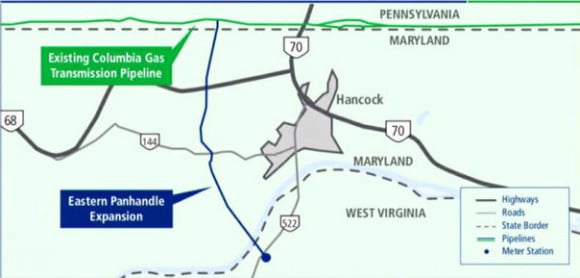
 A newly published study by the Interstate Natural Gas Association of America (INGAA) Foundation is raising eyebrows. The study, titled “North America Midstream Infrastructure through 2035” (full copy below), says the United States and Canada together will need to invest a total of $791 billion, or an average of $44 billion per year, from 2018 to 2035, to build new natural gas and oil pipelines (and associated infrastructure). That is some serious cash! The study makes certain assumptions, like this one: “Because production costs are relatively low in the Marcellus and Utica compared with production costs elsewhere, the study anticipates both production and infrastructure needs related to natural gas will be focused in the U.S. Northeast.” Meaning a lot of the money to build pipelines will go to our region. And this: “The study estimates about 25 billion cubic feet per day of new capacity to move Marcellus and Utica supplies to consumers and export facilities through 2035.” Whoa! According to the updated EIA Drilling Productivity Report issued on Monday, the Marcellus/Utica region will produce 28.9 Bcf/d of natural gas in July. Another 25 Bcf/d on top of that (essentially doubling current production) means by 2035 our region will produce over 50 Bcf/d of natgas. Incredible! No wonder we need more pipeline investment. Here’s an overview, along with a copy of the full study…
 The good news keeps rolling in for Mountain Valley Pipeline–a $3.5 billion, 301-mile pipeline currently under construction from Wetzel County, WV to the Transco Pipeline in Pittsylvania County, VA. MVP is being built to move Marcellus/Utica gas south. Following multiple lawsuits and regulatory challenges by Big Green groups, MVP is getting work done and on track to be completed this year. Just last week we told you that following delays by illegal protesters sitting in trees in the Jefferson National Forest, the Federal Energy Regulatory Commission helpfully extended tree cutting season for MVP to July 31 (see
  Here’s a project we’ve mentioned in passing as part of other posts, but until now, have not specifically focused on. In August 2017, Enbridge received approval (a certificate) from the Federal Energy Regulatory Commission (FERC) to construct and operate the Texas Eastern Appalachian Lease Project (“TEAL Project”). TEAL boosts the capacity along the Texas Eastern Transmission Company (Tetco) pipeline and connects it to the NEXUS pipeline. NEXUS has been under construction since last October (see
  TransCanada, one of Canada’s leading midstream/pipeline companies, cooked up a deal in 2016 to pipe natural gas from Canada’s West Coast to the East Coast in order to fend off cheap supplies of Marcellus/Utica gas that will flow into Canada from the NEXUS and Rover pipelines (see
 In May MDN told you that Big Green groups were successful in getting the U.S. District Court of Appeals for D.C. to force the Federal Energy Regulatory Commission (FERC) to either move forward with, or reject a rehearing request on their decision to approve the Mountain Valley Pipeline (see
  As MDN predicted, yesterday the Pennsylvania Public Utility Commission (PUC) voted to overturn a previous action by liberal administrative law judge, Elizabeth Barnes, to shut down the Mariner East 1 (ME1) pipeline (see