
Miracle! NY DEC Approves Dominion’s New Compressor Stations
 The anti-fossil fuel nutters in New York have finally lost a major battle they’ve waged against the shale industry for the past 5+ years. In June 2014, MDN told you about the Dominion New Market Project–a project that will build two new compressor plants and upgrade one other compressor station in upstate New York–to help flow more abundant, cheap and clean-burning Marcellus Shale gas from Pennsylvania (and beyond) into the northeast (see Dominion Asks FERC for New Compressors in Upstate NY, WV). The project is projected to cost $159 million and provide 112,000 dekatherms per day (Dth/d) of extra natural gas capacity along ~200 miles of existing Dominion pipeline across upstate New York. The existing Dominion pipeline runs through the Horseheads, Ithaca, Syracuse and Albany areas. In March 2015 MDN friend Andy Leahy wrote about the pitched battle antis waged against the project (see NY Antis Flood FERC in Fight Against Dominion’s New Market Project). The Federal Energy Regulatory Commission (FERC) approved Dominion’s New Market Project in October 2015 (see FERC Approves Expansion of Dominion Pipeline in Upstate NY). However, with a ban on fracking in NY, and with projects like the FERC-approved Constitution Pipeline being blocked by the politicized NY Dept. of Environmental Conservation (DEC), it seemed like no pipeline projects or anything to do with shale energy would ever get approved–until we dump Cuomo. Then a miracle happened! At the end of 2016, the politicized DEC finally approved Dominion’s New Market Project and the construction of the compressor stations. MDN owes a huge debt of gratitude to Andy Leahy who unearthed what the DEC clearly wanted to keep quiet. Andy found a reference to the New Market Project approval in the left-leaning Politico and went nosing around and found documentation for the official DEC approvals (below)…
Read More “Miracle! NY DEC Approves Dominion’s New Compressor Stations”

 Tired of having their application to expand a pipeline compressor station blocked, Rice Energy has sued West Pike Run Township in Washington County, PA. In the lawsuit, Rice says that the town had 90 days (under law) to render a decision on the request and did not do so. Eventually the town told Rice “no” to expanding an existing compressor station. The lawsuit asks the court to force the town to approve the application forthwith…
 One of the antis’ favorite tactics in opposing the Mariner East 2 pipeline is to claim it’s unsafe. It’s a bomb waiting to go off. Mariner East 2, as a reminder, is a $2.5 billion, 350-mile natural gas liquids (NGL) pipeline that will run from eastern Ohio through the state of Pennsylvania to the Marcus Hook refinery near Philadelphia. It will flow mostly ethane, but also propane and butane. One town near Philadelphia where the pipeline is slated to run is West Goshen Township (Chester County). The leaders of the town wanted an honest, independent assessment of the pipeline and its potential danger to residents–so they hired the independent consulting firm Accufacts to study the safety of the project. The report is in (full copy below) and shows not only does Mariner East 2 meet, but in fact exceeds federal minimum safety requirements. There goes another anti argument, disappearing into the atmosphere like burned carbon dioxide…
 Inspired by the criminal actions of eco-terrorists in North Dakota (see
  Rabidly anti-drilling organizations like the Philadelphia-based Clean Air Council (CAC) have been using the deep pockets of their contributors to stir up dissent against Sunoco’s Mariner East 2 NGL pipeline, particularly in towns in the Philly orbit (see
  A special offer to MDN readers from the Appalachian Pipeliners Association (APA). MDN readers are invited to the January 2017 APA Dinner Meeting and Presentation: Oil & Gas Journal’s Forecast and Review–2017. Presented by Oil & Gas Journal Editor, Bob Tippee, the presentation (on Jan. 17) is sure to benefit industry operators and suppliers interested in learning more about what’s in store for the year ahead. MDN readers get a special discount to attend…
 As MDN reported last week, on the last business day of 2016, the Federal Energy Regulatory Commission (FERC) issued a favorable final environmental impact statement (EIS) for one of the major pipeline projects in the Marcellus/Utica: the $3 billion Williams Atlantic Sunrise Pipeline project (see
  In July 2016 MDN told you about a smallish, but important pipeline project in the Delmarva Peninsula area, which includes most of Delaware and portions of Maryland and Virginia. Eastern Shore Natural Gas’ 2017 System Expansion project will bring new sources of natgas from an interconnection Eastern Shore has with the mighty TETCo (Texas Eastern Company) pipeline near Philadelphia (see
 As MDN reported last week, area residents packed a small meeting hall in Buckingham County, VA for a five-hour marathon session to express their concerns about building a new compressor station in the county for the upcoming Atlantic Coast Pipeline (see
  Several townships in the Philadelphia orbit appear to be colluding with each other and with the Philadelphia-based Clean Air Council in passing nearly identical resolutions opposing the Mariner East 2 natural gas liquids pipeline. Eight townships or boroughs along or “close to” (meaning not along) the route in Delaware and Chester counties have published resolutions or proclamations badmouthing the project. The municipalities include: Edgmont, West Goshen, Thornbury, Middletown, Westtown, Rose Valley, Swarthmore and Media. Some of the self-incriminating evidence for collusion comes from an admission by one of them: “The community statements are similar to each other because of consultation between their leaders.” And this, from the odious Clean Air Council: “Alex Bomstein, a lawyer with the environmental group Clean Air Council, said that while there are other local campaign such as those in Lebanon and Huntingdon Counties, the efforts in Delaware and Chester Counties are more ‘developed’ in the Philadelphia suburbs. ‘There are more people organizing than elsewhere,’ he said, probably because of a greater population density closer to Philadelphia.” Why would the StateImpact Pennsylvania propagandist quote the CAC in the same article as the colluding towns, unless they were somehow tied together?…
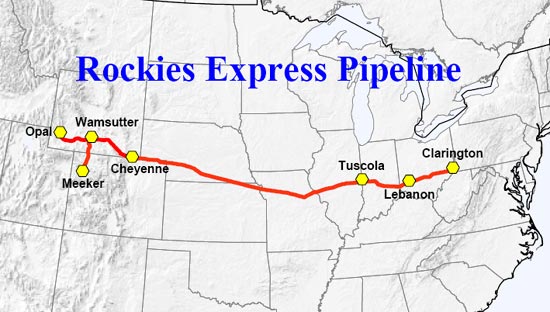 The Rockies Express Pipeline (REX), originally built from Colorado and Wyoming to Monroe County, OH to bring natural gas from west to east, last year reversed the flow for a large and important section of the pipeline. On August 1, 2015 the section of REX from Monroe County, OH to Mexico, MO reversed the flow and began to carry 1.8 billion cubic feet per day (Bcf/d) of Utica and Marcellus Shale gas to the Midwest, including to the greater Chicago area. REX has been hard at work on plans to expand capacity even more by beefing up compressor stations along portions of the pipeline. REX filed a plan with FERC to add another 800 million cubic feet per day (MMcf/d) of capacity along the same portion of the reversed pipeline–for a grand total of 2.6 billion cubic feet per day (Bcf/d). In mid-December, the first 200 MMcf/d of capacity came online (see
  As MDN reported earlier this week, on the last business day of 2016 the Federal Energy Regulatory Commission (FERC) issued a favorable draft (not final, but draft) environmental impact statement (EIS) for the $5 billion, 594-mile Dominion Atlantic Coast Pipeline project (see