
DOJ Ends Probes into Chesapeake Royalty Practices, Land Deals
 In September 2016, Chesapeake Energy filed disclosure forms with the Securities and Exchange Commission which says the U.S. Dept. of Justice (DOJ), a number of states, and even the U.S. Postal Service have served the company with subpoenas for information (see Everybody Just Subpoenaed Chesapeake Energy for Everything). The filing indicated that Chesapeake had received DOJ, U.S. Postal Service and state subpoenas “seeking information on our royalty payment practices. In addition, we have received a DOJ subpoena seeking information on our accounting methodology for the acquisition and classification of oil and gas properties and related matters.” An enterprising investigative reporter with Reuters noticed Chesapeake recently filed another disclosure form with the SEC–to say that the DOJ has now ended what was a three-year probe into the company’s royalty payment and land purchase practices–ended without taking any action…
Read More “DOJ Ends Probes into Chesapeake Royalty Practices, Land Deals”
 The U.S. District Court in Akron, OH has just made a major ruling that affects all Utica landowners and drillers. In 2015, the Ohio Supreme Court accepted a case that will sound familiar to readers of MDN. The case, known as Lutz v. Chesapeake Appalachia, is about whether or not drillers (Chesapeake in this case) are allowed to deduct certain post-production costs from landowner royalty checks. The Ohio Supremes were asked to decide whether Ohio follows the “at the well” rule, which permits the deduction of post-production costs, or if the state follows the “marketable product” rule, which limits the deduction of post-production costs under certain circumstances. The Supremes came down off Mount Olympus in November 2016 to render their verdict (see
  The Pennsylvania State budget is a complicated pile of…bills. At it’s core are three basic budget-related bills that implement the $31.9 billion state budget (unwisely) passed in June. It was unwisely passed because Republican lawmakers voted for a plan to spend money without having a way to pay for it. Stupid. PA Gov. Tom Wolf (liberal Democrat) demanded part of the new revenue required to pay for all that wild spending is to tax the Marcellus industry with a severance tax–on top of the existing impact tax (already the equivalent of a severance tax in other states). One of the three main bills to pay for the budget is the Fiscal Code bill–House Bill 674. HB 674 was adopted by the PA Senate on Monday (vote of 41-9). In the Senate version, which now goes to the House for final adoption, there are a number of “environmental riders”–or bits of legislation that have nothing to do with the budget or spending, but tacked on as a way of getting them passed without the mess of voting on them individually. Swamp politics. One of those provisions is “SECTION 1610-E” which gives drillers the right to reactivate old, non-producing wells after they have not been producing (and the lease considered terminated) under certain conditions…
 We’d call this a case of Atlantic Coast Pipeline (ACP) and Mountain Valley Pipeline (MVP) getting taken to the (pipe) cleaners. The anti-fossil fuel (and far-left) Virginia Outdoors Foundation (VOF) warned both Atlantic Coast and Mountain Valley, years ago, that land the non-profit previously tied up with non-development easements is off limits for their respective pipeline projects. So-called “open space” organizations like VOF get private landowners to sell them easements to their properties–the right to disallow any kind of development on the land, no matter who buys it in the future. But sometimes “no development” doesn’t actually mean “no development”–it’s just a bargaining position. The VOF has just cut a deal to allow ACP and MVP to cross a cumulative 53 acres of land, land with no-development easements, in exchange for adding 1,130 acres in other places to the their no-development easement stash. Oh, and $4,075,000 in cash for VOF’s coffers will be chipped in too. A true shake-down by shake-down artists, all to stick a couple of pipelines in the ground for a few hundred feet where nothing will get built over top of them anyway…
 According to expert analysis by the legal beagles at the Blank Rome law firm, a recent decision by the Superior Court of Pennsylvania disregards established precedent law and has created a new law in PA, possibly “leaving lessees [drillers] in limbo, possibly giving unscrupulous lessors [landowners] a unilateral tool to terminate oil and gas leases, and ultimately harming both lessors and lessees in the process.” In Montgomery v. R. Oil & Gas Enterprises, two (out of three) judges ruled that oil and gas leases could be severed (terminated) both “vertically” and “horizontally” by unilateral actions of the landowner. In this case “vertical” means shale or other rock layers under the ground, and “horizontal” means surface ownership. As with most things legal, this is a complicated case with a lot of history we won’t attempt to recount it chapter and verse. If we can boil it all down, the judges found that a landowner who had purchased a piece of property with an old lease that contained terms for shallow rock layers and deeper rock layers, could, unilaterally, terminate one aspect of that lease (in this case the shallow layer portion of the lease) while keeping the other aspect of the lease intact (the deeper layers, already drilled and producing). The Blank Rome analysis below does a deep dive into the case, frankly ripping the decision to shreds, and postulates the theory that it may lead to cases in which a landowner with a decades-old lease in which the shallow layers are held by production can separate and convey the deeper layers to a family member or family trust, and then terminate the deeper layer lease, re-releasing it to a different driller…
 In an incredible story of how Marcellus Shale drilling benefits local communities, the Municipal Authority of Westmoreland County (i.e. the water authority) reports that it expects royalties received from 52 shale wells drilled on authority-owned land will jump another $1 million this year, to a total of over $3 million. The authority is still pushing forward with a three-year rate hike plan that began in 2016–so customers will get a 7% rate hike this year. Even though the authority has all of that extra cash. Why not suspend the rate hike because of the extra royalty money? Because, says an authority official, “The rate hikes were designed to help pay for a $140 million loan finalized last year for capital improvements to the water system that serves more than 120,000 customers in five counties as well as nearly 25,000 sewer customers.” What will the authority do with the extra $1 million they hadn’t planned on receiving? It’s “more money to be reinvested into the system.” Here’s the lowdown on Westmoreland’s windfall from gas royalties, and why royalties are jumping this year…
 Not only did the Pennsylvania Senate pull a real boner by voting for a severance tax and gross receipts tax (see
  Findlay Township (Allegheny County, PA, west of Pittsburgh) has just signed a deal with Range Resources to allow drilling under (not on) the towns 61-acre Clinton Park. Terms of the deal: Findlay gets a $3,000 per acre signing bonus and when the gas begins to flow, an 18% royalty. That means Findlay will get a nice, fat check for $183,000 in the next 90 days. The lease has been a long time in coming. Town supervisors worked on a deal five years ago, but then drilling slowed down and the deal was “put on the shelf.” Range will actually drill under the property from the Seibel Farm, which sits just over the border in Beaver County. The board of supervisors voted unanimously to approve the deal…
 It’s not often these days we come across a story that mentions a new lease signed, and the amount of money paid as a signing bonus. Such is the case in Ohio County, WV. The Wheeling Park High School has just signed a lease with Southwestern Energy for $3,500 per acre for 66 acres–giving the school district $231,000 of newly found revenue, thanks to the Marcellus/Utica industry. No drilling equipment will be placed on or near school property. When the drilling eventually happens UNDER the school, and the wells begin to flow, Wheeling Park High School will then get more revenue–18% royalties on all gas produced…
 Pennsylvania Rep. Jason Ortitay, Republican from South Fayette (Washington & Allegheny Counties), PA who replaced Jesse White in January 2015 (see
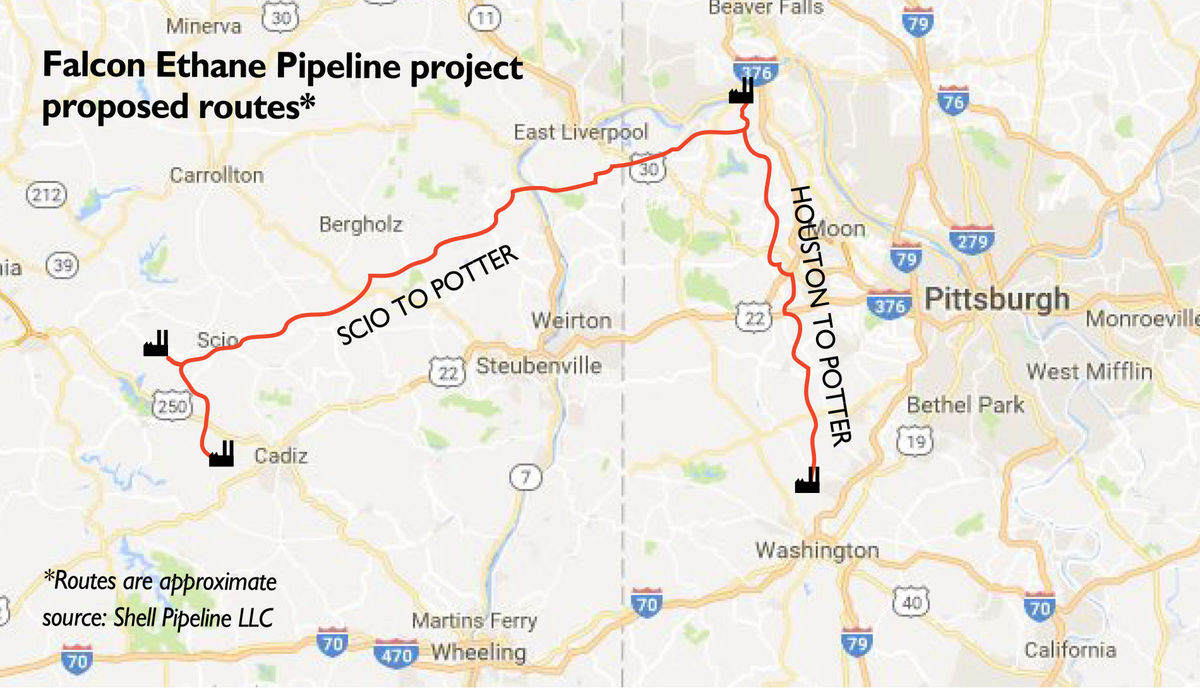
  MDN has been tracking the prices paid by Shell to landowners to run an ethane pipeline under their land to feed the might cracker plant the company is just now beginning to build in Beaver County, PA. Why? So landowners in Beaver (and other locations) have a useful metric for judging the offers they receive. To be fair, a company that wants to run a local gathering pipeline across someone’s land will pay a lot less than Shell is willing to pay–given you can’t move the cracker plant. Interstate pipelines will likely pay something less too. But still, we find it interesting and useful to know what Shell is up to in Beaver. We don’t have a lot of data points, yet. In June, we learned that Shell paid roughly $75 per foot for 3,138 linear feet of pipeline space in Greene Township (see
  What’s this? The Pennsylvania State Senate, which is controlled by the Republican Party, has added insult to injury. We’ve already told you about Republican traitors in the Senate who sold out their House counterparts by voting for a disastrous severance tax to raise money to give away to teachers’ unions (see
  In December 2015, Pennsylvania’s felony-indicted Attorney General, Kathleen Kane (now gone), brought a lawsuit against Chesapeake Energy, Anadarko and Williams accusing them of, among other things, royalty fraud (see