
NC Republicans Hounding Dem Gov for Approving Atlantic Coast Pipe
 There is a political mess brewing in North Carolina–a mess that has made for some strange bedfellows. Rabid anti-fossil fuelers are supporting Republicans in a bid to target NC’s Democrat governor because his administration granted a permit for Dominion Energy’s Atlantic Coast Pipeline (ACP) in the state. We first reported on this developing situation back in September (see Weird: NC Republicans Target Dem Gov for Supporting M-U Pipeline). The situation revolves around a special fund set up by Gov. Roy Cooper, some $57.8 million paid by Dominion, to be used for environmental reclamation projects. Republicans say it’s a slush fund and, using the power of the state legislature, they wrested control of the fund away from Cooper and gave the money away to schools. But Republicans aren’t content to let the matter rest. They now want an investigation into Cooper and the fund and how it got set up. If they’re not careful, they may end up un-approving the permit for the pipeline.
Read More “NC Republicans Hounding Dem Gov for Approving Atlantic Coast Pipe”
 It doesn’t typically happen this way, which makes us feel like we’re Alice that’s just fallen through the looking glass. Normally (not always) Republicans support fracking and pipelines and fossil fuels in general, and Democrats (increasingly) do not. But in North Carolina, the roles are reversed. Republicans in the NC legislature have launched an investigation into Democrat Gov. Roy Cooper over his support of Dominion Energy’s Atlantic Coast Pipeline project. The lawmakers claim a $57.8 million discretionary fund set up by Cooper was, in fact, a “pay to play” slush fund, funded by ACP partners (including Dominion) to help them obtain a permit from the NC Department of Environmental Quality. The allegation is that Cooper got the companies to commit to giving the state $57.8 million, and a day later voila, they had their permit. Quid pro quo. Cooper says the money will be used to repair so-called environmental damage from constructing the pipeline. Republicans say it stinks to high heaven and he needs to “let go” of the money. Seems to us like this is just the latest skirmish in a long-running war between the two sides, and the Atlantic Coast Pipeline project is collateral damage, caught in the middle…
 Despite intense opposition from nutty so-called environmentalists (i.e. fossil fuel haters), the Federal Energy Regulatory Commission issued permission on Tuesday to Dominion Energy to commence construction of the 600-mile, $6 billion Atlantic Coast Pipeline as it passes through North Carolina. Antis like those from the Southern Environmental Law Center are up in arms. Their strategy to stop the project is to attack it in small, specific areas. There is a pending lawsuit against the project using the Endangered Species Act, potentially blocking construction in certain geographies. If that lawsuit goes against the pipeline, it only affects construction in a small area and for a limited time. Yet Southern Environmental Law Center claims that if a pipeline project is stopped at any point along its route, that should trigger stopping the entire project at all points along the route. FERC isn’t buying into the legal bull and has cleared Dominion to start up the bulldozers. This pipeline will get built, despite the best efforts of antis. In fact, Dominion says it will be built and online by late 2019…
 In 2014, the North Carolina legislature passed a law that specifically says local municipalities can’t regulate oil and gas exploration–it is the sole responsibility of the state to do so. Some municipalities thought there were loopholes they could use. Stokes and Chatham counties enacted moratoriums instead of outright bans, hoping to game the system. In order to plug the loopholes, the NC General Assembly approved a 41-page “technical corrections” bill (literally passed in the middle of the night) in September 2015 (see
 Atlantic Coast Pipeline, the $6.5 billion Dominion Energy/Duke Energy pipeline from West Virginia through Virginia and into North Carolina has had a few setbacks, but that isn’t stopping construction on the pipeline–in all three states where it runs. On Monday we reported on the latest setback–news that the Federal Energy Regulatory Commission is refusing to extend tree cutting season for the pipeline (see
  Two weeks ago Dominion Energy asked the Federal Energy Regulatory Commission (FERC) for permission to extend tree cutting/felling season by an extra 45 days, from March 31 to May 15, in West Virginia, Virginia and North Carolina (see
  Dominion Energy’s $6.5 billion Atlantic Coast Pipeline (running from West Virginia through Virginia and into North Carolina) is supposed to get built this year. ACP began to cut trees along the pipeline’s path in late January (see
  We’re not quite sure what to make of this story. North Carolina has been, as we’ve long pointed out, nitpicking in an attempt to slow down (or stop) the Atlantic Coast Pipeline (ACP) from traversing the state (see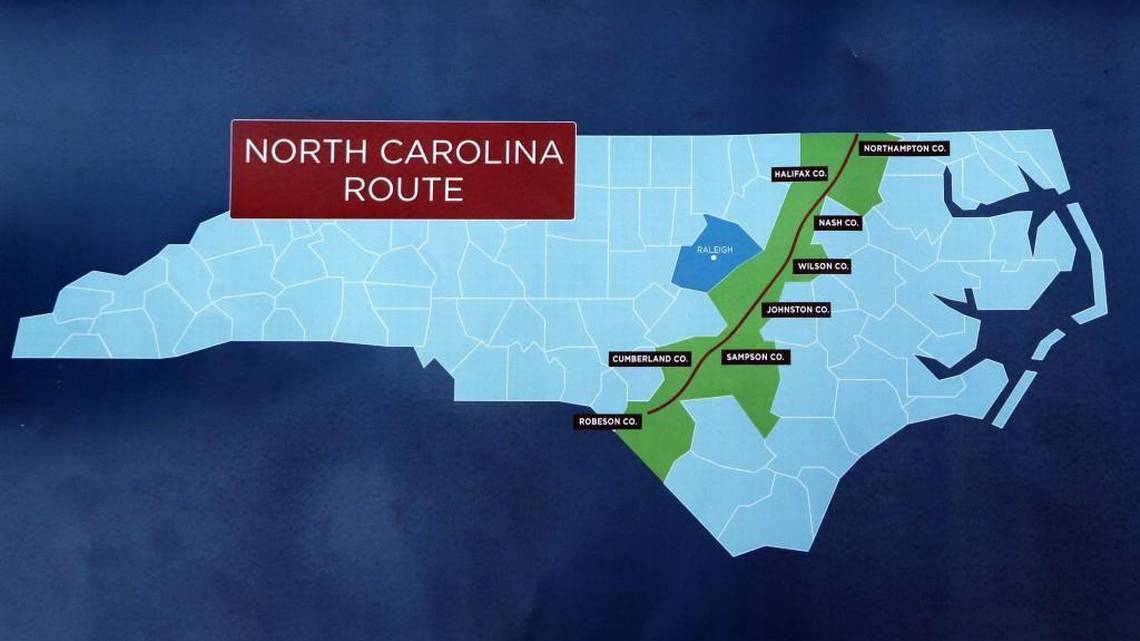
 In December MDN told you that Dominion’s $5 billion Atlantic Coast Pipeline (ACP) project had asked permission from the Federal Energy Regulatory Commission (FERC) to begin clearing trees along the path of the pipeline in all three states where the pipeline will run: West Virginia, Virginia, and North Carolina (see
  North Carolina has a Democrat governor. The state Dept. of Environmental Quality (DEQ) is an executive branch agency. So it’s no surprise to learn that the DEQ is antagonistic toward Dominion Energy’s $5 billion, 594-mile Atlantic Coast Pipeline (ACP)–a natural gas pipeline that will stretch from West Virginia through Virginia and into North Carolina. In October the DEQ rejected a plan submitted by Dominion for the pipeline project, claiming the erosion and sediment control part of the plan is not up to snuff (see