
Atlantic Coast Pipe Gets Ready to Build: Union Help, Eminent Domain
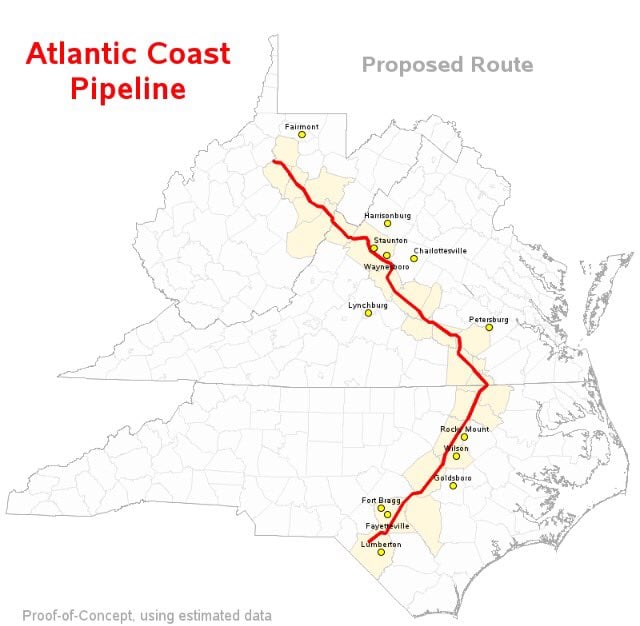
 We have a couple of important signs that Dominion and Duke Energy, the main sponsors of the Atlantic Coast Pipeline, are getting ready to begin building the pipeline. Atlantic Coast Pipeline is a $5 billion, 594-mile natural gas pipeline that will stretch from West Virginia through Virginia and into North Carolina. Years after the project filed with the Federal Energy Regulatory Commission (FERC), it was finally approved by FERC in October (see FERC Approves Atlantic Coast, Mountain Valley Pipeline Projects). In November, the U.S. Forest Service granted its blessing for the pipeline to traverse small portions of two national forests (see USFS Approves Atlantic Coast Pipeline Thru 2 National Forests). Although some of the state water crossing permits are still an issue, it’s a pretty much foregone conclusion WV, VA and NC will not hold up construction of this important project. An announcement from Dominion on Friday to say the company has cut deals with four labor unions for workers, and a story in NC about the pipeline being forced to use eminent domain proceedings with some holdout landowners, combine to paint the picture that this project will soon begin construction…
Read More “Atlantic Coast Pipe Gets Ready to Build: Union Help, Eminent Domain”
 North Carolina has a Democrat governor. The state Dept. of Environmental Quality (DEQ) is an executive branch agency. So it’s no surprise to learn that the DEQ has turned antagonistic toward Dominion’s $5 billion, 594-mile Atlantic Coast Pipeline (ACP)–a natural gas pipeline that will stretch from West Virginia through Virginia and into North Carolina. In October the DEQ rejected the plan submitted by Dominion for the pipeline project, claiming the erosion and sediment control plan is not up to snuff (see
  We find it particularly offensive when a liberal/leftist group, like the National Association for the Advancement of [Liberal] Colored People, or NAACP, declares a pipeline project to be racist. The far-left organization made the outrageous claim, in a report they issued yesterday called “Fumes Across the Fence-Line: The Health Impacts of Air Pollution from Oil and Gas Facilities on African American Communities” (full copy below), that Dominion’s $5 billion 594-mile Atlantic Coast Pipeline (ACP) will force black people in low income communities in eastern North Carolina to bear “more than their fair share” of the so-called “risks” posed by the pipeline. ACP is a natural gas pipeline that will stretch from West Virginia through Virginia and into North Carolina. The Federal Energy Regulatory Commission (FERC) issued a final approval for ACP in October (see
  No doubt being advised and funded by national Big Green groups, a group of backbencher local green groups (Little Green) have taken the first step in what will no doubt turn into a lawsuit to try and stop the Atlantic Coast Pipeline project from getting built. The Federal Energy Regulatory Commission (FERC) approved Atlantic Coast, a $5 billion, 594-mile natural gas pipeline that will stretch from West Virginia through Virginia and into North Carolina, in October (see
  Great news delivered late Friday afternoon: The Federal Energy Regulatory Commission (FERC) issued final, full approvals for both the Atlantic Coast and Mountain Valley pipeline projects. Atlantic Coast is a $5 billion, 594-mile natural gas pipeline that will stretch from West Virginia through Virginia and into North Carolina. Mountain Valley is a $3.5 billion, 303-mile natural gas pipeline that will run from Wetzel County, WV to the Transco Pipeline in Pittsylvania County, VA. Both projects still face an uphill battle before they get built. The North Carolina Dept. of Environmental Quality (DEQ) issued a rejection letter for Atlantic Coast last week (see
  North Carolina has become the first state to complete an environmental evaluation for Dominion’s proposed $5 billion, 594-mile Atlantic Coast Pipeline (ACP)–a natural gas pipeline that will stretch from West Virginia through Virginia and into North Carolina. ACP is slated to run through eight NC counties. After completing it’s evaluation, the NC Dept. of Environmental Quality (DEQ) issued a rejection letter (copy below) for the project. The reason? The DEQ says the erosion and sediment control plan for the project is not up to scratch. Dominion can now do two things: Revise the erosion and sediment control plan and resubmit it, or contest the DEQ’s rejection of the existing plan. Although antis are rejoicing at the news, there really isn’t much here in the way of news. This is not uncommon in pipeline reviews. A government agency (federal or state) will push back on some aspect of the plan, the project builder will modify the plan, and the modified plan will pass muster and life goes on. That’s the way it works. The DEQ is (presumably) doing it’s job and not simply looking for an excuse to reject the project. We’ll give them the benefit of the doubt–this time. Although we’ve not read that Dominion has responded to the rejection, another partner in the project, Duke Energy, has responded–saying they will provide the necessary information the DEQ says is missing in the original plan…
 In 2012 the North Carolina legislature cleared the way for the state to allow horizontal fracking of shale (see
  We spotted an article that says clergy and lay people from the United Church of Christ in Robeson County, North Carolina will hold a prayer vigil today. A liberal pastor has decided to show up at the state Department of Environmental Quality (DEQ) to pray against approval for Dominion’s $5 billion, 594-mile Atlantic Coast Pipeline (ACP)–a natural gas pipeline that will stretch from West Virginia through Virginia and into North Carolina. The DEQ is scheduled to announce a decision about granting the project a necessary permit, at a meeting on Sept. 19th. Which got us to thinking. Perhaps we should pray for the pastor and lay people who will show up to pray today. Here’s our prayer…
 Dominion Energy’s $5 billion, 594-mile Atlantic Coast Pipeline (ACP)–a natural gas pipeline that will stretch from West Virginia through Virginia and into North Carolina, will help butterflies, bees and other “pollinator” insects along the pipeline’s route. Last week Dominion announced an initiative to establish new habitats for pollinator insects. The plan will use 750 acres along roughly 50 miles of the proposed route in Virginia and North Carolina. It’ll be fun to see how so-called environmentalists will find fault with helping the environment…
 The radicals at the Sierra Club are taking another run at stopping Dominion’s Atlantic Coast Pipeline (ACP) project in its tracks–before the first inch of pipe is laid. ACP is a $5 billion, 594-mile natural gas pipeline that will stretch from West Virginia through Virginia and into North Carolina. This time Sierra Club nutters are using a novel approach to try and stop ACP. They’ve asked North Carolina regulators to revoke approval of affiliate agreements by Duke Energy to use the gas that will flow through the pipeline. The Sierra Club’s argument is that the agreements, signed in 2014, are no longer valid. Duke doesn’t need as much natural gas (for electric generation) as they thought they would. And therefore to stay locked into the agreement would be an unfair burden to Duke’s rate payers. If Duke were to pull out of the deals, the ACP project would collapse, which is what Sierra Club happens. Duke has responded that the gas will be used for more than electric generation. Given that NC now has a Dem governor who doesn’t like fracking (see
  In 2012 the North Carolina legislature cleared the way for the state to allow horizontal fracking of shale (see
  This past week, the North Carolina Dept. of Environmental Quality (DEQ) held two public hearings on Dominion’s proposed $5 billion, 594-mile natural gas pipeline that will stretch from West Virginia through Virginia and into North Carolina. One hearing was in Fayetteville, the other in Rocky Mount. Both had more people opposed to the project than for it, although the Fayetteville hearing saw a strong showing of people in favor of the project. The Fayetteville public hearing was held Tuesday, and Rocky Mount on Thursday. Here’s the coverage we could find of the two hearings…
 A very small group of anti-fossil fuelers recently gathered in Samson County, NC to spread lies about the Dominion’s Atlantic Coast Pipeline (ACP) project. ACP is a $5 billion, 594-mile natural gas pipeline that will stretch from West Virginia through Virginia and into North Carolina, bringing Marcellus and Utica Shale gas to the south. The meeting, which local media said had “more than 20” people in attendance, seemed to be mostly representatives from outside Big Green groups pedaling the same tired old lies about pipelines in general, and ACP in particular. Try as they might to spin the meeting as some sort of “movement” among the little guy, the picture accompanying the Dunn (NC) Daily Record can’t cover up the fact there were perhaps a dozen people in the audience–and it looked pathetic…
 Siemens, the largest industrial manufacturing company in Europe with its headquarters in Germany, sought out and has cut a deal with Duke Energy to build a brand new, “first of its kind” advanced natural gas-combustion turbine for Duke Energy’s proposed 400-megawatt expansion at its Lincoln County Combustion Turbine Station near Charlotte. Siemens will build a single turbine able to generate 400 megawatts essentially on demand, as needed, for those times when extra electricity is needed (called “peaking” for peak demand). The project will be built in three phases beginning in 2018, with lots of testing, and won’t be ready until 2024. In return for allowing Siemens to build this new tech and test it out, Duke is getting a sweetheart deal on the price, although the price has not been publicly disclosed. So what does this have to do with the Marcellus/Utica? Long before 2024 there will be, at a minimum, Marcellus/Utica gas flowing to that region via the forthcoming Atlantic Coast Pipeline project. And by that time, seven long years from now, who knows? We expect there may be more pipelines built and in place not even conceived or announced–yet. This will be one more (added to the already 130 announced) power generation projects coming in the PJM region (see today’s companion story, Important New Report on Pipelines & Powergen in Marcellus/Utica). Here’s the exciting news about a brand new technology coming along to leverage abundant, clean-burning natural gas in the Marcellus/Utica and beyond…
 Leftist anti-fossil fuelers are only too happy to poll anything and everything–except for what really matters. How do the VOTERS in Virginia, West Virginia and North Carolina feel about the Atlantic Coast Pipeline (ACP)? ACP is Dominion Energy’s $5 billion, 594-mile natural gas pipeline that will stretch from West Virginia through Virginia and into North Carolina. The Consumer Energy Alliance (CEA), the “voice of the energy consumer,” set out to answer the question: How do voters feel about ACP? In a poll commissioned by ACP, a majority of voters in all three states support the project–by an overwhelming majority. ACP hired Hickman Analytics Inc., a “Democratic-leaning,” Maryland-based firm to do the polling. Harrison Hickman, founder of the firm, said, “By any measure, whether it’s a policy matter or a voting matter, the pipeline has widespread support.” That’s something you won’t read in most news outlets. Here’s the results of the poll…
  In what has to be a major blow to the morale of anti-pipeline crusaders in West Virginia, Virginia and North Carolina, the top elected state officials in the legislatures of all three states, both Republicans AND Democrats (16 of them in all), sent a letter on Tuesday to the Federal Energy Regulatory Commission (FERC) requesting FERC approve the Atlantic Coast Pipeline project. Dominion wants to build a $5 billion, 594-mile natural gas pipeline that will stretch from West Virginia through Virginia and into North Carolina. The leaders of all three state legislators have told FERC, we want this pipeline, we NEED this pipeline, please approve it. Today is the last day FERC will receive public comments on the project. Here’s who signed, along with a copy of the letter sent to FERC…