The Ohio Dept. of Natural Resources (ODNR) is actively working on new regulations “regarding storage, recycling, treatment, processing, and disposal of brine and other waste substances.” That is, for wastewater treatment and disposal from the oil and gas industry. It’s taking the ODNR a while to hash out the new regs (they were instructed to do so back in 2014). However, in the meantime, ODNR issues special orders/permits on a case by case basis to allow wastewater treatment and disposal facilities to start up and operate. Hoping to shut down all drilling (in Ohio and other states that send wastewater to Ohio), the odious Food and Water Watch and misnamed FreshWater Accountability Project sued in the Tenth District Court of Appeals, arguing that because ODNR hasn’t released the new regs, they shouldn’t be allowed to keep issuing temporary/special permits. The Tenth District said the radical enviro groups didn’t have standing to file the case and dismissed it. On appeal to the State Supreme Court, the Supremes said the same thing. Therefore, ODNR’s authority to continue granting temporary/special permits for wastewater treatment remains in effect. Another huge loss for Food and Water Watch… Read More “OH Supreme Court Rejects Anti Request to Stop Wastewater Disposal”
Yet another “fracking may cause earthquakes” study has been published in the so-called peer reviewed journal PNAS (Proceedings of the National Academy of Sciences). Researchers from the University of Miami (in Ohio) admit the kind of earthquakes they talk about in their paper, potentially caused by Utica Shale drilling, are “rare.” But, they are also “concerning.” Yes, everyone should be concerned that in zero percent of Utica well drilling cases (statistically speaking) there have been NO earthquakes. Actually a couple of cases are thought to be related to fracking over a fault–but it’s still unproven. Statistically speaking, it’s 0%. But, there could be problems! Maybe. If the conditions are “just right.” Ya never know. We note the researchers didn’t address concerns over fans in football stadiums that, when they all stomp their feet at the same time, have caused “earthquakes” that are higher on the Richter scale than the ones they postulate “may, maybe, might” happen in Utica drilling. No mention of football fan earthquakes in this study. Below is the “news” about this latest, breathlessly urgent report that everyone should read… Read More “Yet Another Fracking-Causes-Earthquakes “Study” – This Time in Utica”
We often write about pipeline projects in the Marcellus/Utica and their mission to move our prodigious natgas production to new markets where the gas will fetch a higher price. Last fall MDN provided a list of 15 active pipeline projects in our region, aimed at moving our gas to new markets (see List of 15 Active Marcellus/Utica Pipeline Projects Worth $23B). However, sometimes the “new” markets these pipelines serve are located–right here, in the M-U region! That’s right. Not all gas needs to go to the South, the Southwest, Midwest or get exported to Canada and beyond. Sometimes new market demand is hidden in plain sight. Such is the case for Columbia Gas (owned by NiSource) in Ohio. The company said it has “changed our portfolio around” to source locally extracted Marcellus/Utica gas for “at least 40%” and “likely much more” of the gas it sells to its customers. The change to using Marcellus/Utica gas will begin in April. Among the pipelines that will flow the M-U gas Columbia will buy is the recently completed Leach XPress (see Leach XPress Goes Online; FERC Approves Mountaineer & Gulf XPress). Here’s the good news that our own gas will serve those in our own region… Read More “Columbia Gas Customers in OH Start Using M-U Gas in April”
“Keep It In the Ground” (KIITG) activists have launched a new, deceptive campaign in their holy mission to end the use of fossil fuels. The same people behind Food & Water Watch, Food and Water Action, the Sierra Club and other Big Green groups have/are launching fake landowner coalitions in Ohio. These fake coalitions (one of them being the Tri-County Landowners Coalition) have one aim and one aim only–to convince unsuspecting landowners to hate fossil fuels and anything (i.e. drilling, pipelines) to do with fossil fuels. It is a sleazy and disgusting tactic by the ultra-left, preying on honest, hardworking folks who join coalitions hoping to receive guidance on the best way to protect their land while at the same time profiting from it. Don’t fall for these fake coalitions! Our friends at Energy in Depth are sounding the alarm on this latest move by anti-fossil fuel radicals… Read More “Warning to Ohio Residents: Beware Fake Landowner Coalitions”
The Eastern hellbender is the largest salamander in North America, reaching lengths of up to 24 inches. It’s also the official amphibian of Pennsylvania. Photo: Dave Herasimtschuk / Freshwaters Illustrated
(Sigh.) Here we go again. An in-depth news story appearing on the PBS website Allegheny Front theorizes that the presence of natural gas gathering pipelines–run to individual shale wells–are causing a decrease in the population of hellbenders. The theory is that as more and more pipelines are installed under creeks and streams throughout the region (in western PA and easter OH), the construction process muddies the streams and kills aquatic life, including the hellbender. The hellbender is a giant salamander–growing to an average of 15 inches long. Ugly suckers–so ugly they’re cute! OK, so a pipeline gets installed and the water is muddy for a day or two and maybe it kills a hellbender or two, what’s the big deal? Are they an endangered species? No, they are not. They are, however, considered to be “near-threatened”–meaning any decade now they *may* get added to the “threatened” list (but still not endangered). The idea is, of course, to avoid killing enough of a species like the hellbender so that it ends up on a threatened or endangered list. So are pipelines having a negative impact on hellbender populations? The article wants you think so, but actually, there’s zero evidence of any kind of impact by pipelines on hellbender populations. Instead of scientific steak to show a connection between pipelines and hellbender populations, the article serves up anecdotal Cheetos of scary pictures of pipelines being installed. There is no connection between pipeline construction and hellbender populations–that’s the bottom line when you read the following story… Read More “M-U Gathering Pipelines Blamed for Killing “Ancient” Salamanders”
In December 2015 Marcellus/Utica driller Magnum Hunter Resources filed for bankruptcy (see Sad Day: Magnum Hunter Files for Chapter 11 Bankruptcy). Five short months later, in May 2016, Magnum Hunter emerged from bankruptcy–without CEO Gary Evans (see Magnum Hunter Emerges from Bankruptcy with CEO Gary Evans Gone). Apparently the new owners of the company (the former debt holders converted into equity holders) didn’t want Evans running the company. So Evans departed to start a new drilling company not focused on the M-U. In January 2017, just one year ago, Magnum Hunter changed its name to Blue Ridge Mountain Resources (see Magnum Hunter Changes Its Name, Leaves the Bankrupt Past Behind). Since that time the only news we’ve heard about the former Magnum Hunter is that they sold their interest in Eureka Midstream (see Eureka Midstream Confirms MDN Article on New Ownership). That is, until now. Earlier this week, Blue Ridge announced it sold a “non-operating interest” in 21,000 undeveloped Marcellus/Utica acres to an undisclosed investor for $56 million, AND got the undisclosed investor to pony up another $36 million (total deal of $92 million) which Blue Ridge will use to fund an ongoing 2-rig drilling program in southeastern Ohio… Read More “Blue Ridge Mountain Res. Forms JV to Raise $92M for Drilling in OH”
On Tuesday, the Ohio State Supreme Court rejected a case in which landowners who were made part of a “unitization order” (i.e. forced pooling) had objected claiming their property rights were stripped away without due process. In legal terms, the landowners claimed it was a “taking” of their property without just compensation. The Supreme Court rejected the case because, they said, there were other legal means the landowners could have tried first (a lower court) before appealing the case direct to the Supremes using something called a mandamus action. In essence, the Supremes said, “Nice try, but you need to jump through the proper hoops first.” Ultimately the Supremes did not rule on the Constitutionality of the claim itself because the case had gotten to them via the wrong path. We’re guessing the landowners will now go back to square one and use the path laid out by the Supremes. Here’s the low down on the rejection by the Supremes, from the legal beagles at the Vorys law firm… Read More “OH Supreme Court Rejects Challenge to Forced Pooling Law”
On Monday Gulfport Energy (drills mainly in the Utica but also in Oklahoma and Louisiana) issued it’s fourth quarter and full year 2017 results, along with a preview of what they expect to do in 2018. Gulfport has drilled the second highest number of Utica wells in Ohio, second only to Chesapeake Energy. Gulfport’s production in 4Q17 averaged 1.26 billion cubic feet per day equivalent, up 5% from 3Q17 and up a whopping 61% from 4Q16. Gulfport brought 15 Utica wells online in 4Q17. What’s ahead in 2018? The company will spend $770-$835 million in 2018. Astonishingly, Gulfport will not borrow to spend that kind of cash! Their spending will be 100% funded by the cash flow they generate from selling gas and oil and NGLs. Gulfport figures production will average somewhere around 15-19% more in 2018 than in 2017. Using an “average of 2.5 rigs” (how does that work?), Gulfport will drill 36-40 new Utica wells this year with an average lateral length of 11,200 feet. Gulfport plans to bring online 33-37 Utica wells with an average lateral length of 8,000 feet. Here’s the update of what happened in 2017, and what to expect in 2018, for one of the most important players in the Ohio Utica… Read More “Gulfport Energy Continues Focus on Utica in 2018, No Borrowing”
Pennsylvania state officials estimate there are as many as 200,000 abandoned (i.e. “orphan”) oil and gas wells in the state–the vast majority of them conventional wells drilled over 50 years ago. Most of them are not mapped or known. Some of them are hazards for shale drillers who stumble across them when drilling new wells. If you drill horizontally and clip an old/abandoned well, it becomes like an elevator pumping fluids and gas to the surface. Not good. Everyone is committed to finding and marking and capping these old wells–the question is, how do you pay for it? In PA, it’s an ongoing hot potato of who will pay (see Who Pays for Abandoned O&G Wells in PA?). Ohio has it a whole lot easier. There’s only an estimated 600 orphan wells in the Buckeye State. The issue of who will pay in Ohio is moot–the state itself pays for it (meaning Ohio taxpayers2/4/18 correction: The funds come from the Oil and Gas Well fund which oil and gas producers pay into from the severance tax. Our thanks to OOGA for sending along that correction!). A new bill in Ohio just passed the legislature, House Bill 225, which triples the amount of money set aside to cap orphan wells. The bill also “creates a more streamlined and efficient process for identifying and plugging” orphan wells. The amazing thing about the bill is this: both Big Green groups and the drilling industry support it! When was the last time you heard of that happening?! Here’s more about HB 225, the bill everybody loves in Ohio. Who wouldn’t love a bill to help the orphans?… Read More “OH Orphan Well Bill Wins Praise from Both Drillers & Enviros”
Congressman Dennis Kucinich from Ohio, who is running for the nomination to be the Democrat candidate for governor in this fall’s election, has always been a crackpot. A nutjob. Flaky. Ranging out there on the far-left fringe. But he’s also never been taken too seriously. Folks like him. He’s amiable. Not, perhaps, as hardcore as some on the left. That is, until now. In a speech last Thursday in Columbus to unveil his first official policy statement as a candidate, Kucinich said if he’s nominated and wins the governor’s chair (fairly unlikely, but then, you never know), he will use his executive powers as governor to end drilling for natural gas and oil in the state. He also said he would direct the state police to look for out-of-state wastewater haulers transporting brine to Ohio’s injection well sites–and have the police turn them around and send them packing. As for all those Utica Shale landowners who signed leases, what about royalties they will never see and signing bonuses they will never pocket? Don’t worry, Dennis will “work to ensure that landowners who have leased land for drilling would receive a separation fee and all royalties they are due.” Kucinich’s first policy statement for his gubernatorial campaign is a far-out, really wacko (certifiably insane) anti-fracking manifesto (full copy below). Everyone is likely to discount his words as, “That’s just Dennis, you know how he talks. He doesn’t stand a chance of winning.” However, we encourage Buckeye State voters to take him seriously–take him at his word. And make sure he doesn’t win the nomination (or the governorship). His election to the governor’s chair would be an economic disaster for the state and for the Utica Shale industry… Read More “Ohio Democrat Candidate for Governor Says He’ll Ban Utica Drilling”
In early January, the Pennsylvania Dept. of Environmental Protection (DEP) told Sunoco Logistics Partners to suspend all work on the $2.5 billion Mariner East 2 (ME2) NGL pipline–from one side of the state to the other (see PA DEP Caves to Big Green Pressure, Stops All Work on ME2 Pipeline). No further digging of trenches, and no more underground horizontal directional drilling (HDD) work can be done “until Sunoco can demonstrate that the permit conditions can and will be followed.” The concern is that ME2 work is violating multiple permits, regulations and court-ordered restrictions. However, not ALL work was stopped. As we learned a week later, the DEP does not control and regulate everything–only the parts where dirt is moved (see Work on Mariner East 2 Continues Following “Stop Work” Order). There’s still work being done, like welding pieces of pipeline together, even today. Often overlooked in the ME2 project is the small part of the pipeline that crosses the border into Ohio. The PA DEP’s stop work order (and regulatory authority) does not extend there. The pipeline in Ohio is regulated by the federal Pipeline and Hazardous Materials Safety Administration (PHMSA). Just coming to light now is a “Notice of Probable Violation” for ME2 in Ohio, issued by PHMSA on Jan. 11th. A PHMSA inspector noticed scrapes, coating damage and a “gouge” that extended into the pipe wall. Chance are none of it makes a hill of beans worth of difference. However, given the pipeline will flow “flammable” natural gas liquids (primarily ethane and propane), anything but a 100% standard of perfection gives antis an excuse to call for a halt to the project, both in Ohio and in PA, which they’re doing… Read More “PHMSA Issues Notice of Probable Violation to ME2 Pipeline in Ohio”
Yesterday MDN brought you the news that the Federal Energy Regulatory Commission (FERC) has slapped a stop work order on underground horizontal direction drilling (HDD) for Rover Pipeline at the site crossing under the Tuscarawas River (see FERC Stops Rover Drilling Near River After 200K Gal Mud Disappears). There is tough geography in that area. In April 2017, Rover lost approximately 2 million gallons of nontoxic drilling mud at that location, mud which leaked out of the hole and onto the ground (see Rover Pipeline Accident Spills ~2M Gal. Drilling Mud in OH Swamp). That accident caused a shutdown of all Rover HDD work in Ohio. Work eventually resumed (last year). Work at the Tuscarawas location didn’t resume until last December (see FERC Gives Rover OK to Resume All HDD Work, Incl. Tuscarawas River). But now Rover has lost another ~200,000 gallons of drilling mud in the Tuscarawas borehole. Hence the FERC order. Energy Transfer Partners, the builder of Rover, maintains the entire Rover project will be completed by the end of March. Given the new stop work order with no apparent resolution in sight for how ET plans to overcome the problems at Tuscarawas, industry analysts are now speculating that Rover will not be done by the end of March, as advertised… Read More “Analysts Speculate Rover Pipe Will be Delayed Following FERC Order”
In January 2016, Kinder Morgan (KM) committed to building the UTOPIA (Utica To Ontario Pipeline Access) pipeline, a 12-inch ethane pipeline that will run ~240 miles across the state of Ohio where it will connect with another pipeline and flow ethane all the way to a cracker plant in Canada (see Kinder Morgan Ready to Move Forward with UTOPIA East Pipeline). However, all was not utopia with UTOPIA–some Ohio landowners got a bumble bee in their bonnet and refused to deal. KM first sued them using eminent domain, then decided to alter the route instead and signed leases with more reasonable landowners (see UTOPIA East Pipe Re-Routes Around OH Antis, Drops Eminent Domain). Last June, KM’s vice president of public affairs, Allen Fore, said UTOPIA was under construction and due to go online in January 2018 (see UTOPIA NGL Pipeline Under Construction, Should be Online Jan 2018). And so it has! Yesterday KM announced UTOPIA is up and running and flowing ethane from the Utica/Marcellus all the way to a cracker plant in Canada… Read More “UTOPIA has Arrived! KM OH Pipe Flowing Ethane to Canadian Cracker”
Another 345 acres of mineral rights will be auctioned off by the Bureau of Land Management (BLM) in Ohio’s Wayne National Forest (WNF) on March 22nd. This will be the fifth auction of land in WNF by the BLM. The most recent round was in December, when BLM auctioned 350 acres in Monroe County, OH netting $944,000 (see BLM Raises $944K from 4th Ohio Wayne Natl Forest Auction). This time around there are two parcels–39.65 acres and 305.84 acres. Which may not sound like much–so what’s the big deal? WNF is a “patchwork” of public land scattered among private land. Some 60% of the mineral rights below WNF are privately owned. Those mineral rights owners were denied the use of their property rights for more than a decade–until the BLM finally began auctions of government mineral rights in BLM in 2016 (see BLM Launches Auction to Lease Wayne National Forest for Fracking). The government portions of the patchwork are needed to combine with the private portions in order to form drilling units large enough to drill on/under. That’s why this is a big deal. Below is the information we could find on this next (5th) round of mineral rights auctions in WNF… Read More “BLM Auctioning Another 345 Ac. in OH Wayne Natl Forest – March 22”
We’ve written plenty about Mountaineer NGL Storage hub project proposed for Monroe County, OH, located just across the river (and border) from West Virginia (see our Mountaineer NGL Storage stories here). What do we know about the proposed project? The Colorado company behind the project plans to spend up to $500 million to build it; some 20 drillers have expressed interest in contracting with the facility to store ethane; and the nearby PTT Global cracker plant project (if it gets built) and the under-construction Shell cracker plant are both interested in connections to the facility. In November, we learned there is a construction delay until mid-this year (see Yet Another Update on Stalled Mountaineer NGL Storage Proj in OH). Why the delay? The delay is because of regulators in Ohio. There is no one agency charged with reviewing and issuing permits for the entire project–it involves three OH agencies. There also seems to be an issue with one of the agencies, the Ohio Dept. of Natural Resources (ODNR), becoming comfortable with storing NGLs in a salt cavern (done all the time in other locations). ODNR is dragging its feet, and members of the Ohio Oil and Gas Association (OOGA) are beginning to publicly voice their dissatisfaction with the delays… Read More “Ohio Continues to Drag Feet Approving Mountaineer NGL Storage”

 The Ohio Dept. of Natural Resources (ODNR) is actively working on new regulations “regarding storage, recycling, treatment, processing, and disposal of brine and other waste substances.” That is, for wastewater treatment and disposal from the oil and gas industry. It’s taking the ODNR a while to hash out the new regs (they were instructed to do so back in 2014). However, in the meantime, ODNR issues special orders/permits on a case by case basis to allow wastewater treatment and disposal facilities to start up and operate. Hoping to shut down all drilling (in Ohio and other states that send wastewater to Ohio), the odious Food and Water Watch and misnamed FreshWater Accountability Project sued in the Tenth District Court of Appeals, arguing that because ODNR hasn’t released the new regs, they shouldn’t be allowed to keep issuing temporary/special permits. The Tenth District said the radical enviro groups didn’t have standing to file the case and dismissed it. On appeal to the State Supreme Court, the Supremes said the same thing. Therefore, ODNR’s authority to continue granting temporary/special permits for wastewater treatment remains in effect. Another huge loss for Food and Water Watch…
 Yet another “fracking may cause earthquakes” study has been published in the so-called peer reviewed journal PNAS (Proceedings of the National Academy of Sciences). Researchers from the University of Miami (in Ohio) admit the kind of earthquakes they talk about in their paper, potentially caused by Utica Shale drilling, are “rare.” But, they are also “concerning.” Yes, everyone should be concerned that in zero percent of Utica well drilling cases (statistically speaking) there have been NO earthquakes. Actually a couple of cases are thought to be related to fracking over a fault–but it’s still unproven. Statistically speaking, it’s 0%. But, there could be problems! Maybe. If the conditions are “just right.” Ya never know. We note the researchers didn’t address concerns over fans in football stadiums that, when they all stomp their feet at the same time, have caused “earthquakes” that are higher on the Richter scale than the ones they postulate “may, maybe, might” happen in Utica drilling. No mention of football fan earthquakes in this study. Below is the “news” about this latest, breathlessly urgent report that everyone should read…
 We often write about pipeline projects in the Marcellus/Utica and their mission to move our prodigious natgas production to new markets where the gas will fetch a higher price. Last fall MDN provided a list of 15 active pipeline projects in our region, aimed at moving our gas to new markets (see
  “Keep It In the Ground” (KIITG) activists have launched a new, deceptive campaign in their holy mission to end the use of fossil fuels. The same people behind Food & Water Watch, Food and Water Action, the Sierra Club and other Big Green groups have/are launching fake landowner coalitions in Ohio. These fake coalitions (one of them being the Tri-County Landowners Coalition) have one aim and one aim only–to convince unsuspecting landowners to hate fossil fuels and anything (i.e. drilling, pipelines) to do with fossil fuels. It is a sleazy and disgusting tactic by the ultra-left, preying on honest, hardworking folks who join coalitions hoping to receive guidance on the best way to protect their land while at the same time profiting from it. Don’t fall for these fake coalitions! Our friends at Energy in Depth are sounding the alarm on this latest move by anti-fossil fuel radicals…
 In December 2015 Marcellus/Utica driller Magnum Hunter Resources filed for bankruptcy (see
  On Tuesday, the Ohio State Supreme Court rejected a case in which landowners who were made part of a “unitization order” (i.e. forced pooling) had objected claiming their property rights were stripped away without due process. In legal terms, the landowners claimed it was a “taking” of their property without just compensation. The Supreme Court rejected the case because, they said, there were other legal means the landowners could have tried first (a lower court) before appealing the case direct to the Supremes using something called a mandamus action. In essence, the Supremes said, “Nice try, but you need to jump through the proper hoops first.” Ultimately the Supremes did not rule on the Constitutionality of the claim itself because the case had gotten to them via the wrong path. We’re guessing the landowners will now go back to square one and use the path laid out by the Supremes. Here’s the low down on the rejection by the Supremes, from the legal beagles at the Vorys law firm…
 On Monday Gulfport Energy (drills mainly in the Utica but also in Oklahoma and Louisiana) issued it’s fourth quarter and full year 2017 results, along with a preview of what they expect to do in 2018. Gulfport has drilled the second highest number of Utica wells in Ohio, second only to Chesapeake Energy. Gulfport’s production in 4Q17 averaged 1.26 billion cubic feet per day equivalent, up 5% from 3Q17 and up a whopping 61% from 4Q16. Gulfport brought 15 Utica wells online in 4Q17. What’s ahead in 2018? The company will spend $770-$835 million in 2018. Astonishingly, Gulfport will not borrow to spend that kind of cash! Their spending will be 100% funded by the cash flow they generate from selling gas and oil and NGLs. Gulfport figures production will average somewhere around 15-19% more in 2018 than in 2017. Using an “average of 2.5 rigs” (how does that work?), Gulfport will drill 36-40 new Utica wells this year with an average lateral length of 11,200 feet. Gulfport plans to bring online 33-37 Utica wells with an average lateral length of 8,000 feet. Here’s the update of what happened in 2017, and what to expect in 2018, for one of the most important players in the Ohio Utica…
 Pennsylvania state officials estimate there are as many as 200,000 abandoned (i.e. “orphan”) oil and gas wells in the state–the vast majority of them conventional wells drilled over 50 years ago. Most of them are not mapped or known. Some of them are hazards for shale drillers who stumble across them when drilling new wells. If you drill horizontally and clip an old/abandoned well, it becomes like an elevator pumping fluids and gas to the surface. Not good. Everyone is committed to finding and marking and capping these old wells–the question is, how do you pay for it? In PA, it’s an ongoing hot potato of who will pay (see
 In early January, the Pennsylvania Dept. of Environmental Protection (DEP) told Sunoco Logistics Partners to suspend all work on the $2.5 billion Mariner East 2 (ME2) NGL pipline–from one side of the state to the other (see
  Yesterday MDN brought you the news that the Federal Energy Regulatory Commission (FERC) has slapped a stop work order on underground horizontal direction drilling (HDD) for Rover Pipeline at the site crossing under the Tuscarawas River (see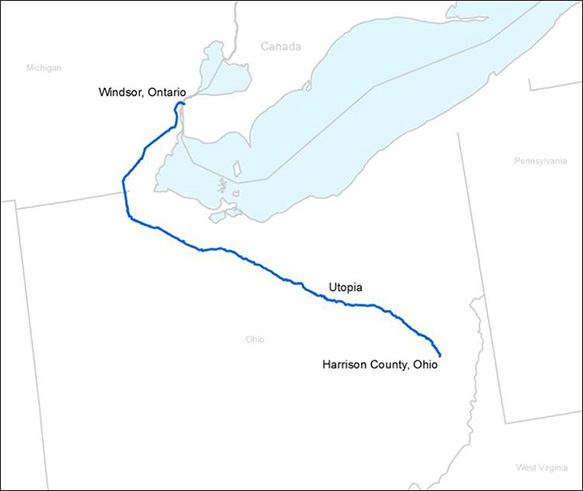

 We’ve written plenty about Mountaineer NGL Storage hub project proposed for Monroe County, OH, located just across the river (and border) from West Virginia (see our