
Hubris: PA Gov. Wolf Caves on Budget, then Claims He Won

As MDN reported last week, the Pennsylvania Republican-controlled legislature passed a budget, and then passed $1.3 billion in new taxes to help pay for it. Not part of the package was a severance tax (see PA Legislature Passes $1.3B in Tax Hikes, No Severance Tax). Last year PA Gov. Wolf threw a temper tantrum and waited nine months before allowing a budget to pass, without his signature and with no severance tax (see PA Gov. Wolf Caves on Budget Deal After 9 Mo. of Temper Tantrums). This year it only took a few weeks for Wolf to cave. He got virtually nothing he wanted in the budget–education funding far below levels he wanted, etc. And yet, he’s claiming this year’s budget was a success–because of him. Talk about hubris…
Read More “Hubris: PA Gov. Wolf Caves on Budget, then Claims He Won”
 Last Friday MDN brought you the really big news that Sunoco Logistics Partners had won a major appeals court case that recognizes them as a public utility in Pennsylvania with the right to use eminent domain to build the Mariner East 2 NGL pipeline (see
 In the past we’ve been pretty critical of the Pennsylvania Independent Fiscal Office (IFO). It claims to provide revenue projections for use in the state budget process along with “impartial and timely analysis of fiscal, economic and budgetary issues to assist Commonwealth residents and the General Assembly in their evaluation of policy decisions.” It’s been our observation the IFO is populated with partisan Democrats. However, we have to acknowledge their prediction of impact fee revenue from 2015 was spot on. Earlier this year the IFO predicted that when the dust had settled, the impact fee would generate $185.5 million (see “Independent” Fiscal Office Says PA Impact Fee Revenue Drops 17%). When the state Public Utility Commission (PUC) finally reported the actual numbers, it turned out to be $188 million (see
  Last year Pennsylvania Gov. Tom Wolf completely botched his first-ever budget, by holding out for nine months seeking a Marcellus-killing severance tax as payback to teachers’ unions that helped elect him (see
  In July 2012 MDN told you about a one-year study of air quality in and around Chartiers Township in Washington County, PA being conducted by the PA Dept. of Environmental Protection (see
  PA’s very liberal Governor, Tom Wolf, has been obstinate in demanding onerous new drilling rules for the conventional, as well as unconventional (shale) drilling industry since he took office. Reworked drilling rules were done and ready to go under previous Governor, Tom Corbett. Then Corbett lost to Wolf, and Wolf demanded to change common sense rules everyone had already agreed to (see
  This pipeline project has been, until now, completely off our radar screen. As pipeline projects go, it’s pretty small. But building even a single square inch of new pipeline, or expanding a compressor station, is anathema to anti-fossil fuel nutters. So we expect this project will be in the headlines starting this week, with a pair open house meetings in the Philadelphia area (and one in Delaware) where the project will get built. The project is being built by Eastern Shore Natural Gas and is called the 2017 System Expansion project. In March 2015, Eastern Shore ran a non-binding open season to see if customers want more natural gas in the Delmarva Peninsula area (includes most of Delaware and portions of Maryland and Virginia). It looks like Eastern Shore’s customers expressed enough interest that they plan to move forward with an expansion project that will bring new sources of natgas from an interconnection Eastern Shore has with the mighty TETCo (Texas Eastern Company) pipeline near Philadelphia. Below we have details on the expansion project, and details for the open house meetings scheduled for this week in PA and DE…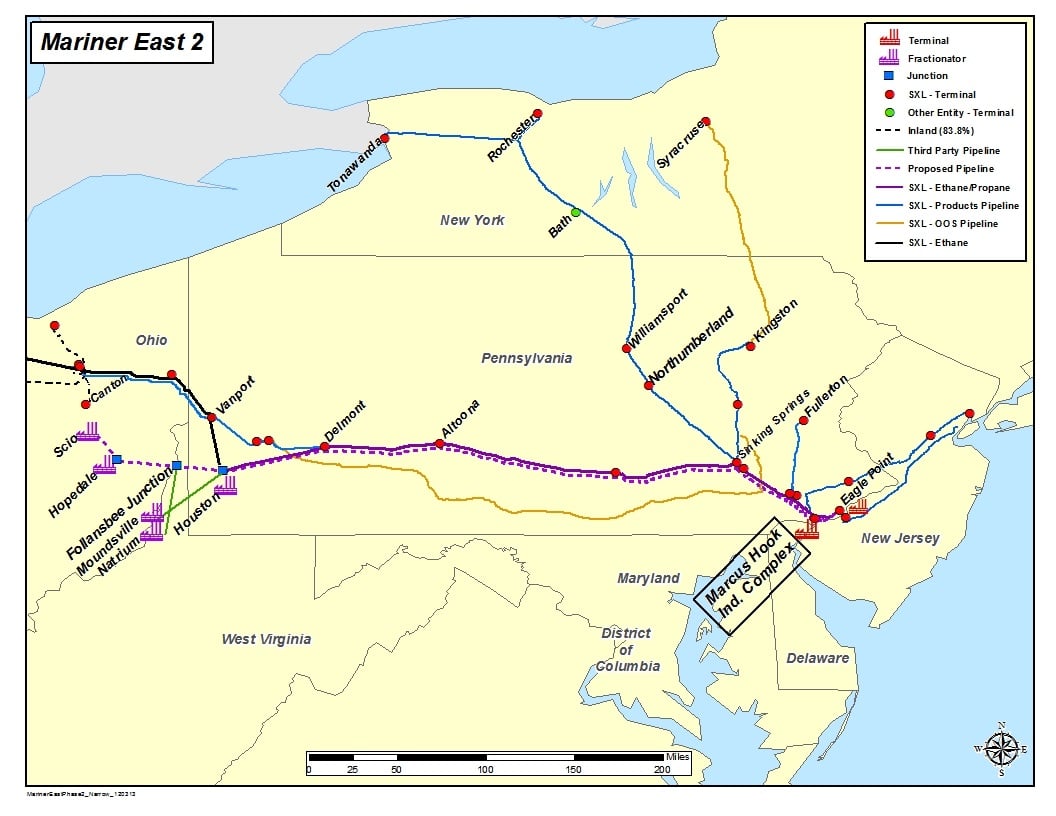
 The federal Environmental Protection Agency (EPA) filed a lengthy comment with the Federal Energy Regulatory Commission (FERC) last week regarding the Williams Atlantic Sunrise Pipeline project (full copy below). The EPA said, in a nutshell, that more studies should be done. The EPA said the pipeline could have “significant adverse environmental impacts.” They also said alternate routes should be considered. A few things to know about the EPA’s filing: First and foremost, the EPA is treated like any other individual or organization who files comments on a project with FERC. That is, the EPA’s comments will receive no special treatment or consideration. Second, the only value in EPA’s comments is publicity for anti-pipeline nutters. Third, the “alternate routes” the EPA professes to prefer have already been considered, thoroughly, and discarded by FERC. So this is a lot of smoke and noise and mirrors–and nothing else…
 MDN has previously reported on efforts in Pennsylvania to substitute a so-called “gross receipts tax” (GRT) on natural gas for a severance tax as a way to raise millions of dollars for Democrats’ voracious appetite to spend money (see
  Pennsylvania legislators went home for the long Fourth of July holiday weekend without a final budget in place. The clock is ticking. The spending part of the budget–some $31.5 billion (a massive amount) has been agreed to by both the Republican-controlled legislature and Democrat Gov. Tom Wolf. However, the budget needs to find another $1.5 billion to fund it–the shortfall in the current plan. Wolf wants “sustainable revenue”–by which he means permanent tax increases on something. Wolf’s preference is to slap a Marcellus Shale-killing severance tax on the natural gas industry. That’s a non-starter for the Republican-controlled legislature–people who actually know how economics work. It does appear the two sides are close to getting the budget passed. This week should tell the tale of how the state plans to raise enough money to bridge the shortfall…
 A new bill in the Pennsylvania legislature, Senate Bill (SB) 1327 looks to undo some of the damage done by the now departed anti-drilling Secretary of the Dept. of Environmental Protection, John Quigley. The federal Environmental Protection Agency (EPA) recently introduced draconian new rules to govern methane emissions from oil and gas drilling (see
 Can a single petrochemical facility, like Shell’s proposed ethane cracker plant in Beaver County, “rebirth” all of Pennsylvania’s moribund manufacturing base? That would be a resounding “Yes!” according to Marcellus Shale Coalition president Dave Spigelmyer and Pennsylvania Manufacturers’ Association president Dave Taylor. Writing a column in the Harrisburg Patriot-News, the two Daves make the case for just how big a hairy deal the coming Shell cracker in PA really is…
 Last December MDN ripped the mask off a group of extremely partisan, virulently anti-drilling Democrats who call themselves the innocent-sounding Multi-State Shale Research Collaborative (see