
Winter Storm Stops Nearly All Feedgas to Cove Point, Elba Island
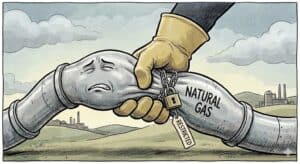 Winter Storm Fern triggered a sharp decline in U.S. LNG feedgas demand, which plummeted to 11.5 Bcf/d on Sunday from a previous weekly average of 17.2 Bcf/d. The storm caused production freeze-offs and price spikes, forcing Elba Island to shut down, and Cove Point inflows fell below 0.2 Bcf/d. Sabine Pass and Freeport (along the Gulf Coast) were down 50% and 30%, respectively. Read More “Winter Storm Stops Nearly All Feedgas to Cove Point, Elba Island”
 Last weekend, EQT CEO Toby Rice showcased the shale gas industry’s resilience during a major winter storm, taking to social media to highlight field efforts to maintain natural gas production at a well pad in Washington County. Despite record price spikes and the looming threat of “freeze-offs,” major producers like EQT, Range Resources, and CNX currently report stable operations. With natural gas fueling 40% of the PJM grid, maintaining pipeline pressure is critical to preventing regional power outages. Industry leaders emphasize that proactive winterization and dedicated crews are essential to ensuring energy security and keeping furnaces running during extreme cold.
  In 2025, the Pennsylvania Department of Environmental Protection (DEP) achieved “historic success” by eliminating a longstanding permit backlog of over 2,400 applications. The DEP acted on more than 40,000 permits and conducted 116,364 inspections to ensure environmental safety. Key initiatives included the launch of the Streamlining Permits for Economic Expansion and Development (SPEED) program. The DEP is celebrating its success by creating a brand new bureaucracy: the Bureau of Permitting Coordination. Kind of a bureau of coordinating bureaus. (You know, the word bureaucracy comes from bureau, meaning a government department, and cracy, meaning rule. Literally, to be ruled by government bureaucrats who are not elected.)
  In an op-ed appearing in the Jamestown Post-Journal, New York State Senator George Borrello argues that New York’s energy crisis, marked by potential blackouts and high costs, stems from the politically motivated closure of facilities like the Dunkirk NRG plant. Initially promised a natural gas conversion, the plant was shuttered, forcing the state to import power and damaging the local economy. Borrello contends that while nuclear energy is a viable long-term goal, the state must immediately embrace natural gas to restore energy independence. He urges Governor Hochul to bypass radical interests and reopen the Dunkirk plant to provide reliable, affordable power and vital tax relief for Chautauqua County.
  To manage a historic surge in electricity demand caused by an arctic chill, PJM Interconnection has issued maximum generation alerts across 13 states. The regional grid operator anticipates record-breaking winter peaks, prompting calls for deferred maintenance and the potential deployment of backup power from data centers. While utilities in Western Pennsylvania, such as FirstEnergy and Duquesne Light, report stable operations, PJM is preparing industrial customers for demand response programs to reduce usage. In response, U.S. Steel has already increased internal power generation to reduce grid strain. These proactive steps aim to ensure regional reliability amid persistent extreme temperatures throughout the week.
  We simply could not believe this when we read it. We had to re-read it several times to be sure our eyes weren’t lying. Massachusetts Governor Maura Healey is responsible for blocking new natural gas pipelines from entering her state, as she previously bragged but then denied (see
  MARCELLUS/UTICA REGION: Efforts to kill PA’s gas industry disguised as environmental protection; How WV natural gas development benefits local communities; OTHER U.S. REGIONS: Woodside provides 4Q update for Louisiana LNG project; Virginians can expect to see electricity costs skyrocket by $1,100 per household; Tractor-trailer carrying LNG overturns in Maryland; NATIONAL: U.S. natural gas extends weather-driven rally; Alpha Generation advances commitment to long-term contracting efforts; Data centers are the physical internet; Big Banker Larry Fink abandons renewables for AI; M&A – Rise of the oil and gas serial acquirer; Democrats are shying away from climate messaging; INTERNATIONAL: Crude gains as geopolitical risks grow; EU warns against over-reliance on USA gas; Mexico shelves planned shipment of oil to Cuba.
  Yesterday, the natural gas price rocketship continued its flight into the stratosphere. U.S. natural gas futures soared Monday, with the front-month contract surging to a three-year high, closing at $6.80/MMBtu, as winter storm Fern swept across the country, driving up heating demand and threatening supply. Spot prices are literally through the roof, spiking to levels we’ve not seen in years. The deep freeze continues through the eastern half of the country at least until Feb. 9, according to NOAA’s temperature outlook. However, there are signs that a “sharp collapse” may soon unfold.
 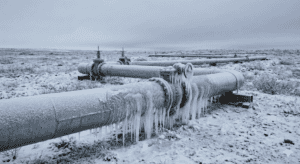 We’ve recently begun to highlight flow restrictions along pipelines that carry Marcellus/Utica molecules. When flows slow or stop (can’t reach other markets), the price typically falls because supply exceeds demand. But sometimes, the opposite happens. If pipelines are restricted due to outages and freeze-offs (as is happening right now with Winter Storm Fern), the supply of natural gas is diminished, leaving insufficient supply to meet increased demand due to the cold weather. When that happens, spot prices for natural gas soar. Wood Mackenzie reported that natural gas freeze-offs across the country reached a single-day high of 17 billion cubic feet (Bcf) on January 25th, approaching the record 18 Bcf set during Winter Storm Uri, as an intense Arctic weather system sweeps across the United States. What about the situation in the M-U?
  The Intermediate Court of Appeals of West Virginia vacated an order combining 58 oil and gas tracts into a Harrison County drilling unit, ruling that the state’s Oil and Gas Conservation Commission failed to provide sufficient findings of fact. The case involves the “JOsborn 213 Unit” operated by Arsenal Resources, which mineral rights owners claim failed to negotiate in good faith as required by law. The court found the Commission ignored conflicting testimony and provided only summary conclusions rather than a detailed analysis. Consequently, the case was remanded for further proceedings, requiring the Commission to properly evaluate all evidence and issue a new order.
 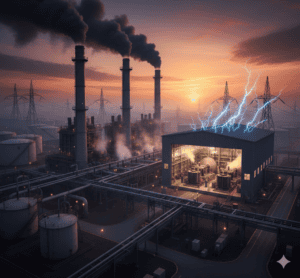 New England’s Democrat-led energy policies have failed spectacularly, leaving the region as an “energy island” during peak winter demand. Despite ambitious “net-zero” goals, a recent snowstorm forced the power grid to rely on oil for 40% of its electricity because renewables like wind and solar contributed less than 2%. New England policymakers like Govs. Maura Healey of Massachusetts and Janet Mills of Maine have created artificial scarcity and price spikes by blocking natural gas pipeline expansions. They insist on unreliable renewables. When a storm like Winter Storm Fern hits, it forces New England to rely on carbon-intensive oil and increases the risk of blackouts. You can’t fix stupid.
  Last May, NRG Energy announced a deal to acquire LS Power’s portfolio of natural-gas power plants in a deal valued at roughly $12 billion, including debt, that will expand NRG’s footprint in Texas and along the East Coast (see
  An Arctic blast in the U.S. has sent natural gas prices soaring to their highest levels since 2022, fueled by surging heating demand and production “freeze-offs” in major shale basins. As the world’s leading LNG exporter, supply disruptions in the U.S. now trigger global price hikes, particularly in Europe, which relies heavily on American gas following the loss of Russian pipeline flows. While increased global liquefaction capacity and floating inventories help manage volatility in LNG prices, the market has become structurally more interconnected. Consequently, when the U.S. freezes, the global LNG market catches a cold.
  The Marcellus/Utica rig count gained 1 rig seven weeks ago in the Ohio Utica, bringing the regional total to 39 rigs. For the past seven reports in a row, the M-U has maintained that count—the most rigs it has operated in more than a year. Pennsylvania has held at 18 active rigs for ten consecutive weeks. Ohio has operated 14 rigs for seven straight weeks (its highest in over a year). And West Virginia maintained 7 rigs, which it has operated since May 30, 2025. There were 24 rigs targeting the Marcellus and 15 targeting the Utica last week. The national count regained 1 rig last week, bringing the total back up to 544 active rigs.