
MDN’s Energy Stories of Interest: Mon, Dec 8, 2025 [FREE ACCESS]
 OTHER U.S. REGIONS: Bowman buys RPT to boost data center power engineering; Newsom’s California slouching towards a self-inflicted energy crisis; NATIONAL: Natural gas surge 9% this week on strong flow of exports; MAHA activists urge Trump to fire his E.P.A. Administrator; Green energy’s problems go beyond messaging; Climate rift opens between Amazon and rivals in row over data centre power; Halliburton promotes Slocum to COO role; WoodMac flags ‘key themes’ shaping lower 48 in 2026; U.S. retail gasoline prices fall below $3 per gallon, the lowest since 2021; INTERNATIONAL: Crude finishes higher on short covering; Today’s $67 per barrel is only $44 in 2008 dollars; Rationality returns to Australia as climate scare wanes; China’s paradox – kingdom of solar, wind, hydro, nuclear and coal. Read More “MDN’s Energy Stories of Interest: Mon, Dec 8, 2025 [FREE ACCESS]”
 Ascent Resources, formerly American Energy Partners, was founded by gas legend Aubrey McClendon and is a privately held company focused 100% on the Ohio Utica Shale. Ascent, headquartered in Oklahoma City, OK, is Ohio’s largest natural gas producer and the 8th largest natural gas producer in the U.S. The largest shareholder in the privately owned company is the private equity firm Energy & Minerals Group (EMG), with an “over 30% stake” in the company. EMG plans to sell that stake in one of its portfolio companies to another EMG company. Another (smaller) investor, the Abu Dhabi Investment Council, has sued to block the transfer, alleging a “conflicted sale” that will short-change existing investors.
 In Q3 2025, U.S. E&Ps (drillers) successfully leveraged rigorous cost-cutting and capital discipline to maintain stable earnings despite commodity price volatility. With lifting costs down 16% since mid-2022, producers offset revenue pressures through efficiency and consolidation. RBN Energy reports that performance diverged by sector in 3Q: oil-weighted producers saw earnings rise 19% on stabilized crude prices and reduced impairments, while gas-weighted peers suffered a 27% earnings slump due to lower realizations. Total production increased 4.7%, mainly driven by oil majors. Looking ahead to Q4, the outlook shifts; oil producers face headwinds as prices dip toward $60/bbl, while natural gas producers anticipate a strong finish fueled by winter demand and rising Henry Hub prices.
  Here we go again. The environmental left is attacking the shale industry by accusing it of shipping drill cuttings (the leftover rock and dirt that comes out of a borehole) to local landfills in the Buckeye State (Ohio), where it will irradiate everyone and everything close to it. According to the left, drill cuttings “could be contaminated with radioactivity and other chemicals.” And, according to the same people, lack of regulations in Ohio “allows it [radioactive drill cuttings] to slip by regulators, especially in Ohio,” and end up in the same landfills as “household trash.” Is there anything to the claim that drill cuttings are radioactive and a threat to those who live near landfills?
  In October 2024, the Bidenistas announced seven hydrogen hub projects (from 33 finalists) that would receive a collective $7 billion in federal funding (see
  A commentator writing for Reuters warns that soaring U.S. natural gas prices and falling global values are squeezing profit margins for American LNG exporters, threatening future exports. The narrowing price gap between U.S. and European markets, driven by high domestic demand and global oversupply, has reached its lowest point since 2021. The prognosticator postulates that while immediate production cuts are unlikely, a surge in new global capacity by 2027 could force reductions in U.S. LNG exports. Furthermore, rising domestic prices pose a political challenge for President Trump, as his promise to lower consumer energy costs conflicts with market tightening driven by increased LNG exports and energy-intensive data centers.
 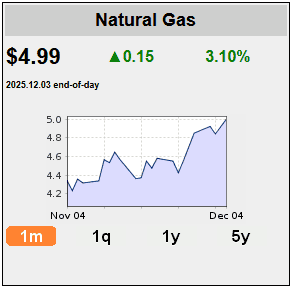 Yesterday, the NYMEX “front-month” futures price for natural gas closed up 15 cents at $4.995 (call it $5), which is the highest closing price for NYMEX in nearly three years (since Dec. 27, 2022). Intraday trading of the front-month contract floated above $5 at points. Weather forecasts of impending frigid weather were the main reason for the increase. Futures prices are now up more than 60% compared with a year ago. “Forecasts for the coldest December since 2010 may tip storage into a deficit by Christmas,” trading firm EBW Analytics wrote in a note to clients. Fewer molecules with more demand equals higher prices. As for the spot price at trading hubs in the Marcellus/Utica region, averaging all of them together, the price closed yesterday at $4.74, nearly at parity with the Henry Hub spot price of $4.87. That’s unheard of!
  Yesterday, the Pennsylvania Independent Fiscal Office (IFO) released its latest quarterly Natural Gas Production Report for July through September 2025 (full copy below). There were 116 new horizontal wells spud (drilled) in 3Q25, a huge increase of 53 wells (+84%) compared to 3Q24. Natural gas production volume was 1,934 billion cubic feet (Bcf) in 3Q25, up 93 Bcf (+5%) from 1,841 Bcf produced in 3Q24. The average Pennsylvania spot hub price was $2.18, an increase of $0.74 (+51%) from the prior year’s $1.44. All in all, it was a great third quarter for the PA Marcellus. The numbers are going in the right direction.
  Wondering how your business can profit from the Marcellus/Utica with production and drilling on the increase once again? A
  Three anti-shale drilling groups—the PA Council of Trout Unlimited, the Keystone Trails Association, and the Responsible Drilling Alliance—have requested the Pennsylvania Department of Environmental Protection (DEP) hold a hearing on the Chapter 105 permit requested for a 3.9-mile shale gas access road and staging area proposed by PA General Energy in Gamble and Cascade Townships, Lycoming County. The aim of their request is not to elicit information or express concerns that can be addressed to achieve a better outcome; rather, it is to flood the hearing with bombastic charges in hopes of blocking the project altogether.
  There have been a number of new reports recently released predicting how new AI data center projects will affect (a) demand for electric power, and (b) demand for natural gas to generate that power. We spotted what at first glance appears to be contradictory predictions in two new reports issued this week. On Monday, BloombergNEF (the research arm of Bloomberg) issued a report predicting data center power demand will hit 106 gigawatts (GW) by 2035, a 36% jump from its previous outlook. Two days later, Enverus Intelligence® Research (EIR), a subsidiary of Enverus, issued a report that predicts 30 GW of new U.S. data center capacity will be needed over the next five years (by 2030)—significantly below the 50 GW forecasted by major grid operators. One report is wildly optimistic, the other pessimistic. What gives?
  Another story in our Bizarre Files series. So-called climate activists have made a huuuge discovery. They can burn (flare) methane (CH4) coming out of an abandoned coal mine in Colorado, and it turns into carbon dioxide (CO2). Who knew? The activists declare that burning methane is “better” for the environment — that it’s green! Why? Because methane flying into the atmosphere is a bazillion times more “harmful” to Mom Earth than is carbon dioxide flying into the atmosphere. Yet when the oil industry does the same exact thing, flaring methane that comes out of an oil well instead of allowing it to fly into the atmosphere, those same climate activists declare it’s a climate disaster. It’s the end of mankind. Bizarre.
  Pennsylvania and Ohio should be looking over their shoulders regarding new data centers and their decisions on where to locate them. West Virginia is making serious efforts to be THE destination for new AI data centers to locate in the Marcellus/Utica region. The West Virginia Office of Energy’s recent summit highlighted the state’s unique position to power the booming AI and data center sectors through its vast natural gas reserves. Like PA and OH, WV’s homegrown natural gas offers a reliable, cost-effective, and flexible solution for necessary baseload power. What’s beginning to set WV apart from its neighbors is legislation that explicitly targets data centers.