
EQT Surveying in Upper Burrell for Wells Planned in Murrysville
 Upper Burrell residents (Westmoreland County, PA) recently received notifications from consulting firm Verdanterra regarding upcoming surveying for natural gas lateral wells. These horizontal wells will be drilled from EQT’s Hermes well pad in neighboring Murrysville (also in Westmoreland County), following EQT’s recent acquisition of Olympus Energy. While Township Supervisor Chairman Ross Walker described the process as a standard, “innocuous” procedure conducted by foot without land disturbance, the project highlights the increasing length of well laterals in the Appalachian region. Read More “EQT Surveying in Upper Burrell for Wells Planned in Murrysville”
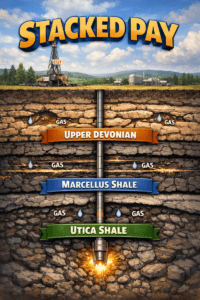 EQT is leveraging its position as the largest natural gas producer in the Marcellus/Utica (second largest in the country) to transition from a “single-target” driller to a “multi-bench” developer. The company aims to drill in more of the M-U’s “stacked pay zones.” What are the zones (layers) that EQT will target in addition to the Marcellus? And where is it experimenting with stacked pay zones right now?
  In a March 25, 2026, decision in the Omni Energy Group, LLC v. Ohio Department of Natural Resources court case, Judge Algenon L. Marbley from the U.S. District Court for the Southern District of Ohio dismissed Omni’s amended complaint regarding Class II injection well permits. Omni alleged that the ODNR unlawfully set injection pressures too low, rendering its multimillion-dollar investment in two injection wells inoperable. This case goes back to events that began in 2019, events we previously covered in a 2024 post (see
  Venture Global (VG) and Edison S.p.A., an Italian electric utility company headquartered in Milan, have signed a commercial agreement to fully resolve their pending arbitration regarding the Calcasieu Pass LNG project. Expected to conclude by the end of Q2 2026, the settlement terminates all legal disputes between the companies. As part of the deal, VG will deliver additional LNG cargoes to Europe, specifically targeting the Italian market through the Adriatic LNG Terminal starting in May 2026. This agreement strengthens their long-term partnership and enhances Italy’s energy security amidst global geopolitical disruptions.
  OTHER U.S. REGIONS: NYS plan to open state forests to solar and wind “massive step in the wrong direction”; NATIONAL: U.S. natural gas gains as April contract expires; Execs predict what price WTI oil will hit in future; Energy Capital Partners proceeds with caution on gas-fired power plant deals; Here’s the long-term case for investing in producers of oil and natural gas; Democrats revive a Jimmy Carter tax mistake on ‘windfall’ profits; Climate lawfare is stalling America’s energy future; INTERNATIONAL: Oil jumps as war risks intensify; Treasury Sec says Hormuz insurance program to start soon; Crude oil and LNG supply are at risk of the worst-possible scenario.
  The Marcellus/Utica region received a combined 11 new drilling permits last week, Mar. 16 – 22, down 6 from the 17 permits issued two weeks ago. Pennsylvania issued 10 of the permits. Ohio issued 1. And, West Virginia issued no new permits last week. The drillers who received new permits last week included EOG Resources, EQT, and Laurel Mountain Energy.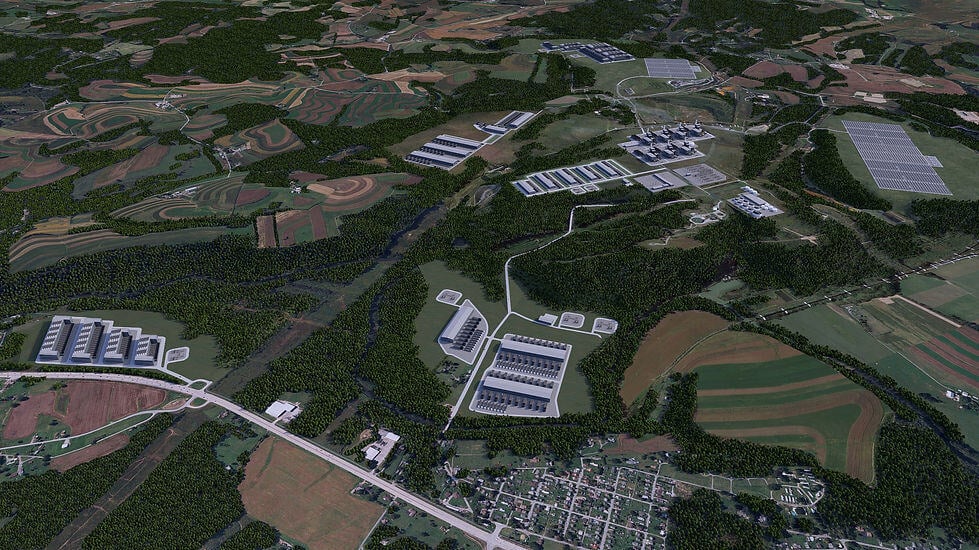
 South Carolina regulators have approved Duke Energy’s proposal to build a 1.4-gigawatt (GW) natural gas-fired power plant in Anderson County, marking the utility’s first new generation project in the state in a decade. Scheduled for construction in 2027 and operational by 2031, the facility aims to address surging energy demands driven by population growth and economic expansion, though critics (falsely) attribute the need primarily to AI-driven data centers. Supported by Governor Henry McMaster under the S.C. Energy Security Act, the project is expected to generate an annual $84 million economic impact while ensuring long-term power reliability for the region.
  Nine Energy Service, a Houston-based provider of onshore completion solutions with operations in a number of shale basins, including major operations in the Marcellus/Utica, received court approval for a prepackaged Chapter 11 bankruptcy plan earlier this month (see
  Last week, we told you that a supposed “group of rural Ohioans” in Adams and Brown counties was seeking a constitutional amendment to ban data centers exceeding 25 megawatts, citing concerns over resource consumption and a lack of local control (see
  Speaking at this week’s CERAWeek event in Houston, industry groups express cautious optimism that permitting reform, specifically the SPEED Act, could pass within a narrow eight-week window. While Senate negotiations recently resumed after disputes over offshore wind, experts warn that looming midterm elections may soon stall progress. Proponents argue that streamlining environmental reviews is vital for infrastructure and energy affordability. However, if a deal isn’t reached before July or during the “lame duck” session, shifting House leadership could deprioritize the reform. The appointment of energy veteran Alan Armstrong to the Senate provides a final push for the legislation.
  Pennsylvania State Senator Gene Yaw is introducing legislation to modernize Pennsylvania’s 1961 Oil and Gas Conservation Law, which currently relies on standards predating modern horizontal drilling. By aligning the statute with contemporary practices, the bill aims to accelerate permit reviews for Utica wells and treat them consistently with Marcellus shale operations. Yaw argues that updating these outdated rules will reduce resource waste, minimize surface impacts, and prevent natural gas from being left underground.
  Williams is addressing the surging energy needs of data centers by deploying modular natural gas-fired power units. In fact, the company has a 6-gigawatt (GW) project backlog by the early 2030s. Williams executive Jaclyn Presnal highlights that modularization provides essential “speed to power” and extreme reliability through built-in redundancy, outperforming traditional large-scale plants for phased projects. These initiatives incorporate batteries to manage AI-driven loads and leverage pipeline expansions, such as the Transco Power Express (see
  Epsilon Energy, a relatively small company, used to concentrate most of its effort on developing Marcellus Shale wells. However, over the past few years, the company has expanded into other plays and now owns assets in the Anadarko (Oklahoma), the Permian (Texas), the Powder River Basin (Wyoming), and the Western Canadian Sedimentary Basin (in Alberta, Canada). In the Marcellus, Epsilon does not do its own drilling. It is a joint venture partner with (gives money to) Expand Energy, and Expand does the drilling in the Marcellus. Epsilon issued its latest quarterly update yesterday, discussing what’s on the docket for 2026. And, what’s on the docket is that Expand plans to drill five new wells this year on Epsilon’s leased acreage in northeast Pennsylvania.
 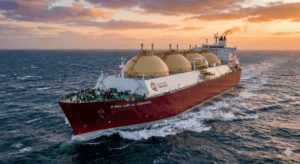 The Marcellus Shale Coalition writes that Pennsylvania sits at the center of U.S. Liquefied Natural Gas (LNG) development, as highlighted by the EU–U.S. LNG Cooperation 2.0 Summit held in February in Pittsburgh. Utilizing the Appalachian Basin’s vast resources, the state has driven the shale revolution, making the U.S. a leading global energy exporter. This production has been vital for European energy security, providing a critical alternative to Russian gas.