
Antero Resources | Bradford County | Butler County | Carroll County | Energy Companies | EOG Resources | EQT Corp | Expand Energy | Guernsey County | Harrison County | INR/Infinity Natural Resources | Laurel Mountain Energy | Lycoming County | Ohio | Ohio County | Pennsylvania | Pennsylvania General Energy | Weekly Permits | West Virginia | Wetzel County
31 New Shale Well Permits Reported for PA-OH-WV Jun 22 – 28
 The Marcellus/Utica region received 31 new drilling permits last week, June 22 – 28, the very same number issued two weeks ago! Can’t remember the last time that happened. Last week, Pennsylvania issued just 5 new permits. Ohio issued 13 new permits. West Virginia also issued 13 new permits last week. The drillers who received new permits included: Antero Resources, EOG Resources, EQT, Expand Energy, Infinity Natural Resources, Laurel Mountain Energy, and Pennsylvania General Energy. Read More “31 New Shale Well Permits Reported for PA-OH-WV Jun 22 – 28”
 Antero Resources, the largest Marcellus/Utica (M-U) driller in West Virginia, released its Q1 2026 update last week. Antero placed 20 Marcellus wells to sales during Q1 with an average lateral length of 11,652 feet. Thirteen of these wells have been online for approximately 60 days with an average rate per well of 25 MMcfe/d, including 1,457 Bbl/d of liquids per well. Antero’s drilling and completion capital expenditures during Q1 were $222 million. In addition to capital invested in drilling and completion activities, the company invested $25 million in land during the first quarter. Through its land investment, Antero added approximately 5,400 net acres, representing 24 incremental drilling locations at an average cost of approximately $900,000 per location.
  In Antero Resources Corp. v. Stonewall Gas Gathering LLC, the Texas Business Court resolved a contract dispute over a 2014 gas gathering agreement following a bench trial. The court denied Antero’s claims for $200 million in past and future monetary damages. However, it granted Antero “declaratory relief” and specific performance, ordering Stonewall to reduce Antero’s service fees in accordance with the affiliate agreements and to produce the requested contract documents. The court awarded Antero $1 in nominal damages for discovery breaches, while a ruling on attorney’s fees was deferred pending further proceedings.
  Antero Midstream (AM) recently detailed its 2026 growth strategy, targeting an adjusted EBITDA of $1.19 billion to $1.24 billion, representing an 8% year-over-year increase. This growth is driven by Marcellus Shale infrastructure expansion and the integration of recently acquired HG Midstream assets. The company plans capital expenditures between $190 million and $220 million, primarily for gathering and compression infrastructure across its Appalachian footprint. Key focuses include high-return rich gas gathering projects and dry gas infrastructure development. With strong projected free cash flow, Antero Midstream aims to maintain capital discipline, reduce leverage to approximately 3.0x, and pursue opportunistic share repurchases.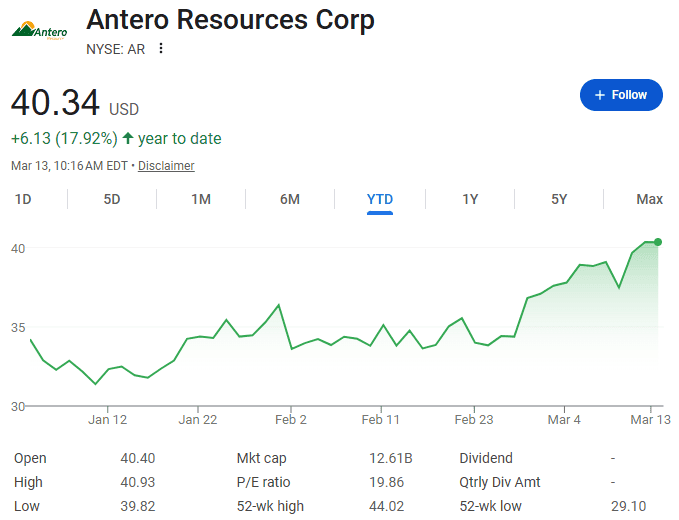
 Here’s a lawsuit that had (until now) escaped our radar screen. It’s a lawsuit dealing with the issue of post-production deductions. The case is Kirkbride v. Antero Resources Corp. and is being litigated in the U.S. District Court for the Southern District of Ohio. On March 6, 2026, Magistrate Judge Elizabeth Preston Deavers denied a motion to certify the case as a class action. This is a significant development in the ongoing legal friction between Ohio landowners and energy companies over how royalties are calculated.
  In December, Antero Resources announced a deal to sell its Ohio Utica assets to a partnership of Northern Oil & Gas (NOG) and Infinity Natural Resources (INR) for $1.2 billion in cash (see
  In December, Antero Resources announced a deal to sell its Ohio Utica assets to a partnership of Northern Oil & Gas (NOG) and Infinity Natural Resources (INR) for $1.2 billion in cash (see
  Antero Resources Corporation has reached a proposed settlement with the U.S. Department of Justice (DOJ) and the state of West Virginia to resolve Clean Air Act violations at 242 oil and gas facilities in West Virginia and Ohio. To address unauthorized volatile organic compound (VOC) emissions, Antero will invest approximately $5.8 million in system improvements and monitoring, reducing annual emissions by over 1,100 tons. The company will also pay a $3.8 million civil penalty and spend $1.5 million to permanently plug and remediate abandoned wells in WV. Total price tag: $11.1 million.