
Utica Super Lateral Wells Now Catching on in Other Plays
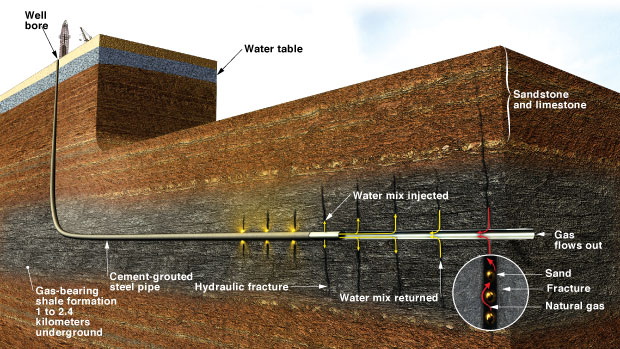
What is a “super lateral” as opposed to a “long lateral” when it comes to shale drilling? And who is drilling these really long wells? That’s the topic of a recent post by energy expert Richard Zeits on the Seeking Alpha investors website. We’ll give you our definition. But first, some brief background. When you read about a “lateral” in shale wells, it refers to the part of the well that is horizontal. When drilling a new well, you first (of course) drill vertically–more or less straight up and down. But at a certain depth, when you hit the shale layer you are targeting, you gradually turn the hole so that it becomes horizontal, running through the rock layer (see the illustration). The horizontal part is the lateral. In the early days of Marcellus (and Utica) shale wells, laterals were perhaps a maximum of 2,000 feet in length. Today? The longest on-shore lateral in the world (all three of them, actually) are located in Ohio–drilled by Eclipse Resources. Eclipse’s wells–first the Purple Hayes, then the Great Scott and most recently the Outlaw–are considered “super laterals” because they exceed 15,000 feet. In the case of the Outlaw C 11H well in Guernsey County, OH, the lateral is a staggering 19,500 feet long (see Eclipse Breaks Record Again – New Longest Shale Well in World!). If we use the metric that a “super lateral” is 15,000 feet or longer, there is one Marcellus well that qualifies (see Range Resources Drills Longest Marcellus Well Ever – in Washington Co.). While Mr. Zeits doesn’t use the exact metric of 15,000 feet, he does talk about super laterals, and predicts they will soon become common. He notes some new news for us: Chesapeake Energy has drilled an Eagle Ford oil well with a 17,000 foot lateral. Zeits says we should expect to see this in other plays too. We found his musings over super laterals, and the economics behind them, interesting…
Read More “Utica Super Lateral Wells Now Catching on in Other Plays”
 In early June, MDN brought you the news that officials with Ascent Resources (formerly American Energy Partners) and Chesapeake Energy said their respective companies are putting a renewed focus on Jefferson County, OH in the coming months (see
  As we were reading about yesterday’s big news of EQT buying Rice Energy, we came across a couple of lists (same list, different sources) listing the top 10 natural gas-producing companies in the United States. The list was reworked to show that the combination of EQT and Rice will create the #1 largest natural gas-producing company in the country. An astonishing feat. But what caught our eye in looking over the “top 10” list was just how many of the companies in that list have operations in the Marcellus/Utica. At one time or another, all 10 of the top 10 owned leases and/or drilled in the Marcellus/Utica. By our count, 8 of the top 10 still do. You already know that EQT/Rice will become the #1 producer. But who is #2, and #3? And what about the rest of the list? We have it for you below…
 We’re going to take a stab at this, and we are not confident we will get it 100% right. With that as a warning, we recently reported that a case brought by landowners in northeastern PA against Chesapeake Energy over unwarranted royalty deductions suffered a bit of a setback (see
  Pennsylvania’s landowners, at least many of them, continue to be angry about getting low–or no–royalty checks. That’s not what they signed up for when leasing their property. A group of 200+ landowners packed a meeting last week in Wyoming County, PA to discuss the situation, and what to do next. The meeting was organized by the Pennsylvania Chapter of the National Association of Royalty Owners (NARO). One distinct possibility raised at the meeting: force Chesapeake (and others) into arbitration. NARO’s approach is to push for legislation, specifically PA House Bill (HB) 557 (see
  Jefferson County, OH is not the first (or even second or third) county you think of when you think “Utica drilling.” But that may soon change. Jefferson shares borders with other counties that are heavily drilled–Carroll, Harrison and Belmont. There has been some drilling in Jefferson in the past, but with the slowdown over the past few years, not much has happened. But according to Ascent Resources and Chesapeake Energy, their respective companies are putting a renewed focus on the county in the coming months. Which is good news indeed. Couple that with a possible ethane cracker plant coming to Belmont County, and (according to the Chamber of Commerce), Jefferson is heading for “a brighter future” thanks to the Utica industry…
  Sometimes we wish we had gone to law school–to better understand some of the cases involved with oil and gas. This is one of those times. When you read words like “arbitrability,” the eyes start to glaze over. We’ll do our best to summarize some important news for landowners who want to sue Chesapeake over shorted royalty checks. Starting in 2008, Chesapeake Energy, under then-CEO Aubrey McClendon, began leasing acreage in northeastern Pennsylvania for shale drilling. Said drilling happened and in 2013, Scout Petroleum purchased royalty rights from some NEPA landowners. That is, Scout took over receiving the royalty payments in return for giving those landowners an up front, lump sum. In 2014, when it became obvious Chesapeake was using aggressive deductions from royalty payments (i.e. landowners were getting hosed), Scout filed a lawsuit against Chesapeake, requesting (under the lease language) that their grievances against Chessy be arbitrated AND (not specifically under the lease language) that Scout and thousands of other landowners be lumped together into class action arbitration (see
  Chesapeake Energy released its first quarter 2017 update yesterday. Chesapeake, the second largest natural gas producer in the United States, has its fingers in a lot of shale pies. But two of the key pies is the Marcellus and Utica. What does yesterday’s update tell us about Chessy’s involvement in the northeast? Utica production was down in 1Q17, from 138,000 barrels of oil equivalent in 1Q16 to 96,000 barrels in 1Q17. However, Marcellus production was up, slightly, from 134,000 barrels in 1Q16 to 146,000 barrels in 1Q17. Total production, across all of Chesapeake’s wells, dropped by 21% in 1Q17 versus a year ago. However, perhaps the biggest news is that Chessy seems to be out of the woods financially. In 1Q16 Chesapeake lost $1.1 billion. In 1Q17, the made (profited, in the black) $75 million–more than a huge $1.2 billion swing in just one year’s time. Kudos to Chesapeake CEO Doug “the ax” Lawler. And we’re laughing at corporate raider Carl Ichan–the guy who hired Lawler. Icahn bailed by selling his Chesapeake stock late last year (see
  Truly maddening. A Pennsylvania farming family has had to put up with Chesapeake Energy’s lame justifications for not paying them a dime in royalties over the past two years, even though Chesapeake continues to extract gas from their property. Chesapeake claims that since 2015, their costs to extract/sell gas from Russ Forba’s land exceeded any revenue generated–by $112,000. Chesapeake promised Forba that the company would not try to recoup those “costs” from future royalties. The company just broke its promise. On Monday, Forba received a statement from Chesapeake revising the price of the gas sold (down), and revising the post-production costs claimed (up) for the month of April 2015. Chesapeake then deducted the extra $5,700 “loss” from current royalty payments to cover the difference–something they PROMISED would never happen. This is why PA landowners are incensed and calling for legislation. We don’t blame them…
 The sharp folks over at the Pittsburgh Business Times have been looking through data from the Pennsylvania Department of Environmental Protection (DEP) and have compiled a list of 20 drillers who have at least a dozen shale wells in the southwest PA region. And they ranked them from lowest to highest. We’ve grabbed the list below. The interesting thing for MDN is that there is one name in the list not familiar to us, and we’ve been watching this space since 2009. Always fun to learn something new. Here’s the list of southwest PA’s “Top 20” Marcellus drillers…
 Paul Sidorek, an accountant representing some 60 northeastern Pennsylvania landowners who receive royalty income from drilling, is also a landowner himself. In 2009 Sidorek leased 145 acres, a lease that was eventually sold to Chesapeake Energy. Because of the troubles encountered by others, Sidorek wrote into his lease a 20% royalty and made sure the lease explicitly stated that no expenses could be deducted from the sale of the gas produced on his property. That is, NO post-production expenses could be deducted. And yet, Chesapeake disregarded the lease and deducted as much as 30 percent from his royalties, attributing it to “gathering” and “third party” expenses, an amount that adds up to some $40,000 a year (see
  In September, MDN brought you research on 10 of the largest Marcellus/Utica drillers that have “hedged” their 2017 production (see