
Enbridge Plans New 28-Mile Gas Pipe in Chatham & Lee Counties in NC
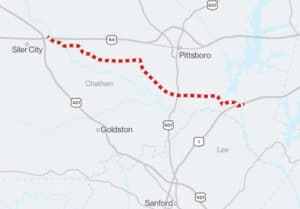
Enbridge Gas is developing a 28-mile natural gas pipeline to meet growing residential, commercial, and industrial energy needs in Chatham and Lee counties in North Carolina. The project, intended to connect Siler City to Moncure, is part of a larger state natural gas infrastructure buildout that Duke Energy says is crucial to meeting demand, especially from new data centers. With strong economic and population growth in the region, additional natural gas capacity is essential to support expanding communities and major industrial users, as well as to help ensure continued, reliable service for existing Enbridge Gas customers. This greenfield project is, of course, stirring up environmentalists who claim it will harm the environment (as well as cause mythical global warming). Read More “Enbridge Plans New 28-Mile Gas Pipe in Chatham & Lee Counties in NC”
 Enbridge has announced a non-binding open season inviting existing and potential shippers to bid on firm natural gas transportation services. The offer includes up to 300,000 GJ/day (~285 MMcf/d) of capacity for its M12, M12-X, or M17 services. Available paths connect the strategic Dawn Hub to Parkway, Kirkwall, and Dornoch, facilitating efficient gas movement across Ontario to major North American markets. Shippers of Marcellus and Utica molecules will be interested in this open season.
 Enbridge Inc. is a major North American energy infrastructure (primarily pipeline) company based in Calgary, Canada, specializing in the transportation, distribution, and generation of energy. It operates the world’s longest crude oil/liquids pipeline system, transporting 25% of North America’s crude oil, alongside significant natural gas, renewable power, and natural gas utility operations. Enbridge’s fourth quarter 2025 update highlights significant developments impacting the Marcellus/Utica region, primarily driven by surging demand for natural gas to support data centers and power generation, as well as continued infrastructure modernization.
 The environmental left in Rhode Island is all hot and bothered over a plan to replace or add a total of 12.3 miles of pipeline for the Algonquin natural gas pipeline network. Enbridge Inc. is proposing a $300 million expansion of the Algonquin natural gas pipeline (the Algonquin Reliable Affordable Resilient Enhancement project), scheduled for 2029, that involves replacing and extending small segments across Rhode Island and Massachusetts. Radical antis in Rhode Island argue the expansion contradicts Rhode Island’s “Act on Climate” goals and promotes reliance on fossil fuels. They have, in our humble opinion, gone clinically insane over the continued use of fossil energy—including clean-burning natural gas. It’s bizarre.
 The Texas Eastern Transmission Pipeline (TETCO), operated by Enbridge, is a major 8,580-mile interstate natural gas system connecting Gulf Coast/Texas supplies to the Northeast US. Originally designed for northbound flow, it now heavily supports bidirectional, southbound, and regional supply, including Marcellus/Utica gas. A short 5.3-mile section of TETCO (actually four separate pipelines that make up TETCO) running through Greene County, PA, needs a fix to protect it from coal mining activities set to begin directly underneath the pipeline in that area.
 In early September, MDN told you about the news that Enbridge had made a final investment decision (FID) for the Algonquin Reliable Affordable Resilient Enhancement (AGT Enhancement) project to flow an additional 75 million cubic feet per day (MMcf/d) of Marcellus/Utica molecules through the Algonquin Gas Transmission pipeline throughout New England and the northeast (see
 An article appearing in the Peekskill (NY) Herald has this headline: “Natural Gas Pipelines: A Path to Renewable Energy?” The subhead reads, “Several projects propose solutions that address the threat of statewide energy shortages in the near future.” The article highlights four active pipeline projects in the Empire State that we have covered multiple times. These pipelines would flow more Marcellus gas from Pennsylvania (perhaps beyond) into New York and New England. They include Enbridge’s Project Maple, Williams’ Northeast Supply Enhancement (NESE), Williams’ Constitution Pipeline, and Iroquois Gas Transmission’s Iroquois Enhancement by Compression (ExC). Where does each project stand?
 The Tennessee Valley Authority (TVA) is a federally owned electric utility corporation in the U.S. TVA’s service area covers all of Tennessee, portions of Alabama, Mississippi, and Kentucky, and small areas of Georgia, North Carolina, and Virginia. TVA is the country’s sixth-largest power supplier and the largest public utility company. In May 2023, TVA announced that it would convert the Kingston Fossil Plant (coal-fired) in East Tennessee to become a natural gas-fired plant capable of generating 1,500 megawatts of electricity (see
 Speaking at the Sept. 30 Northeast Energy and Commerce Association 2025 Fuels Conference, gas pipeline executives expressed optimism that shifting federal and state politics in New England are creating opportunities for natural gas infrastructure expansion. Panelists emphasized the need to alleviate regional gas constraints to support the growth of electric generation and data centers. Speakers also highlighted the complementary role of LNG infrastructure, the challenge of financing new pipelines, and urged Massachusetts to reconsider strict decarbonization targets to ensure energy reliability.
 We’re not sure how to feel about this story. Outrage. Relief. Sarcasm. Befuddlement. All of those emotions swirl in our heads. For years, we have chronicled the radical/left position of former Attorney General (and now Governor) Maura Healey in Massachusetts with her opposition to pipelines and natural gas energy (here’s one of many examples:
 Shell, Norway’s Aker BP, and Canada’s Enbridge have all quit a Big Green-backed organization called the Science Based Targets initiative (SBTi), a corporate climate action organization that is supposed to enable companies and financial institutions worldwide to “play their part in combating the climate crisis,” primarily by eliminating fossil fuels. Someone finally woke up at Shell and these other companies, and they quit, pulling their funding with them, which shut down SBTi’s work on a so-called net-zero standard for oil and gas in the process.
