
Army Corps Engrs Reinstates MVP Permits for 4 WV River Crossings
 In May, the radical Sierra Club claimed a victory in temporarily stopping construction work of the Mountain Valley Pipeline (MVP) at four river crossings in West Virginia (see Army Corps Engineers Suspends MVP Permit for River Crossings). The Sierra Club and a mishmash of other radicalized green groups filed a motion asking the Fourth District U.S. Circuit Court of Appeals to suspend a permit issued by the U.S. Army Corps of Engineers that allows MVP to construct the pipeline across streams and rivers in the Mountain State. The Clubbers’ tortured logic was this: When constructing the pipeline across a river, the stated standard (according to the permit) is that construction can take no longer than 72 hours. MVP says it will need longer when constructing the pipeline across four rivers–Elk, Gauley, Greenbrier and Meadow. Therefore (say the Clubbers), MVP is in violation of the general permit issued by the Corps and that means ALL (not just those four rivers) construction should be stopped, immediately. The Corps said they had reviewed the standards and at that point (in May) rescinded the permit as it applies ONLY to those four rivers, NOT to any locations. The Corps has just reissued the permit in question, tweaked to allow MVP more time. That’s the new news and the good news. However, in June the Fourth District Court agreed with the Clubbers and for now, has stopped construction at all 591 stream crossings the pipeline traverses in WV (see Sierra Club Succeeds in Delaying MVP Project in WV via Court Order). So even though the underlying reason the case was brought in the first place, that construction will take longer at four crossings (out of 591) is now resolved, the court order is still in place preventing work at any of the crossings in WV…
Read More “Army Corps Engrs Reinstates MVP Permits for 4 WV River Crossings”

 Years ago when Sunoco Logistics Partners (aka Energy Transfer Partners) originally proposed and planned the Mariner East 2 twin pipelines from the edge of eastern Ohio through the entire length of Pennsylvania to the Marcus Hook refinery near Philadelphia, the completion date promised was the end of 2016. Little could Sunoco foresee the multiple lawsuits, regulatory hearings and illegal protest actions that would conspire to throw the project off schedule for more than a year and half. When pipeline companies plan such multi-billion dollar projects, they first get customers (drillers) to sign on the dotted line, guaranteeing there will be enough product (and revenue) to make the project worthwhile. Drillers *did* sign on the dotted line, and they’re still waiting. Waiting and now pressuring Sunoco to get the darned thing up and running. The pipeline itself is 98% complete–in the ground and connected. But an all-important 2% is still not complete, most of it in the Philly suburbs–Delaware and Chester counties. Sunoco continues to have problems with underground horizontal directional drilling and with ongoing litigation by towns in the Philly area. What to do, with customers breathing down your back? Sunoco has come up with an ingenious solution that is sure to send the crazies into orbit. Sunoco is asking the federal Pipeline and Hazardous Materials Safety Administration (PHMSA) for permission to use part of an existing 12-inch pipeline in that area that previously carried refined petroleum products (things like gasoline, heating oil, and jet fuel), repurposing the pipeline to carry NGLs (ethane, propane, butane, etc.). This is only a short-term fix until the last bits of the full ME2 is up and running…
 The married couple who started Lancaster Against Pipelines (LAP), Mark and Malinda Clatterbuck, are far-left radicals who pretend to be mom and pop, salt-of-the-earth, neighbor-next-door, aw-shucks common folks who would never engage in “violent” protests. Mark Clatterbuck admits to traveling to North Dakota to participate in the mass action against the Dakota Access Pipeline–a “protest” that turned quite violent and destroyed millions of dollars of property. No, we’re not saying nor implying that Clatterbuck himself engaged in illegal actions while there. We are saying the Clatterbucks’ sympathies lie with protest movements that sometimes result in such actions. The Clatterbucks made some big boasts–that some 1,000 people had pledged to protest and get themselves arrested to stop Atlantic Sunrise, a $3 billion, 198-mile pipeline project running through 10 Pennsylvania counties to connect Marcellus Shale natural gas from northeastern PA with the Williams’ Transco pipeline in southern Lancaster County. Something under 50 people have actually been arrested for illegal actions in trying to stop construction. As the Atlantic Sunrise project nears completion in all locations, including Lancaster County, apparently LAP is feeling neglected. Nobody talks about them anymore. They didn’t/couldn’t stop the pipeline, as they had boasted they would. So in an attempt to grab one more headline, Mark and another LAP protester, Elliot Martin, connected themselves together at a pipeline construction site using a “sleeping dragon”…
 We write about Boardwalk Pipeline Partners every now and again. They don’t have a lot of pipelines in the Marcellus/Utica region–but what they do have is important. One of the pipelines operated by Boardwalk is the huge Texas Gas Transmission (TGT)–originally built from the Louisiana Gulf Coast to the upper Midwest to supply Illinois, Indiana and Ohio with natural gas. But then the Marcellus/Utica Shale happened and TGT needed to change strategies. Through a series of projects, TGT made the pipeline system bidirectional, so it could flow gas from the Marcellus/Utica to points south, going as far as the Gulf Coast. In May 2016 TGT began to flow up to 626 million cubic feet per day of Marcellus/Utica gas as far away as the Gulf Coast (see
  Rover Pipeline has violated one of the sacrosanct rules of life (and of pipeline construction): “Say what you’ll do, then do what you say.” Rover told the Federal Energy Regulatory Commission it would restore areas previously dug up to lay the pipeline by certain dates (primarily June 30th). In return, based on those promises from Rover, FERC allowed the company to begin service on certain sections of the $3.7 billion, 711-mile natural gas pipeline that runs from PA, WV and eastern OH through OH into Michigan and on to Canada via the Vector Pipeline. Rover has been pressuring FERC to allow two of the laterals–the Burgettstown and Majorsville laterals, that reach into western Pennsylvania–to begin service (see
  MDN told you last week that Sierra Club lawyers are attempting to bamboozle a court into halting construction of the Mountain Valley Pipeline (MVP) in Virginia, as they were able to do in West Virginia (see
  Sunoco Logistics Partners was drilling horizontally underneath Snitz Creek in Lebanon County, PA for its Mariner East 2 Pipeline project when it experienced yet another “inadvertent return”–nontoxic drilling mud leaking out of a place where it shouldn’t. Sunoco spilled five gallons of nontoxic drilling mud. This is the third time it’s happened in June, and the sixth time it’s happened at the Snitz Creek location in total. Predictably, antis were hysterical. Hysterical, not as in funny, but hysterical as an insane, out-of-control overreaction. Theatrics. Drama. That kind of hysterical. The reaction from antis is organized by “green” groups–in particular by one person from a local green group calling itself Concerned Citizens of Lebanon County. Five gallons of nontoxic drilling mud (the same stuff used to make kitty litter and lipstick) is, quite literally, NOTHING. We’ve seen 5 gallon spills of very toxic gasoline at the local gas station that went unnoticed. Gasoline is far more “toxic” to the environment than what’s happening at Snitz Creek. Why do drilling mud spills keep happening at the Snitz Creek location? Obviously the ground in that area is porous. Every time Sunoco drills under the creek another few feet, drilling mud pops out and drilling activity gets shut down, yet again. This is a recurring situation. We don’t know what the solution is, but not building the pipeline (which is 99% done) is not one of the options. Hopefully Sunoco can find a solution quickly so we can put this ongoing, manufactured, and tiresome drama queen theatrics behind us…
 Platts is reporting U.S. natural gas production hit a new, all-time high last week, mainly due to a surge in natgas production in the Texas Permian. Although Marcellus/Utica production “pulled back modestly” this past week, if you look at the entire month of June, we hit new all-time highs for production yet again. However, it wasn’t just the good news of new record production that caught our attention in the Platts update, but this statement: “Looking ahead, it’s possible that Northeast production growth could flounder this summer, thanks to continued in-service /delays on Rover Pipeline’s upstream supply laterals.” Rover is desperately trying to get FERC to grant permission to open the Majorsville and Burgettstown laterals, as we pointed out yesterday (see
  In January Dominion Energy announced a deal to buy out and merge in South Carolina-based SCANA Corporation (see
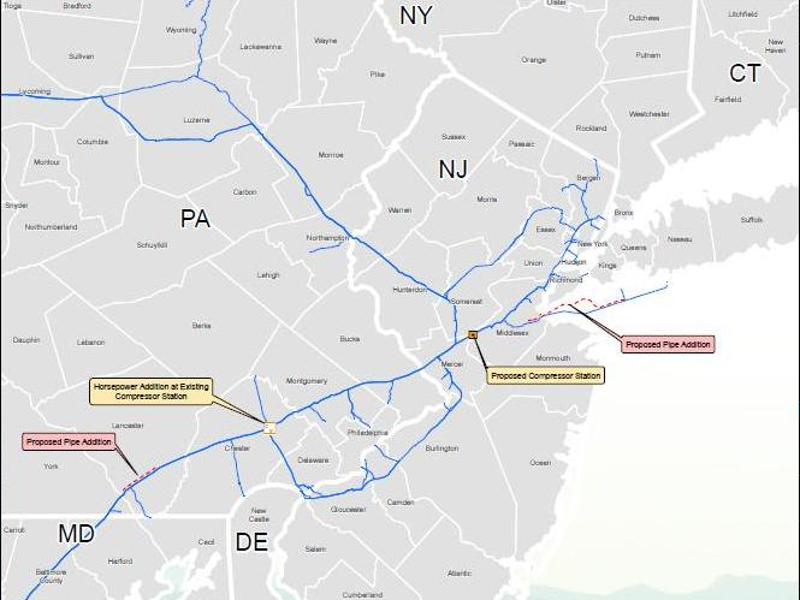
 Spectra Energy’s Algonquin Incremental Market (AIM) pipeline project is an $876 million expansion of the existing Algonquin pipeline system designed to carry 342 million cubic feet of natural gas per day to New England states that badly need the gas. On March 3, 2015 the Federal Energy Regulatory Commission (FERC) issued their final approval for the project, allowing it to go forward. Construction began in 2015 and, following extreme opposition from New York State over a small portion of the project, it finally went online in in 2016. New York’s radical, anti-drilling governor, Andy Cuomo, tried to stop the Algonquin using the flimsy excuse that some of the drilling for the pipeline would happen a half mile from a nuclear power plant–a plant that’s shutting down anyway (see
  The lawyers that infest the Sierra Club are still celebrating a temporary court victory last week that essentially stops construction of the Mountain Valley Pipeline (MVP) in West Virginia (see
  In March, MDN brought you the news that the Federal Energy Regulatory Commission (FERC) had taken “significant action” to address the Trump tax cut legislation enacted last December (see