
Anti-Drilling/Fossil Fuel | Energy Services | Industrywide Issues | Pipelines | Regulation | Transco | Williams
Williams’ PennEast Pipe Competitor Hits a Brick Wall in New Jersey
 In March 2019, MDN told you about a new Williams plan to beef up the Transco pipeline in Pennsylvania and New Jersey, to deliver an extra 829 MMcf/d (originally 1 billion cubic feet per day) of Marcellus gas to PA, NJ, and Maryland (see Williams Announces Transco Competitor to PennEast Pipe in NEPA). The project, called the Regional Energy Access expansion project, was aimed at competing with the PennEast Pipeline project by flowing gas from northeastern Pennsylvania to the Trenton, NJ area. PennEast got canceled after stiff opposition from liberal state officials in New Jersey. Williams is now facing the same opposition for its project.
Read More “Williams’ PennEast Pipe Competitor Hits a Brick Wall in New Jersey”

 When a pipeline company considers whether or not to build a new pipeline, the company conducts an “open season”–a time when drillers (producers), traders, buyers, and others who want guaranteed capacity along that pipeline can sign long-term contracts. Such contracts guarantee pipeline companies will be able to make back the considerable amount of money they have to spend to build the pipeline. What happens when those 5-, 10-, and 20-year contracts expire?
 Pipeline giant Williams issued its first quarter 2022 update earlier this week. Among the bits of news coming from the update is that Williams has reached an agreement on two new gathering expansions for the “rich” Utica and Marcellus regions. Also newsworthy: the company has signed customers on the dotted line for its Texas to Louisiana Energy Pathway Project, a 364 MMcf/d Transco expansion project to serve the growing LNG export market along the Gulf Coast.
 In July 2020 Dominion Energy announced it was canceling the Atlantic Coast Pipeline (ACP)–a 600-mile Marcellus/Utica pipeline project from West Virginia through Virginia and into North Carolina (see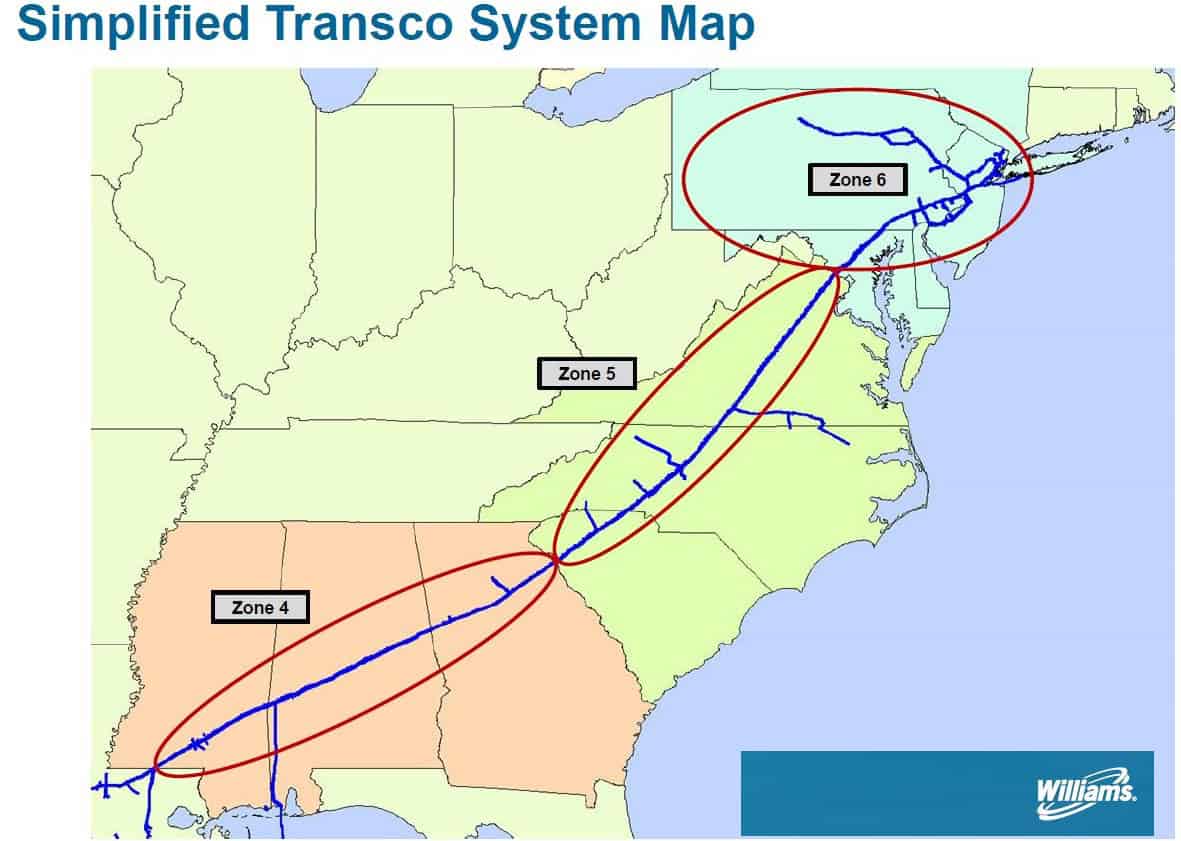
 Anecdotally in reading articles about electric power production in New England, we know that almost all electricity is produced in the region by natural gas (unless they run low, then they use fuel oil). We also know a majority of the electricity produced in the PJM region, including the M-U area, is also produced by natural gas. What we didn’t know (but do now) is that the vast majority of electricity in the southeastern U.S. is produced by natural gas. Most of the molecules feeding southeast gas plants come from the M-U.

 In October 2020 the Sisters of the Corn (our name for a group of leftist nuns in Lancaster County, PA) filed yet another frivolous lawsuit against Williams over a pipeline that crosses their land–a pipeline (Atlantic Sunrise) that has been up and running safely for years (see
  Appearing on a Barclay’s energy conference webcast yesterday, Williams CEO Alan Armstrong said his company plans to keep spending around $1.2 billion per year through 2026 to keep growing and expanding. One of the prime drivers of growth and expansion for Williams in the coming years is LNG exports. Feedgas to LNG plants continues to increase. According to S&P Global Platts, U.S. LNG feedgas demand will increase from 10.9 Bcf/d this year to 14.9 Bcf/d in 2026. Williams intends to deliver much of that increased demand to the plants that use it.
 On March 19 Williams petitioned the Federal Energy Regulatory Commission (FERC) to extend the time to build the FERC-approved Northeast Supply Enhancement (NESE) pipeline project in the New York City area by an extra two years (see
  No doubt you heard about the ransomware attack on the Colonial Pipeline, a pipeline that flows a significant amount of refined products (gasoline and diesel fuel) from the Gulf Coast where it’s refined as far north as New Jersey. Most of the gasoline supply for states like North and South Carolina comes from the Colonial Pipeline. When the pipeline went offline for over a week, most gas stations in NC ran out of gas. It was panic city across the state. The outage pointed out the weakness of having most of a state’s supply of fuel provided by a single pipeline. Top officials in NC are equally (perhaps more) concerned that most of the state’s natural gas supply comes from a single interstate pipeline: the mighty Williams Transco pipeline.