DT Midstream | Energy Companies | Energy Services | Energy Transfer Partners | Expand Energy | Industrywide Issues | Pipelines | Williams
Expand Energy is the 800-Pound Gorilla in the Pipeline Sector
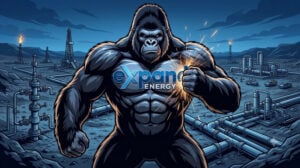 We stumbled across an article by East Daley Analytics that is a real eye-opener for us. East Daley analyzed 13 major public G&P (gathering and processing) operators (i.e., pipeline companies). They found that Expand Energy (created by the merger of Chesapeake Energy with Southwestern Energy), with major assets in the Marcellus/Utica and the Louisiana Haynesville, accounts for 52% of DT Midstream’s gathering volumes, 32% of Williams’, and 21% of Energy Transfer’s throughput. Yikes! Just one company. [Article amended below. See our note at the end.] Read More “Expand Energy is the 800-Pound Gorilla in the Pipeline Sector”
 Last November, New Jersey (and New York) issued a federal Clean Water Act permit to build the Williams Northeast Supply Enhancement (NESE) pipeline project (see
  Pipeline giant Williams announced a $5.34 billion investment led by Blackstone Credit & Insurance, in partnership with Apollo and KKR, to fund its five behind-the-meter Power Innovation projects: Socrates, Apollo, Aquila, Socrates the Younger, and Neo. All five projects are located in Ohio and will use Utica (or Marcellus) shale gas. In exchange for the money, the investors receive a 49% noncontrolling ownership stake, while Williams retains 51% ownership and operational control, plus a buyout right between years 7 and 14. While the headline numbers focus on high-finance metrics, the practical, on-the-ground effect of this deal directly reshapes the Appalachian natural gas landscape, pipeline dynamics, and the regional race to power the AI-driven data center boom.
  The Trump administration and its officials continue to aggressively push the Williams 125-mile Constitution Pipeline project, which would stretch from the prolific shale gas fields of Susquehanna County, PA, into and through New York State, to Schoharie County, NY, to move Marcellus gas into New York State and New England. In June, Trump EPA Administrator Lee Zeldin visited Binghamton to advocate for reviving the long-stalled project (see
 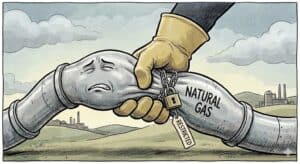 Williams’ Transco Southeast Supply Enhancement Project (SESE) is a 55-mile, 42-inch-wide pipeline that will run through Pittsylvania County, Virginia, and Rockingham, Guilford, Forsyth, and Davidson counties in North Carolina. Construction for SESE started March 2, 2026, according to FERC filings. Transco (Williams) received its final federal authorization and a Notice to Proceed, and crews mobilized in early spring. Initial activities have included tree felling, installation of acoustic barriers, and test drilling in preparation for blasting. Antis finally gave up trying to block construction of SESE in June (see
  Yesterday, pipeline giant Williams announced the appointment of Lloyd W. “Billy” Helms Jr. and Robb E. Turner as its newest board members, expanding its board from 10 to 12 members. Helms brings more than 40 years of oil and gas experience, including senior leadership roles at Utica driller EOG Resources, where he served as president and chief operating officer. Turner brings 35-plus years of experience in energy operations, finance, and investing, including co-founding ArcLight Capital Partners and serving as chair of The Madava Group and Revenant Energy. The question is, how do these two additions connect to and impact Williams’ Marcellus/Utica operations?
  In February, MDN alerted you to yet another gas-fired power plant project that Williams (the pipeline giant) was adding to its roster. Williams entered the gas-fired power plant space (actually building and operating them) in April 2025 via a subsidiary called Will-Power (see
  The Federal Energy Regulatory Commission (FERC) isn’t letting any grass grow under its feet regarding the advancement of the Constitution Pipeline, a 125-mile greenfield pipeline from the Marcellus gas fields of Susquehanna County, PA, to Schoharie County, NY, to deliver Marcellus gas into New York State and New England. FERC is actively reviewing two requests related to reviving the project (see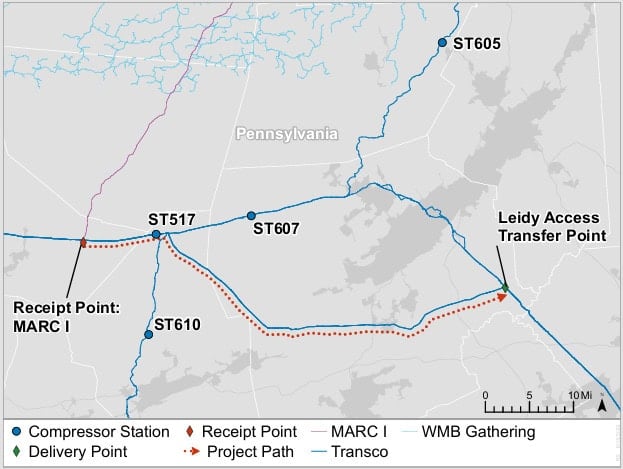
 Williams’ Transco Southeast Supply Enhancement Project (SESE) is a 55-mile, 42-inch-wide pipeline that will run through Pittsylvania County, Virginia, and Rockingham, Guilford, Forsyth, and Davidson counties in North Carolina. It will provide natural gas to Duke Energy customers. Big Green sued to overturn a federal water quality permit issued by the U.S. Army Corps of Engineers. Big Green wanted the court to block construction until the full case could be heard. In May, a three-judge panel from the U.S. Court of Appeals for the Fourth Circuit (4th Circuit) rejected arguments Big Green put forward that claimed the Army Corps’ decision was “arbitrary and capricious” and refused to block construction (see
  Yesterday, President Trump accused New York Governor Kathy Hochul of reneging on her pledge to allow the 125-mile Constitution Pipeline project to be built in the Empire State. The project was canceled in 2020 after New York repeatedly rejected the necessary permits. President Trump brokered a deal with New York Governor Kathy Hochul to resurrect the project last year (see
 It seems that not all of the judges who sit on the U.S. Court of Appeals for the Fourth Circuit (4th Circuit) are clowns, the way the three judges who oversee cases dealing with the Mountain Valley Pipeline (MVP) Southgate project are (see
  In April, MDN reported that anti-fossil fuel fanatics had not yet given up on trying to block construction of the Williams Northeast Supply Enhancement (NESE) pipeline, a $1 billion+ project designed to increase Transco pipeline capacity and flows of Marcellus gas heading into New York City and other northeastern markets. Even though there was an official groundbreaking ceremony at Brooklyn’s Floyd Bennett Field in New York City in April, antis are still doing their best to block this project. They pinned one of their last hopes on a relatively obscure state agency in New Jersey, pressuring it to refuse to issue a license for the project (see