
Energy Services | Equitrans/EQT Midstream | Industrywide Issues | Pipelines | Regulation | Statewide VA | Statewide WV | Virginia | West Virginia
Forest Service Issues Final EIS to Mountain Valley Pipe 3rd Time
 Yesterday the 303-mile, 94% complete Mountain Valley Pipeline project received a Final Supplemental Environmental Impact Statement from the U.S. Forest Service, clearing the way for the pipeline to get built through a piddly 3.5 miles of Jefferson National Forest. Ring the bells! Dance for joy! Blow the party noisemakers, right? Wrong. This is the third time this same permit has been issued. Nobody was impressed. We only found a single news story about it. The stock of Equitrans, the builder, moved up one penny on the news. Why the muted response? Because everyone has seen this movie before.
Read More “Forest Service Issues Final EIS to Mountain Valley Pipe 3rd Time”
 For a moment, we thought we were reading an article in
  There is an ongoing issue with cleanup at a Chesapeake Energy well pad in Bradford County, PA. The Pennsylvania Dept. of Environmental Protection (DEP) showed up at the site to conduct an inspection earlier this year, in January. The DEP inspector found “multiple pools and puddles on the site contaminated with drilling wastewater and possible fracking chemical fluids.” The DEP issued a notice of violation (NOV) for failing to prevent contamination from being discharged on the site. Chesapeake promised to get it cleaned up. Yet, in multiple repeat inspections since then, inspectors have continued to find contaminated fluids on the ground.
 Last time we visited this topic, West Virginia Senate Bill (SB) 188, aimed at making WV’s gas-fired power generation more competitive with its neighbors in Pennsylvania and Ohio, had passed the Senate and was on a fast track for a vote in the House (see
  Virginia Natural Gas (VNG) continues to ramp up the amount of “responsible” gas it purchases to resell to its customers. VNG provides clean, safe, reliable, and affordable natural gas service to more than 300,000 residential, commercial, and industrial customers in southeast Virginia. In October 2019, MDN told you that VNG cut a deal with Southwestern Energy to purchase enough supply of responsible gas for 20% of VNG’s customers (see
  This is a story that may (or may not) be directly tied to Marcellus/Utica gas, but it makes a larger point nonetheless. Peninsula Pipeline Company (PPC), a subsidiary of Chesapeake Utilities Corporation, just completed an 11.3-mile pipeline expansion that will bring additional natural gas capacity to the Vero Beach, Florida, area. The project, which cost approximately $10.5 million to build, interconnects with existing PPC infrastructure in Sebastian and extends to Vero Beach. The new facilities will transport natural gas to five new delivery points, extending service to the communities of Wabasso, Wabasso Beach, Indian River Shores, North Hutchinson Island, and Harbor Isles.
 If leftists can redefine what is and what is not “waters of the United States” (WOTUS), they can pretty much control you and what you can and can’t do with your own private property. WOTUS, according to the Bidenistas, is pretty much anything down to mud puddles, as they proposed earlier this year (see
  The U.S. Energy Information Administration (EIA) tracks all things energy and energy-related in the U.S. and around the world. Although the EIA has been somewhat ruined by Bidenista influences, it remains our favorite government agency. The agency’s data and predictions are (mostly) reliable. Yesterday the EIA published new data that shows overall U.S. natural gas consumption in January and February of this year has hit its lowest consumption since 2017 (for January) and 2018 (for February). Why the plunge in natgas usage here at home?
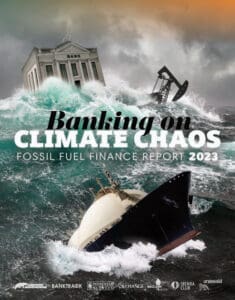 This one has us laughing. A group of some of the hardest of the hardcore left in the “environmental” movement–including the Rainforest Action Network, BankTrack, Indigenous Environmental Network, Oil Change International, Reclaim Finance, the Sierra Club, and Urgewald–join forces to publish a report called “Banking on Climate Chaos” (full copy below). It is the 14th annual such report, detailing the amount of money invested in fossil energy companies by the world’s 60 largest banks. We thought we might flip the script and promote Big Banks doing the right thing (investing in fossil energy) by using the left’s work against them. Cool, right?
 New York politicians are so consumed with hatred of fossil fuels they are forcing residents to pay an average of $28,000 to convert their homes away from heating and cooking with natural gas, propane, and fuel oil (see
  Yesterday the U.S. Environmental Protection Agency (EPA) announced new proposed federal vehicle emissions standards that will force Americans to give up driving gasoline and diesel-powered vehicles and instead switch to electric vehicles, which are much more expensive to buy. The Biden EPA said the new standards will “accelerate the ongoing transition to a clean vehicles future and tackle the climate crisis.” Which is total B.S. The Bidenistas intentionally use inflammatory language, calling EVs “clean” vehicles, as opposed to fossil energy vehicles which, by inference, are “dirty.” They also claim the new standards will tackle the “climate crisis”–perpetuating an unproven theory that mankind is causing the earth to catastrophically warm.
 Yesterday MDN told you about the recently-filed application by the State of Pennsylvania to attract one of 6 to 10 so-called hydrogen hubs to the Keystone State (see
 In January, Ohio House Bill (HB) 507 became law with the signature of Gov. Mike DeWine (see
  Once a month, U.S. Energy Information Administration (EIA) analysts issue the agency’s Short-Term Energy Outlook (STEO), their best guess about where energy prices and production will go in the next 12 months. Yesterday’s latest edition once again revises down the price EIA believes the Henry Hub will average for all of 2023. Last month’s STEO predicted an annual average of $3.02/MMBtu in 2023. This month’s STEO says the HH will average $2.94. Let’s add some color around that prediction.