
EPA Proposes Changes to Limit States’ Ability to Block Pipelines
 Last week, the EPA proposed a new rule (copy below) to restrict states’ and Native American tribes’ ability to block major projects, such as pipelines and data centers, by abusing the Clean Water Act. By narrowing Section 401 reviews to focus solely on direct water pollution, the Trump administration seeks to accelerate fossil fuel infrastructure and AI development through increased regulatory predictability. This move reverses Biden-era policies that allowed for never-ending environmental evaluations. While administration officials argue these constraints prevent unnecessary delays, environmental radicals contend the proposal undermines local authority to protect drinking water and ecosystems. A final rule is expected this spring. Read More “EPA Proposes Changes to Limit States’ Ability to Block Pipelines”
 The U.S. Energy Information Administration (EIA) predicts U.S. electricity generation will reach 4,423 billion kilowatthours by 2027, driven by steady annual growth. That’s up 3.7% from 4,260 billion KWH in 2025. While natural gas remains the primary power source, its market share is slipping alongside coal, which is declining 5% annually due to plant retirements. Dispatchable (on-demand) sources of electricity generation (natural gas, coal, and nuclear) accounted for 75% of total generation in 2025, but EIA expects their share to fall to about 72% in 2027. EIA expects the combined share of generation from solar and wind power (unreliable renewables) to rise from about 18% in 2025 to about 21% in 2027. Renewables are still minuscule compared to dispatchable natural gas and coal—which is as it should be if you care anything about energy security.
  The rumor mill is in overdrive today with news that Coterra Energy is in serious talks with Devon Energy exploring a potential merger “that would be among the biggest oil and gas deals in years.” While the primary driver of this deal is gaining massive scale in the Permian Basin, Coterra’s substantial Marcellus Shale assets in northeastern Pennsylvania (NEPA) are a major point of speculation for analysts and investors. It appears possible (likely?) that a combined company would sell off the PA Marcellus assets.
  Sorry, Field of Dreams, but if you build it, they don’t necessarily come. That’s the hard lesson for one of the biggest boondoggles of the Biden years—seven hydrogen hub projects (from 33 finalists) promised a collective $7 billion in federal funding (see
  JobsOhio, a private, nonprofit corporation that works on behalf of the state to drive job creation and new capital investment in Ohio by attracting business, contracts its economic research to Cleveland State University (CSU) to keep tabs on the Utica Shale industry. JobsOhio released the latest CSU updated report earlier this week (full copy below), showing that more than $114.6 billion has been invested in Ohio across natural gas, natural gas liquids, and petrochemical supply chain industries since 2011. Ohio’s shale energy sector drew approximately $3.5 billion in fresh capital between July and December 2024.
  Duke Energy is considering constructing a 1,360-megawatt natural gas power plant on 1,600 acres in Davidson County, North Carolina. This is the first we’ve heard of this project, and judging by our research, the first anyone has heard of it. Prior to this, we were aware of two Duke gas-fired projects in N.C.—one in Person County and one in Catawba County (see
  At the end of November, Talen Energy, a leading energy producer in the U.S. (owns and operates approximately 13.1 gigawatts (GW) of power infrastructure) completed the acquisition of two gas-fired power plants for $3.8 billion: one located near Wilkes-Barre in northeastern Pennsylvania, and the other in Guernsey County, in eastern Ohio (see
  The U.S. Energy Information Administration (EIA) issued its latest monthly Short-Term Energy Outlook (STEO) on Tuesday. The STEO is the agency’s monthly best estimate of where energy prices and production will head over the next 12 months. The EIA published its first energy-sector forecasts through 2027. For natural gas, the EIA predicts the U.S. benchmark Henry Hub spot price to decrease about 2% to just under $3.50 per million British thermal units (MMBtu) in 2026, then rise sharply in 2027 to just under $4.60/MMBtu. The reason for the sharp increase next year? Growth in demand—led by expanding LNG exports and more natural gas consumption in the electric power sector—will outpace production growth.
  One of the significant stories of 2024 in the Ohio Utica was about Austin Master Services (AMS), a radiological waste management solutions company in Martins Ferry, Ohio, that processes and transports fracking waste for disposal. AMS ran into trouble when it ran out of money. The Martins Ferry facility in Belmont County, where waste is temporarily stored, had vastly exceeded its permitted limit of 600 tons (storing over 10,000 tons), resulting in a permit violation. The Ohio Attorney General’s office filed a lawsuit against the company in March 2024 to compel compliance and require the company to clean up the facility. After the company didn’t perform, the Ohio Department of Natural Resources (ODNR) stepped in to handle the cleanup (see
  In December, MDN brought you the news that Antero Resources, the country’s fifth-largest natural gas producer and largest producer in West Virginia, had cut a deal to buy WV driller and midstreamer HG Energy II for a combined (upstream & midstream) $3.9 billion (see
  In August, the parents of four children under the age of 18 (from three families) filed a lawsuit on their kids’ behalf against EQT subsidiaries EQT Production Company and EQT XL Midstream Operating, claiming that emissions from a nearby compressor station and nearby shale wells operated by EQT have led to severe health-related problems for the kids (see
  Ohio State Representatives Gary Click and Kellie Deeter have introduced legislation to establish a 13-member bipartisan Ohio Data Center Study Commission. This initiative responds to the rapid expansion of approximately 200 data centers across the state, which has sparked community concerns regarding agricultural land use, noise pollution, water consumption, and energy demands. The commission aims to provide a platform for public dialogue and develop a comprehensive report to guide future development. By evaluating these impacts, lawmakers hope to encourage smart, balanced growth that potentially prioritizes brownfield redevelopment over rural green spaces while ensuring long-term resource stability.
  MDN was among the first to tell readers that so-called environmental groups were quickly morphing from anti-fracking to anti-data center. Over the past three months, we’ve observed in various posts how opposition to data centers (from the same people who oppose fracking and shale energy) has gone from local and regional anti groups (see
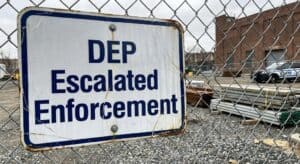 On August 17, Eureka Resources’ Williamsport Second Street facility (one of the three wastewater treatment plants previously operated by Eureka) leaked some of its stored untreated frack wastewater, which ended up in the nearby Susquehanna River via a storm drain (see
  In November of last year, both New York and New Jersey issued the required federal water permits for the Williams Transco Northeast Supply Enhancement (NESE) natural gas pipeline project (see