
Through the Roof: Winter Storm, Bitter Cold Drive NYMEX to $6.80
 Yesterday, the natural gas price rocketship continued its flight into the stratosphere. U.S. natural gas futures soared Monday, with the front-month contract surging to a three-year high, closing at $6.80/MMBtu, as winter storm Fern swept across the country, driving up heating demand and threatening supply. Spot prices are literally through the roof, spiking to levels we’ve not seen in years. The deep freeze continues through the eastern half of the country at least until Feb. 9, according to NOAA’s temperature outlook. However, there are signs that a “sharp collapse” may soon unfold. Read More “Through the Roof: Winter Storm, Bitter Cold Drive NYMEX to $6.80”
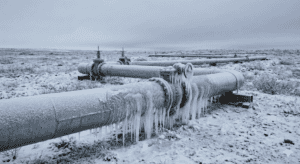 We’ve recently begun to highlight flow restrictions along pipelines that carry Marcellus/Utica molecules. When flows slow or stop (can’t reach other markets), the price typically falls because supply exceeds demand. But sometimes, the opposite happens. If pipelines are restricted due to outages and freeze-offs (as is happening right now with Winter Storm Fern), the supply of natural gas is diminished, leaving insufficient supply to meet increased demand due to the cold weather. When that happens, spot prices for natural gas soar. Wood Mackenzie reported that natural gas freeze-offs across the country reached a single-day high of 17 billion cubic feet (Bcf) on January 25th, approaching the record 18 Bcf set during Winter Storm Uri, as an intense Arctic weather system sweeps across the United States. What about the situation in the M-U?
  The Intermediate Court of Appeals of West Virginia vacated an order combining 58 oil and gas tracts into a Harrison County drilling unit, ruling that the state’s Oil and Gas Conservation Commission failed to provide sufficient findings of fact. The case involves the “JOsborn 213 Unit” operated by Arsenal Resources, which mineral rights owners claim failed to negotiate in good faith as required by law. The court found the Commission ignored conflicting testimony and provided only summary conclusions rather than a detailed analysis. Consequently, the case was remanded for further proceedings, requiring the Commission to properly evaluate all evidence and issue a new order.
  New England’s Democrat-led energy policies have failed spectacularly, leaving the region as an “energy island” during peak winter demand. Despite ambitious “net-zero” goals, a recent snowstorm forced the power grid to rely on oil for 40% of its electricity because renewables like wind and solar contributed less than 2%. New England policymakers like Govs. Maura Healey of Massachusetts and Janet Mills of Maine have created artificial scarcity and price spikes by blocking natural gas pipeline expansions. They insist on unreliable renewables. When a storm like Winter Storm Fern hits, it forces New England to rely on carbon-intensive oil and increases the risk of blackouts. You can’t fix stupid.
  Last May, NRG Energy announced a deal to acquire LS Power’s portfolio of natural-gas power plants in a deal valued at roughly $12 billion, including debt, that will expand NRG’s footprint in Texas and along the East Coast (see
  An Arctic blast in the U.S. has sent natural gas prices soaring to their highest levels since 2022, fueled by surging heating demand and production “freeze-offs” in major shale basins. As the world’s leading LNG exporter, supply disruptions in the U.S. now trigger global price hikes, particularly in Europe, which relies heavily on American gas following the loss of Russian pipeline flows. While increased global liquefaction capacity and floating inventories help manage volatility in LNG prices, the market has become structurally more interconnected. Consequently, when the U.S. freezes, the global LNG market catches a cold.
  Last April, Knighthead Capital Management, Homer City Redevelopment (HCR), and Kiewit Power Constructors Co. announced a plan to convert the former Homer City Generating Station, previously the largest coal-fired power plant in Pennsylvania (Indiana County, 50 miles east of Pittsburgh) into a more than 3,200-acre natural gas-powered data center campus, designed to meet the growing demand for artificial intelligence (AI) and high-performance computing (see
  The Marcellus/Utica rig count gained 1 rig seven weeks ago in the Ohio Utica, bringing the regional total to 39 rigs. For the past seven reports in a row, the M-U has maintained that count—the most rigs it has operated in more than a year. Pennsylvania has held at 18 active rigs for ten consecutive weeks. Ohio has operated 14 rigs for seven straight weeks (its highest in over a year). And West Virginia maintained 7 rigs, which it has operated since May 30, 2025. There were 24 rigs targeting the Marcellus and 15 targeting the Utica last week. The national count regained 1 rig last week, bringing the total back up to 544 active rigs.
 Last November, Accomack County, Virginia, secured a $6.5 million state grant to expand piped natural gas to the Eastern Shore, a move aimed at stabilizing the local economy (see
 Last Thursday, the Trump administration announced it is restructuring or terminating approximately $84 billion in clean energy projects (boondoggles) initiated during the Biden era, reflecting a sharp pivot toward “energy dominance” through fossil fuels and nuclear power. Rebranded as the Office of Energy Dominance Financing (EDF), the agency has canceled $30 billion in “green” loans, including major wind and solar transmission projects, while revising another $53 billion in loans. Under Energy Secretary Chris Wright, the office—which holds $290 billion in lending power—will prioritize coal, oil, and gas over renewables, marking a significant reversal of previous climate-focused infrastructure investments.
  Enverus
 Last Friday, MDN reported that the rumor mill was in overdrive with chatter that Devon Energy and Coterra Energy are exploring a potential merger “that would be among the biggest oil and gas deals in years” (see
  As we predicted may happen in a post yesterday, the NYMEX “front month” natural gas futures price closed above $5 yesterday (see