
Rover Again Asks FERC for OK to Restart Tuscarawas Drilling
 On Jan. 24, the Federal Energy Regulatory Commission (FERC) sent a letter to Rover Pipeline stopping drilling at the Tuscarawas River site, which had only restarted in December (see FERC Stops Rover Drilling Near River After 200K Gal Mud Disappears). In a strongly worded letter dated Sunday, Jan. 28, Rover told FERC they are “frustrated by the inaccurate central premise underlying the letter received from” FERC shutting down drilling at that location (see Rover “Frustrated” with FERC Order to Stop Drilling at Tuscarawas). Some 99% of all construction work is now complete for Rover Pipeline. There’s only a little more to do to finish things up, including installation of a second Rover Pipeline (next to the first) underneath the Tuscarawas River. Rover has “lost” 200,000 gallons of drilling mud down the hole in drilling for the second pipe. However, the “lost” mud has not come back to the surface. Mud disappearing–and staying down the hole–when drilling for pipelines is not uncommon. Yet FERC will not lift the stop work order. On Friday, FERC sent a letter to Rover saying Rover must provide information on three different scenarios before work can resume: (1) how Rover plans to complete drilling at the current location without losing any more mud, (2) change locations and run the second pipe under another part of the Tuscarawas River, or (3) forget about drilling and installing a second pipe altogether, and stick with just a single pipe already in place now. FERC’s letter brought a swift response. On Sunday, Rover provided a mountain of evidence to say the current plan of drilling under the river at the existing location is the right plan. Rover went one step further, asking FERC to allow them to begin drilling again by yesterday (Monday) afternoon at 3pm. To the best of our knowledge, that did not happen…
Read More “Rover Again Asks FERC for OK to Restart Tuscarawas Drilling”

 PTT Global Chemical, based in Thailand, has snagged a major/important new partner in its project to build a $6 billion ethane cracker complex in Belmont County, Ohio. That partner is Daelim Chemical, a subsidiary of Daelim Industrial, which is one of Asia’s top engineering/construction firms (and one of the largest companies in South Korea). The addition of Daelim is yet another positive sign that PTT will, at some point this year, pull the trigger and make a “final investment decision” (FID) to move forward with the project. PTT disappointed when they didn’t follow through with an FID in 2017, as they had promised. To be fair, these projects are big and a misstep can bankrupt a company. The Belmont cracker will be the largest single investment made by PTT since becoming a company–so we understand their reticence. Still, when you promise, you promise. Just last month, in December 2017, PTT delivered the disappointing news that there would be no FID announcement in 2017, but that there would be a big announcement “in early 2018” (see
  In December 2015 Marcellus/Utica driller Magnum Hunter Resources filed for bankruptcy (see
  On Tuesday, the Ohio State Supreme Court rejected a case in which landowners who were made part of a “unitization order” (i.e. forced pooling) had objected claiming their property rights were stripped away without due process. In legal terms, the landowners claimed it was a “taking” of their property without just compensation. The Supreme Court rejected the case because, they said, there were other legal means the landowners could have tried first (a lower court) before appealing the case direct to the Supremes using something called a mandamus action. In essence, the Supremes said, “Nice try, but you need to jump through the proper hoops first.” Ultimately the Supremes did not rule on the Constitutionality of the claim itself because the case had gotten to them via the wrong path. We’re guessing the landowners will now go back to square one and use the path laid out by the Supremes. Here’s the low down on the rejection by the Supremes, from the legal beagles at the Vorys law firm…
 On Monday Gulfport Energy (drills mainly in the Utica but also in Oklahoma and Louisiana) issued it’s fourth quarter and full year 2017 results, along with a preview of what they expect to do in 2018. Gulfport has drilled the second highest number of Utica wells in Ohio, second only to Chesapeake Energy. Gulfport’s production in 4Q17 averaged 1.26 billion cubic feet per day equivalent, up 5% from 3Q17 and up a whopping 61% from 4Q16. Gulfport brought 15 Utica wells online in 4Q17. What’s ahead in 2018? The company will spend $770-$835 million in 2018. Astonishingly, Gulfport will not borrow to spend that kind of cash! Their spending will be 100% funded by the cash flow they generate from selling gas and oil and NGLs. Gulfport figures production will average somewhere around 15-19% more in 2018 than in 2017. Using an “average of 2.5 rigs” (how does that work?), Gulfport will drill 36-40 new Utica wells this year with an average lateral length of 11,200 feet. Gulfport plans to bring online 33-37 Utica wells with an average lateral length of 8,000 feet. Here’s the update of what happened in 2017, and what to expect in 2018, for one of the most important players in the Ohio Utica…
 In a strongly worded letter dated Sunday, Rover Pipeline tells the Federal Energy Regulatory Commission (FERC) they are “frustrated by the inaccurate central premise underlying the letter received from” FERC shutting down drilling at the Tuscarawas River location. On Jan. 24 FERC sent a letter to Rover stopping drilling at Tuscarawas, which had only restarted in December (see
  Pennsylvania state officials estimate there are as many as 200,000 abandoned (i.e. “orphan”) oil and gas wells in the state–the vast majority of them conventional wells drilled over 50 years ago. Most of them are not mapped or known. Some of them are hazards for shale drillers who stumble across them when drilling new wells. If you drill horizontally and clip an old/abandoned well, it becomes like an elevator pumping fluids and gas to the surface. Not good. Everyone is committed to finding and marking and capping these old wells–the question is, how do you pay for it? In PA, it’s an ongoing hot potato of who will pay (see
 In December MDN told you about a small-but-growing brewery in Canton, OH started by shale co-workers who had “a passion for easy drinking brews” (see
  In early January, the Pennsylvania Dept. of Environmental Protection (DEP) told Sunoco Logistics Partners to suspend all work on the $2.5 billion Mariner East 2 (ME2) NGL pipline–from one side of the state to the other (see
  Yesterday MDN brought you the news that the Federal Energy Regulatory Commission (FERC) has slapped a stop work order on underground horizontal direction drilling (HDD) for Rover Pipeline at the site crossing under the Tuscarawas River (see
  The Ohio EPA continues its yapping insistence that the Federal Energy Regulatory Commission (FERC) *permanently* shut down underground horizontal directional drilling (HDD) work being done by Rover Pipeline near the Tuscarawas River over concerns that nontoxic (totally safe) drilling mud keeps disappearing down the borehole. FERC listened, sort of. In an order dated yesterday, FERC told Rover to *temporarily* stop HDD work at Tuscarawas until Rover can outline a plan for moving forward that FERC has confidence will address concerns over the disappearing drilling mud. When mud used for drilling holes comes out on the surface any place other than the hole from which it went down, it’s called an “inadvertent return.” We call it a leak. However, if that same mud never comes back to the surface, as sometimes happens, it’s fine. Except when it’s a LOT of mud, as is the case in drilling near Tuscarawas where a cumulative 200,000 gallons of it have disappeared down hole, not (so far) coming back out. Sooner or later it seems likely that at least some of that mud will come back to the surface–somewhere. That’s the concern that no doubt prompted FERC to send Rover a letter yesterday telling them to (for now) stop HDD work at Tuscarawas…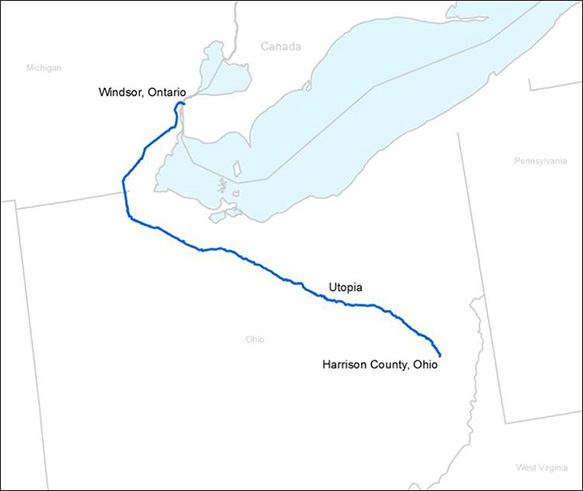

 The Ohio Environmental Protection Agency (OEPA) continues to hound the Federal Energy Regulatory Commission (FERC) about a potential spill of drilling mud by Rover Pipeline near the Tuscarawas River. Last week we told you that OEPA, which has ZERO regulatory oversight of the Rover Pipeline project, had been told (by informants) that when Rover restarted underground horizontal directional drilling (HDD) work at the Tuscarawas site, some 146,000 gallons of drilling mud went down the hole but never came back out (see