 Here we go again. A new “study” published today by Harvard University researchers supposedly indicates that Pennsylvania, Ohio, and West Virginia are loaded with underground natural gas storage sites that may leak like the Aliso Canyon debacle in California. The new study published in the journal Environmental Research Letters, titled “A national assessment of underground natural gas storage: identifying wells with designs likely vulnerable to a single-point-of-failure” (full copy below), says there are 14,138 active underground storage (UGS) wells in 317 locations/facilities in the U.S. The study identifies 2,715 active UGS wells across 160 facilities that, like the failed well at Aliso Canyon, were not originally designed for gas storage. (Gasp) Even worse: The majority (88%) of these repurposed wells are located in OH, MI, PA, NY, and WV. (Double gasp) Here’s the thing: Aliso Canyon was one facility that had a catastrophic failure (a failure which, by the way, hurt no one–it just released some extra methane into the air). While it may be interesting and useful to know (for accident prevention) that there are other facilities constructed years ago, like Aliso Canyon, that were later repurposed to be used for underground storage–each and every location is different, with unique characteristics. No two storage sites are the same geologically. It does not follow, as implied in the report, that because Aliso Canyon leaked, that these other “similar” facilities will eventually fail and leak. However, our main objection to this research–and why we call it fake research–is that the researchers never bothered to go into the field and take air samples to see if there is any ACTUAL leaking going on at any of these thousands of other sites! Fake mainstream news sources are just now picking up on the story and running it. Nothing sells newspapers (or grabs online eyeballs) like fear. And hey, it serves the mainstream narrative that fossil fuels are the ultimate evil. Here’s the kicker: This latest “research” was funded, in large part, by the virulent anti-fossil fuel Heinz Foundation and The Nature Conservancy. That tells you all you need to know about this latest bought-and-paid-for “research” study with a Harvard label slapped on it…
Read More “Fake Harvard Study Generates Fake News re NatGas Storage in M-U”

 Major General James A. “Spider” Marks is the former Commanding General, U.S. Army Intelligence Center, and was the senior intelligence officer for the 2003 liberation of Iraq. Since retiring from the military, General Marks has led many business ventures in education, energy, and research, and served as the President and CEO of Global Linguist Solutions, a private company that provided linguistics services to the U.S. military in Iraq and was the largest employer of native Iraqis. He is an on-air national security, military, and intelligence contributor to CNN and an adjunct professor at Georgetown University. Spider Marks doesn’t suffer fools gladly. In an op-ed written for the Harrisburg Patriot-News, Marks takes aim at so-called protesters (paid activists) who ran up a $40 million tab of destruction in North Dakota (paid for by taxpayers) with their so-called protest camp there, and who now are attempting to invade Pennsylvania and recreate the same chaos. Marks calls a spade a spade in his deft column…
  On Wednesday, the Pennsylvania Senate Majority Policy Committee and Environmental Resources and Energy Committee held a joint hearing to examine the economic benefits natural gas production has brought the Keystone State. MDN friend David Spigelmyer, president of the Marcellus Shale Coalition, was present and let legislators know that PA has become the #2 natural gas producer in the country, and that remarkable feat has brought PA billions of dollars in investment. The investment in new or converted natural gas electric plants alone has reached $10 billion! Thad Hill of Calpine Corporation (nation’s largest generator of electricity from natural gas) also spoke. While the adults were inside talking about serious issues, children in adult bodies were outside misbehaving, as they typically do. Radicals (paid protesters) from Earthworks held a protest rally on the steps of the Capitol where they held up big, black balloons. Yeah, we have no idea what makes them tick either…
  In October 2016, MDN reported that electric company FirstEnergy had begun construction of a new electric substation in Washington County, PA to provide electricity to “support two natural gas processing facilities being developed in the area” (see
  When (not if) the Atlantic Sunrise Pipeline begins construction this summer in Lancaster County, PA, area businesses plan to take advantage of the economic boon that will arrive along with some 250 workers who will build it. Atlantic Sunrise is a $3 billion, 198-mile pipeline project running through 10 Pennsylvania counties to connect Marcellus Shale natural gas from northeastern PA with the Williams’ Transco pipeline in southern Lancaster County. Construction in Lancaster County will last approximately nine months and is projected to inject $75 million in the local economy. What kinds of businesses will benefit? Some include “housing, rental equipment, food sources, welding supplies, waste disposal, construction material, security, fuel, water trucks, concrete services, buses and transportation, auto repair, laundry services, drain tile work and hauling services.” And that’s only some of the services needed. Campgrounds are another business expected to experience a big uptick in demand. According to Williams spokesman Christopher Stockton, “We are encouraging all our construction contractors to utilize local service providers as much as possible.” That’s good news for local businesses. Here’s how local businesses in Lancaster County (and elsewhere) can sign up to get their piece of the Atlantic Sunrise action…
  Here we go again. A new “study” published today by Harvard University researchers supposedly indicates that Pennsylvania, Ohio, and West Virginia are loaded with underground natural gas storage sites that may leak like the Aliso Canyon debacle in California. The new study published in the journal Environmental Research Letters, titled “A national assessment of underground natural gas storage: identifying wells with designs likely vulnerable to a single-point-of-failure” (full copy below), says there are 14,138 active underground storage (UGS) wells in 317 locations/facilities in the U.S. The study identifies 2,715 active UGS wells across 160 facilities that, like the failed well at Aliso Canyon, were not originally designed for gas storage. (Gasp) Even worse: The majority (88%) of these repurposed wells are located in OH, MI, PA, NY, and WV. (Double gasp) Here’s the thing: Aliso Canyon was one facility that had a catastrophic failure (a failure which, by the way, hurt no one–it just released some extra methane into the air). While it may be interesting and useful to know (for accident prevention) that there are other facilities constructed years ago, like Aliso Canyon, that were later repurposed to be used for underground storage–each and every location is different, with unique characteristics. No two storage sites are the same geologically. It does not follow, as implied in the report, that because Aliso Canyon leaked, that these other “similar” facilities will eventually fail and leak. However, our main objection to this research–and why we call it fake research–is that the researchers never bothered to go into the field and take air samples to see if there is any ACTUAL leaking going on at any of these thousands of other sites! Fake mainstream news sources are just now picking up on the story and running it. Nothing sells newspapers (or grabs online eyeballs) like fear. And hey, it serves the mainstream narrative that fossil fuels are the ultimate evil. Here’s the kicker: This latest “research” was funded, in large part, by the virulent anti-fossil fuel Heinz Foundation and The Nature Conservancy. That tells you all you need to know about this latest bought-and-paid-for “research” study with a Harvard label slapped on it…
 We’ve written a number of times about DUCs–otherwise known as drilled-but-uncompleted wells. When a shale driller drills a new well, it doesn’t always happen all in one go. You first drill the hole down, and then curve the drillbit and drill the horizontal portion–called the lateral. Then you pull the drill bit out of the ground and (at some point) the fracking process begins. Fracking doesn’t always happen right away. Sometimes wells are initially drilled but not fracked–essentially putting them in inventory to be fracked later. Those wells are DUCs. Since a lot of the cost to develop the well has already been spent in preparing the site and drilling the hole, to come along at a later time and frack is much “cheaper” if you (as a driller) want to bump up your production. Price of gas low right now? Drill the initial hole, mothball the project, and come back later when the price of gas goes up and finish it off and hook it up to production. The DUC inventory is a closely watched number. Analysts at Platts have been watching and have noticed something interesting. In most shale plays–particularly oil plays like the Permian in Texas–drillers are sinking initial holes as fast as they can and the DUC inventory numbers are going up up up. The Permian has seen 476 new DUCs added since January! But in the Marcellus, only 3 new DUCs have been added since last December. Which is “puzzling.” What does it mean?…
 No more “acting” for Pennsylvania’s Secretary of the Dept. of Environmental Protection (DEP). In May 2016, DEP Secretary John Quigley was fired for using a PRIVATE email account to collude with his Big Green friends to try and bully PA’s legislators into supporting his onerous proposed regulations (see
  In December 2016, the Pennsylvania Dept. of Environmental Protection (DEP) unveiled new regulations to clamp down on methane emissions and other other air pollution that allegedly comes from shale drilling sites (see
  Believe it or not, Shell previously hired a third-party consultant to perform a traffic study in the area where Shell plans to build a $6 billion ethane cracker in Beaver County, PA. Based on the findings and recommendations of that study, Shell has begun to secure parking spots for construction workers that will descend on that location to build the plant–beginning later this year. One of the recommendations is to limit the number of parking spots to no more than 1,500 at any one location. Shell currently has three locations lined up and (mostly) ready to go, enough for 3,100 parking spots. At its peak, the project will employ something like 6,000 workers. So either Shell will line up more spots, or maybe workers will carpool…
 You know how money-grubbing, cheap, careless and in general no-good those Big Oil companies are, right? They only care about themselves. They seek to rape and pillage Mom Earth, keeping piles of gold in their coffers, killing humankind in the process. That’s the picture painted by anti-fossil fuel nuts. Here’s the real picture: In 2016, between employees and the corporation, Exxon Mobil donated more than $50 million to colleges and universities across the United States. That is a staggering number. Many of those colleges and universities were located in the Appalachian basin (Marcellus/Utica), including $2.7 million in PA, $800K in OH, $1.4 million in VA, $3.2 million in NY and $1.2 million in NJ. Just the opposite of the negative picture painted by the enemies of fossil fuels…
  In December 2015 MDN told you about EQT’s application to drill a single shale well in Jefferson Hills (Allegheny County), PA (see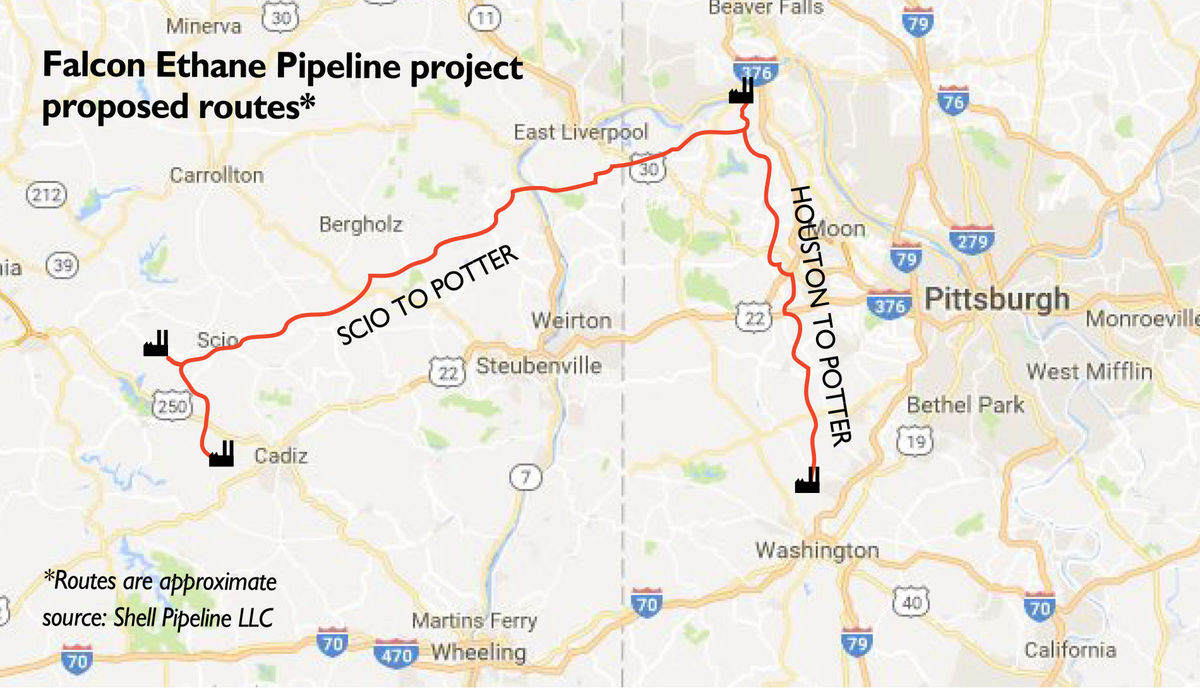
 As we have endlessly covered, Shell is in the midst of building a $6 billion ethane cracker plant in Beaver County, PA (see
  As MDN alerted you on May 10, President Trump has nominated two highly qualified individuals to serve on the Federal Energy Regulatory Commission–Neil Chatterjee and Rob Powelson (see