
Homer City Gas Plant Workforce Jumps to 1,800, Headed for 2,000
 The hill above Homer City now has more people working on it than the borough below has living in it. Homer City Generation dropped a Labor Day announcement on Friday: more than 1,800 direct-hire tradespeople and skilled contractors are on site building the 4.4-gigawatt (GW) gas-fired plant and data center campus rising from the bones of what was once Pennsylvania’s largest coal-fired power station. The borough of Homer City has roughly 1,800 residents. That’s a nice bit of symmetry, and it says more about what this project means to Indiana County than any press release paragraph could. Read More “Homer City Gas Plant Workforce Jumps to 1,800, Headed for 2,000”
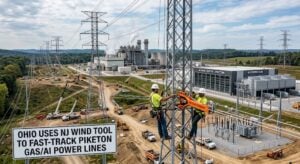 Ohio has asked PJM to dust off a rarely used piece of grid-planning machinery — a tool invented to string wires to offshore wind farms — and use it instead to speed up $4.2 billion in new high-voltage power lines to the 10-gigawatt SoftBank data center and gas plant complex at Piketon. We got our hands on the letter. It’s dated June 15, 2026, from PUCO Federal Energy Advocate Sarah J. Parrot to PJM President and CEO David E. Mills, and it’s been sitting quietly for nearly three months. It surfaced this week because PJM is briefing its Transmission Expansion Advisory Committee (TEAC) on the request today, Sept. 8, to use the “state agreement approach.”
  Six weeks after announcing it would sell up to 49% of its $1.2 billion Florida Energy Pathway pipeline (see
 NATIONAL: U.S. natural gas futures gain ahead of long weekend; Why oil majors don’t want to build new U.S. refineries; Elevated crack spreads and crude oil prices contribute to higher prices at the pump; White House to focus on what’s blocking energy permitting reform; Cash-strapped blue cities stand to collect billions from climate suits headed to Supreme Court; INTERNATIONAL: Oil holds, gains; Iran, Oman claim to close in on Hormuz deal; Analysts still expect USA-Iran deal by end-September; Formentera and Daly Waters Energy achieve first natural gas sales from the Beetaloo basin.
  The Marcellus/Utica region received 39 new drilling permits last week, August 24 – 30, up significantly from the 19 permits issued two weeks ago. Pennsylvania finally bounced back, issuing the vast majority of the new permits, with 25. Ohio issued 8 permits. And West Virginia issued 6 new permits. The drillers who received new permits were: Antero Resources, Campbell Oil & Gas, CNX Resources, EOG Resources, EQT, Expand Energy, Infinity Natural Resources, PennEnergy Resources, and Repsol Oil & Gas.
  It’s that time of year again. Cove Point LNG, the Berkshire Hathaway-operated export terminal on the Maryland shore of the Chesapeake Bay, is heading into its annual maintenance turnaround — and when the plant goes down, roughly 850 million cubic feet per day (MMcf/d) of demand for Marcellus/Utica gas simply evaporates. MDN has obtained the official notice from pipeline operator BHE GT&S laying out exactly what happens and when.
  Pennsylvania’s utility regulators just told the General Assembly what Marcellus drillers have been saying for two years: the electricity business is about to get very busy, and natural gas is going to be the one doing the heavy lifting. On Tuesday, September 1, the Pennsylvania Public Utility Commission (PUC) released its annual Electric Power Outlook for Pennsylvania, this one covering 2025 through 2030. The report is required by state law — the PUC has to collect demand forecasts from the state’s 11 electric distribution companies (EDCs, the utilities that run the poles and wires to your house) and hand a summary to the Legislature and the Governor every September. Usually it’s a snoozer. Not this year.


 Two weeks ago, we told you Net Power had pivoted to building plain old gas plants and would worry about the carbon dioxide later (see
  EQT is planning another pipeline — and this one is big. Through a brand-new subsidiary called Appalachian Transmission Gateway LLC (ATG), the Marcellus/Utica’s largest driller has opened bidding on the “POWER Pipeline,” a 42-inch, 50-mile line that would carry a full 1 billion cubic feet per day (Bcf/d) of gas from Greene County, Pennsylvania, west to the Clarington hub in Monroe County, Ohio. The open season quietly began Aug. 26 and runs through Oct. 26. We found no press release announcing it — the notice simply went up, and the trade press caught it a week later.
  Range Resources had a genuinely rotten 16 hours at its Laurel Hill B well pad in Cogan House Township, Lycoming County, last week. First, a gasket blew on a water filter pod and sent recycled frack water down the pad’s fill slope. Then, while the state inspector was standing there writing that one up, a water truck hauling more of the same stuff drove off the access road and rolled over. MDN obtained both DEP inspection reports, and they tell a more complete story than the headlines indicate.
  Yesterday, the Pennsylvania Independent Fiscal Office (IFO) released its quarterly Natural Gas Production Report covering April through June 2026 (full copy below). Three numbers, all pointing in the same direction: PA drillers spudded (started drilling) 89 new horizontal wells in 2Q26, down 16 wells (-15.2%) from the 105 spudded in 2Q25. Production volume was 1,925 billion cubic feet (Bcf), down 32 Bcf (-1.6%) from 1,957 Bcf in 2Q25 — the lowest quarterly volume since 4Q24. And the average Pennsylvania spot hub price was $2.11 per MMBtu, down 27 cents (-11.3%) from last year’s $2.38.