
Energy Transfer 1Q17 – Updates on Rover, Mariner East 2 Pipelines
 Last week Energy Transfer Partners (ETP), the main operating division of Energy Transfer Equity (ETE), released its first quarter 2017 financial and operating update. ETP is the company that built the Dakota Access Pipeline, which was finally completed after Obama was ejected from office–and is right now building the Rover Pipeline. Another division of ETE was, until last month, Sunoco Logistics Partners. In April Sunoco LP was merged into ETP (see Sunoco Logistics Partners Ceases to Exist as of Today). Sunoco LP, now ETP, is building the Mariner East 2 (ME2) pipeline project. So as part of last week’s update, we got mini-updates on two critically important projects for the Marcellus/Utica: Rover and ME2. The Rover chatter indicates all systems are go and they are on track to have the project completed and in-service as far as the Midwest Hub in July, and the rest of the way to Michigan in November. ME2 chatter contained an interesting question and response. An analyst’s question seems to indicate that ETP (the Sunoco Logistics part of it) is considering a joint venture arrangement for the ME2 pipeline project. President & CEO of Sunoco LP (not sure what his title is now) Mike Hennigan was quick to tamp down that speculation. He didn’t deny it, saying the company is having “conversations”–but he did say their focus right now is to finish the darned thing. Get it built…
Read More “Energy Transfer 1Q17 – Updates on Rover, Mariner East 2 Pipelines”
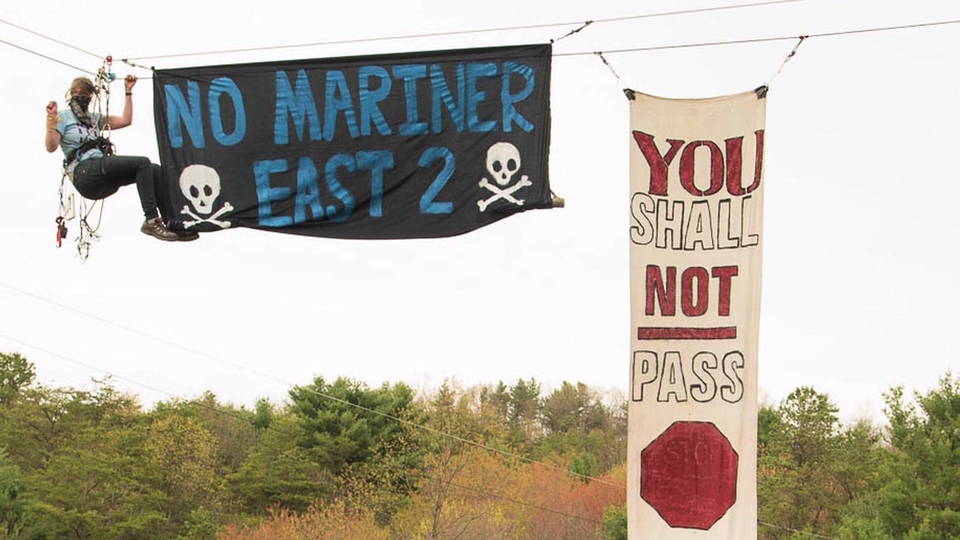 Elise Gerhart has been up a tree before. You may recall our story about Elise, daughter of a Huntingdon County, PA landowner, radicalized by Big Green groups (as evidenced by her association with well known protesters previously arrested), who took to a tree on her mom’s property in order to illegally stop crews working on tree clearing for the Mariner East 2 pipeline (see
  Events related (or of interest) to the Marcellus and Utica Shale, primarily pro-drilling events.
 The “best of the rest” – stories that caught MDN’s eye that you may be interested in reading. In today’s lineup: How Delaware Riverkeeper funders live (like kings); Tokyo Gas invests in U.S. shale player Castleton Resources; anti-pipeliners harming the environment they profess to protect; how much natgas comes from fracking?; Pruitt recuses himself from several lawsuits against EPA; Chesapeake – the good and the ugly; Russia suspends LPG exports to Ukraine – again; and more!
 Eclipse Resources, a Marcellus/Utica pure play driller headquartered in State College, PA that drills mostly in Ohio, has done it again. Yesterday as part of Eclipse’s first quarter 2017 update, the company announced it has broken its own record for drilling the longest land-based lateral well in the world by drilling a Utica well with a lateral that’s 19,300 feet long (3.7 miles). Incredible! You may recall Eclipse was the previous holder of that record with their Purple Hayes well (18,500 feet long), drilled one year ago (see
 This one has us spitting nails. We have reported, for months, about the activities of so-called protesters against Williams’ $3 billion Atlantic Sunrise Pipeline project. In particular, there is a group in Lancaster County, PA opposing the pipeline creatively called Lancaster Against Pipelines (LAP). Some of their members previously attended and participated in protests against the Dakota Access Pipeline in Standing Rock, ND–protests that turned violent and destroyed millions of dollars in equipment (see
 Chesapeake Energy released its first quarter 2017 update yesterday. Chesapeake, the second largest natural gas producer in the United States, has its fingers in a lot of shale pies. But two of the key pies is the Marcellus and Utica. What does yesterday’s update tell us about Chessy’s involvement in the northeast? Utica production was down in 1Q17, from 138,000 barrels of oil equivalent in 1Q16 to 96,000 barrels in 1Q17. However, Marcellus production was up, slightly, from 134,000 barrels in 1Q16 to 146,000 barrels in 1Q17. Total production, across all of Chesapeake’s wells, dropped by 21% in 1Q17 versus a year ago. However, perhaps the biggest news is that Chessy seems to be out of the woods financially. In 1Q16 Chesapeake lost $1.1 billion. In 1Q17, the made (profited, in the black) $75 million–more than a huge $1.2 billion swing in just one year’s time. Kudos to Chesapeake CEO Doug “the ax” Lawler. And we’re laughing at corporate raider Carl Ichan–the guy who hired Lawler. Icahn bailed by selling his Chesapeake stock late last year (see
  On Wednesday Rice Energy released its first quarter 2017 update, and yesterday the company held an earnings call to discuss it. On the down side, Rice continued to lose money during the quarter. Rice lost $21 million in 1Q16, and the loss widened to $35 million in 1Q17. But it seems to us the rest of the news they shared was pretty darned good. Production soared–from 61.4 billion cubic feet equivalent (Bcfe) in 1Q16, to 114.5 Bcfe in 1Q17–an 86% increase year over year (vast majority of that was natural gas). Rice’s lateral length now measures over 9,000 feet on average. In 1Q17 Rice added 2,000 Marcellus acres and 2,000 Utica acres to its portfolio, and the company says it’s on track to add a total of 15,000 acres this year. During 1Q17, Rice brought 15 new Marcellus wells online, and 10 new Utica wells. Rice CEO Dan Rice, on the earnings call, said (our words) while everyone is zigging, they like to zag. While everyone else is trying to buy up acreage all over Hades half acre, Rice prefers to concentrate and narrow its focus on truly prime locations that will produce stellar wells. Dan also said the company is in the catbird seat when it comes to new pipelines coming online over the next several years. We’ll explain. Below are excerpts from the earnings call, the 1Q17 update (with financials), and the latest PowerPoint slide deck…
 Yesterday midstream and utility giant Dominion issued its first quarter 2017 update. Along with the update Dominion held an earnings call. On that call we learned new information about both the Atlantic Coast Pipeline (ACP) project, Dominion’s Cove Point LNG export project, and a plethora of other projects, including natgas-fired power plants and more pipelines in the works. Dominion CEO Tom Farrell shared the exciting news that Cove Point is now 89% complete and will be “in service” later this year. As for Atlantic Coast Pipeline, Dominion has now purchased 80% of the materials they will need to build it. Farrell said the pipeline will be online in the second half of 2019. Another six pipeline projects are underway (at a cost of $700 million)–with five of the six due to be done THIS YEAR. Dominion is a happening company. Below are extracts from the earnings call, the 1Q17 update (with financials), and the newest PowerPoint slide deck used during the earnings call…
 The U.S. The House of Representatives’ Committee on Energy and Commerce held a hearing on Wednesday to hear testimony on a proposed plan to grant the Federal Energy Regulatory Commission (FERC) more authority to speed up the pipeline approval process. Up for discuss is an amendment to the Natural Gas Act to grant FERC more authority in coordinating what is, admittedly, a complex review process. A more powerful FERC would, for example, likely be able to override states like New York that refuse to grant water crossing permits (permits that are issued under a federal law!). Don Santa, executive director of the Interstate Natural Gas Association of America, was one of the people testifying before the assembled Congressmen. He said things have gotten pretty bad over the past two years–yes with FERC, but also with other federal and state agencies. Here’s some of what was said at the hearing…
 Did you know that even with our super-productive fracking methods, we still only pull out an estimated 5% of oil found in shale, and an estimated 20% of natural gas? That’s abysmal! Can’t we do better? Indeed, perhaps we can. Shale oil and gas is locked up in teeny tiny pores in shale rock–very small “pockets” if you want to think of it that way. The reason we don’t currently do a better job of accessing more of those small pockets is lack of understanding in how fluids flow through these small pores, which measure nanometers across. It takes one billion nanometers to make up one meter, or roughly three feet. Exciting new research shared this week in the journal Physics of Fluids sheds new light on the physics of fluids flowing through shale rock. The research paper, “Many-body dissipative particle dynamics modeling of fluid flow in fine-grained nanoporous shales” (full copy below). This new research means we are on the path to learning how to extract even more oil and gas from the same shale rock. Now that’s something to celebrate!…
 The City of Green, Ohio, located in Summit County (south of Akron, north of Canton) seems to have no problems with spending boatloads of taxpayer money on anti-pipeline efforts. A few weeks ago Green City Council voted to give $10,000 to the anti-pipeline CORN–Coalition to Reroute Nexus. We call the group CORNballs and have written extensively about their supposed desire to just see the NEXUS pipeline routed around them, pretending to be NIMBYs (
 As we do every month (and have for two years), MDN tracks how many rigs oilfield services company Patterson-UTI Energy reports operating–as a proxy for rig count health in the Marcellus/Utica. Patterson operates a number of rigs in the northeast, as well as other areas of the continental United States (and Canada). Patterson was our “canary down the mine shaft” for discerning when the deep, dark recession in drilling would turn around. It happened in June 2016–and every single month since that time, including the month of April. In March, Patterson’s rig count jumped up by 10, to an average of 88 active rigs operating in the U.S. That has been the biggest single monthly increase since they began adding rigs again last June–until April. Last month the Patterson rig count rocketed to 115, up an amazing 27 rigs in a single month. What in the world happened? We have an answer…