
OH Court Sides with Mariner East 2 Pipe in Eminent Domain Case
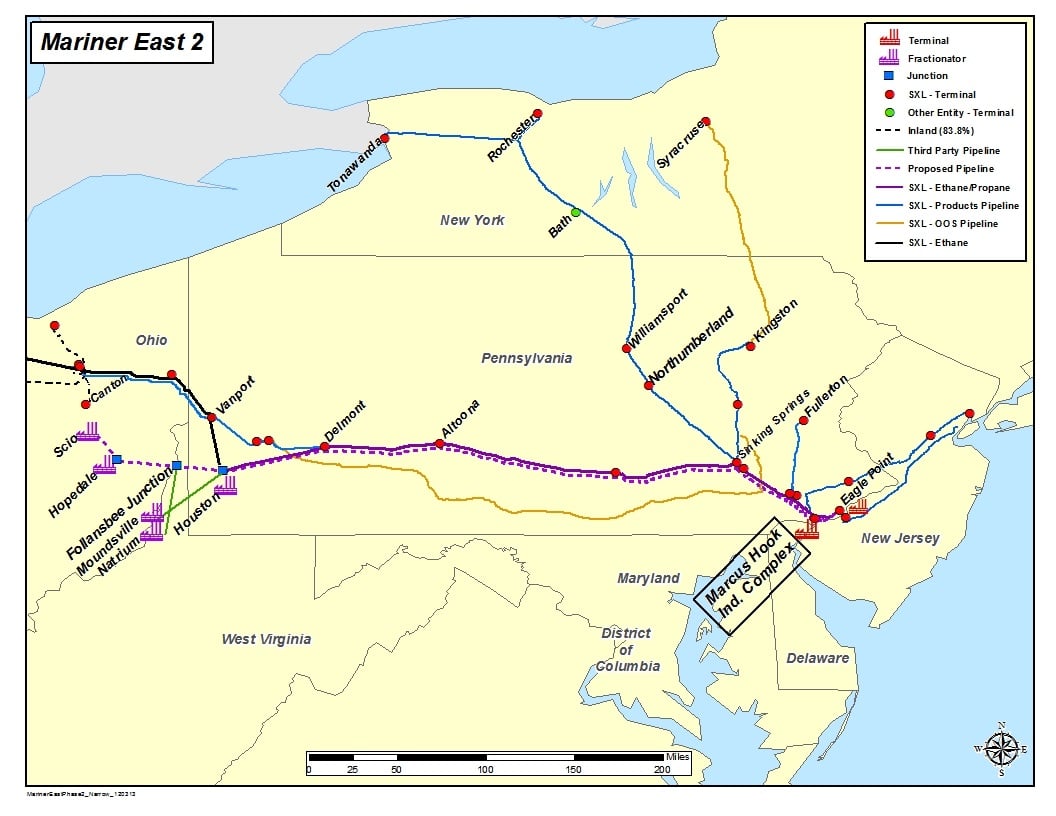
An Ohio landowner whose land Sunoco Logistics Partners wants to traverse with the Mariner East 2 pipeline tried a novel legal argument. The landowner’s attorneys argued in the Ohio Seventh District Court of Appeals that pure propane and pure butane–both of which would be transported through the pipeline from eastern Ohio all the way to the Marcus Hook refinery near Philadelphia–are not “petroleum.” At least, not petroleum for the purposes of the permit which grants Sunoco the right to use eminent domain to build the pipeline to transport petroleum products. The Court of Appeals justices rejected that argument and said, in essence, that propane and butane fit under the definition of petroleum as that word has been used for generations…
Read More “OH Court Sides with Mariner East 2 Pipe in Eminent Domain Case”
 In April of this year, Mountaineer NGL Storage announced an open season for a new underground NGL storage facility in Monroe County, Ohio, near Clarington, along the Ohio River (see
  Two weeks ago MDN wrote a post outlining an initiative to begin regulating small, low-pressure gathering pipelines–something not now done (see
  You may recall that for some time we’ve been following the back and forth between Range Resources and their (former) wastewater impoundments in Washington County, PA. The PA Dept. of Environmental Protection (DEP) fined Range a whopping $4.15 million for violations in September 2014 (see
 This is not an electioneering site. We are not on the payroll of any candidate. We have tried to avoid most comments on the upcoming presidential election. You obviously know where our political sympathies lie, if you’ve read this site for any length of time. Below we bring you someone else’s words outlining, in succinct form, the energy positions and proposed policies of both Hillary Clinton and Donald Trump. When you read it, objectively, there is only one candidate who supports the oil and gas industry and is worthy of your vote next Tuesday, November 8th…
 Events related to drilling in the Marcellus and Utica Shale, primarily pro-drilling.
 The “best of the rest” – stories that caught MDN’s eye that you may be interested in reading. In today’s lineup: DTE says NEXUS on schedule for 4Q17; rig counts stable in northeast; unbelievably biased green-sponsored push-poll; PA Sen Don White speaks frankly about energy & Clinton; slowdown in FERC approval for Texas LNG plants; Rockefeller family tied to corrupt Clinton Foundation; beginning of the end in Europe’s natgas war with Russia; and more!
 MDN reported on Monday of this week that we are down to the wire with passing Pennsylvania House Bill (HB) 1391, a bill that would guarantee a 12.5% minimum royalty payment for PA landowners (see
  In May 2014 Panda Power Funds broke ground on building an 829-megawatt Marcellus gas-fired electric generating plant in Asylum Township, Bradford County, PA (see
  EQT issued its third quarter 2016 update yesterday. The company reports losing money on its drilling operations ($22 million), but making money on midstream operations ($133 million), so they ended the quarter in the black. Highlights include production zooming up 26% higher over the same period last year. EQT drilled 24 wells in 3Q16, which breaks down as 21 Marcellus wells, 2 Upper Devonian wells and 1 Utica well. However, the biggest news coming from yesterday’s update came from the analyst phone call when EQT president Steve Schlotterbeck said, “We continue to make solid progress on both the cost and recovery efforts and we’re encouraged that the Deep Utica can compete with or surpass our core Marcellus economics in the near future.” That is, although they just got done drilling a bunch of Marcellus wells, it is the Utica that has turned EQT’s head in a major way. Why? Schlotterbeck also said he thinks Utica drilling will end up costing the company half as much as Marcellus drilling (due to higher production in Utica wells). The company sees itself as primarily a Utica driller in the not-too-distant future. Here’s the update, along with a select portion of yesterday’s analyst phone call…
 MPLX, Marathon Petroleum Corp.’s fuels processing, transportation and logistics subsidiary, issued its third quarter 2016 update yesterday. MPLX reported that profits more than tripled, to $141 million, in 3Q16. MPLX is the owner of MarkWest Energy after buying them out late last year. One of the keys to MPLX’s increase in profits? Yep–the Marcellus/Utica. On an analyst phone call yesterday, MPLX’s president Don Templin said: “While other basins are in decline the Marcellus and Utica rich gas volumes continue to grow. For 2016 we continue to expect processed volumes to increase by approximately 15% year-over-year and gathered volumes to increase by approximately 20%. And in 2017, we expect an additional 10% to 15% increase in processed volumes compared to 2016.” Here’s the MPLX 3Q16 update…
 Each month MDN tracks how many rigs oilfield services company Patterson-UTI Energy reports operating–as a proxy for when/if the drop in rig counts for the Marcellus/Utica will turn around. Patterson operates a number of rigs in the northeast, as well as other areas of the continental United States (and Canada). Patterson reported losing $84 million during the second quarter of 2016, responding that the company is positioned for a recovery (see
  The 16,000-member Pennsylvania Medical Society is controlled by a small and dedicated group of radical leftists. They’re also shockingly stupid, for doctors and medical people (you might want to seek medical care in another state). The PA Medical Society’s 300-member House of Delegates voted unanimously to pass a resolution calling for a total ban on fracking in the Keystone State. Stop it–all of it–right now. That’s what they said. Even though there is no evidence that fracking harms human health. That is, independent studies done all say the same thing: fracking is safe. However, biased bought-and-paid-for studies say fracking will kill ‘ya. We find it astonishing that there was not one single delegate who didn’t vote for the resolution–which proves our point that radical, lock-step lefties control the society…
 One of the largest banks in the world (#11) is the German-based Deutsche Bank. They have major branches in dozens of countries, including the U.S. The Equity Research – North America operation of Deutsche Bank attended the Platts 9th Annual Appalachian Oil & Gas Conference in Pittsburgh earlier this week. The DB analyst who attended wrote up notes and shared them. We found the writeup interesting and thought you would too…