
NY Gov. Hochul Goes BANANA, Bans Data Centers for at Least 1 Year
 New York Governor Kathy Hochul yesterday had the ignominious distinction of signing an Executive Order establishing the nation’s first statewide moratorium on new hyperscale data centers, temporarily pausing state environmental permit issuance for up to 1 year. New York is CLOSED for business. We wonder if this decision jeopardizes a $100 BILLION project in the Syracuse area: a new chip-making plant by Micron. The Micron plant will build the chips used by hyperscale data centers — the same data centers Hochul just banned. How’s that for a kick in Micron’s teeth? Read More “NY Gov. Hochul Goes BANANA, Bans Data Centers for at Least 1 Year”
 NATIONAL: U.S. natural gas futures snap losing streak; SLB, Liberty Energy form strategic alliance for data center infra. and power; Climate litigation activists embedded in new NAS attribution study; Climate retreat documented in the New York Times; Alice in Hydrogen Land; America barely uses OPEC oil, so why are oil and gas prices so high?; INTERNATIONAL: Oil hits one-month high; Houthis strike Saudi Arabia in major escalation; Japan chooses reliable energy over climate nonsense.
  A little over two weeks ago, MDN reported that THE Delaware Riverkeeper was sounding the alarm (the perennial “sky is falling” group) that the Penn America LNG export facility had come back to life and is planning a new LNG export project near Philadelphia (see
  The far-left activists who occupy and control the Delaware River Basin Commission (DRBC) are shocked and dismayed that their iron grip on power is slipping away. As we reported yesterday, Congress is close to adopting an amendment to the federal Water Resources Development Act (WRDA) that would block the DRBC and its sister organization, the Susquehanna River Basin Commission (SRBC), from banning hydraulic fracturing (and shale drilling) within their respective jurisdictions (see
  Pipeline giant Williams announced a $5.34 billion investment led by Blackstone Credit & Insurance, in partnership with Apollo and KKR, to fund its five behind-the-meter Power Innovation projects: Socrates, Apollo, Aquila, Socrates the Younger, and Neo. All five projects are located in Ohio and will use Utica (or Marcellus) shale gas. In exchange for the money, the investors receive a 49% noncontrolling ownership stake, while Williams retains 51% ownership and operational control, plus a buyout right between years 7 and 14. While the headline numbers focus on high-finance metrics, the practical, on-the-ground effect of this deal directly reshapes the Appalachian natural gas landscape, pipeline dynamics, and the regional race to power the AI-driven data center boom.
  Four Washington County, Ohio, Class II injection wells voluntarily stopped operating July 1-2 after state regulators from the Ohio Department of Natural Resources (ODNR) said they may be affecting nearby oil and gas production wells. The wells are Redbird Nos. 4 and 5, American Growers No. 1, and Nichols No. 1-A, although the Nichols owner disputed that operations had ceased at that well. ODNR and operators will develop corrective plans, while a third-party consultant examines nearby private water wells. Activists want broader, long-term groundwater testing, noting that Redbird No. 4 waste has previously migrated more than 5 miles underground. It’s important to note that the alleged migration of fluids affected other (conventional) oil and gas wells, NOT water wells.
  An important (precedential) court ruling to alert Pennsylvania surface (and mineral rights) owners to. The Pennsylvania Superior Court ruled earlier this month that an oil-and-gas mineral rights owner does not have an automatic, unrestricted right to place a well on a separately owned surface estate. When the deed or lease contains no express surface-access right, the mineral owner must establish that using that surface is “strictly necessary”—not merely reasonable—to reach and develop the underlying oil and gas. The case in question concerns land in Westmoreland County but will almost certainly apply to other locations as well.
  Energy Transfer has asked the Pennsylvania Public Utility Commission (PUC) to restructure and dissolve the Sunoco Pipeline Company, separating its pipeline assets between two new entities. Energy Transfer NE NGL Pipelines LLC would own and operate the Mariner East system and other natural gas liquids pipelines, while Energy Transfer RP Pipelines LLC would control refined petroleum product pipelines. The proposal also would transfer Sunoco’s public utility operating certificates. Formal protests and intervention petitions are due July 27, 2026.
  Last week was (once again) noteworthy for the Baker Hughes rig count. Although the Marcellus/Utica count didn’t budge, the national count increased by 1 rig. The national count has risen over the last four weeks — by 19 rigs. The new national count of 581 is the highest the combined count has been since May 2025 (well over a year). The combined M-U rig count remained at 36 active rigs for the ninth consecutive week. The M-U’s chief competitor, the Haynesville, maintained its count of 55 active rigs, operating 19 more than the M-U.
  For the past decade, landowners in Wayne and Pike counties in northeastern Pennsylvania have unfairly been denied the ability to profit from fracking on (and under) their property, simply because they happen to live inside the imaginary boundaries of the Delaware River Basin, an area under the iron hammer control of the Delaware River Basin Commission (DRBC). The DRBC, unlike its counterpart in the Susquehanna River Basin (SRBC), is controlled by left-wingers. They falsely claim that allowing fracking anywhere in the basin would destroy the water supply of 14 million people. Congress is now on the cusp of overturning this ongoing tragedy.
  On July 12, the Pennsylvania Senate and House passed, and Governor Josh Shapiro signed into law, a $50.84 billion General Fund budget. It was only 12 days late this year. This is a net-positive budget for the Marcellus/Utica industry. It contains no new taxes or fees on production, delivers a long-sought modernization that unlocks the deep Utica play, and builds legal scaffolding favorable to gas-fired power for data centers. The only new obligations — full-cement plugging and (for midstream-adjacent projects) data-center reporting — are modest.
  In early May, Devon Energy completed its buyout of and merger with Coterra Energy, paying $21.4 billion in Devon stock (see
  Eastern Gas Transmission and Storage (EGTS), a wholly owned subsidiary of Berkshire Hathaway Energy Company (Warren Buffett’s company), filed a new project with the Federal Energy Regulatory Commission (FERC) in July 2025 (see
 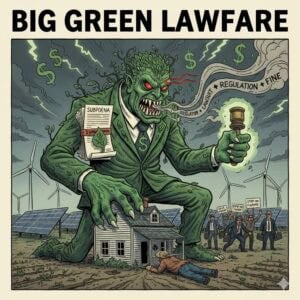 A long-running and favorite tactic of the environmental left is to use our own judicial system against us. On the federal level, foreign-backed groups like the Sierra Club, Earthworks, Food & Water Watch, and others have (in the past) challenged new pipeline or drilling projects, filing appeal after appeal up the line, blocking construction until said lawsuits were resolved. Last June (2025), the Federal Energy Regulatory Commission (FERC) took away the left’s ability to block construction while lawsuits are filed and played out (see