
Northeast PA Will Benefit from Transco NESE Project in NYC
 Williams has commenced construction of its Transco Northeast Supply Enhancement (NESE) project, extending through northeast Pennsylvania, New Jersey, and New York (see Groundbreaking Ceremony for NESE Pipe in NYC an All-Star Event). This infrastructure upgrade, primarily involving new pipes and enhancements to existing compressor stations on the Transco pipeline system, aims to deliver more natural gas to New York City, which faces a supply shortage. Northeast Pennsylvania is strategically positioned to supply gas to this system, making the NESE project a benefit for the region by meeting New York City’s demand for natural gas. Read More “Northeast PA Will Benefit from Transco NESE Project in NYC”
 Earlier this year, the Federal Energy Regulatory Commission (FERC) approved the Williams Transco Southeast Supply Enhancement Project (see
  PowerTransitions, an independent power producer specializing in redeveloping legacy power facilities, has agreed to acquire five New York gas-fired power plants — Batavia, Hillburn, Massena, Shoemaker, and Sterling — totaling 323 megawatts (MW) from Alliance Energy Group affiliates. Terms of the deal were not disclosed. The deal marks PowerTransitions’ entry into the New York market, bringing its total portfolio to approximately 550 MW across seven stations spanning multiple NYISO zones. PowerTransitions says the acquired sites offer “brownfield redevelopment potential” for new power generation and battery storage. Frankly, this one is a head-scratcher for us.
  OTHER U.S. REGIONS: NY Senator Harkham Climate Act mal-information; NATIONAL: U.S. natural gas futures post sixth straight gain; Earth Day 2026 – “Our power, our planet, our propaganda” redux; Misguided ‘repair the world’ climate philanthropy; The more the U.S. drills, the healthier our planet; GE Vernova’s gas turbine business is strong; Fifth Circuit says government’s tax power is not designed to control behavior; INTERNATIONAL: Crude rises on Iran-US standoff.
  The rumor mill is chattering once again. Bloomberg reports that Arsenal Resources, a private natural gas producer focused on the Marcellus Shale, is considering a potential sale of itself valued at approximately $1.5 billion. The company, owned by its creditors since emerging from bankruptcy in late 2019 (see
  The Iroquois Gas Transmission’s Enhancement by Compression (ExC) project will increase horsepower at three compression stations — two in New York and one in Connecticut — by an extra 125 MMcf/d, to flow more Marcellus/Utica gas into New York City and New England. The NY Department of Environmental Conservation (DEC) approved the permits for the NY compressors with the condition that Iroquois pays a $1.5 million “contribution” (we call it a bribe) to the “Disadvantaged Community Benefit Program” (see
 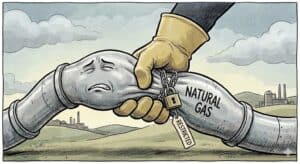 Natural gas flows along the Rover Pipeline have been cut by 387 MMcf/d (out of 3.25 – 3.4 Bcf/d) due to maintenance at the Bulger Compressor Station, which is expected to last through the end of the month, curbing Appalachian takeaway capacity to the Midwest and Canada. Additionally, the MarkWest Harmon Creek gas processing plant in Washington County, PA, is reported to be offline due to this work.
  Yesterday, the Pennsylvania Department of Environmental Protection (DEP) informed the House Environmental and Natural Resource Protection Committee that it remains uncertain about the final contents of its plan to reduce methane emissions from oil and gas operations, which is due to the EPA in January 2027. That is, they don’t have a clue. This cluelessness follows an extensive public comment period on a proposed plan for onerous regulations (developed during the dark Biden years) that aims to satisfy federal obligations primarily through general permits and references to federal standards.
  Halliburton, the world’s second-largest OFS (oilfield services) company, issued its first quarter 2026 update yesterday. CEO Jeff Miller said, “In North America, I see clear signs that we are in the early innings of a recovery.” Cool. Of course, he’s talking about oil drilling, mostly. While the update and earnings conference call did not specifically mention the Marcellus/Utica, they did include information highly relevant to our region. In particular, the company prominently mentioned its electric fracking “e-fleets” and said that the current low price of natural gas represents a significant opportunity for drillers to save money by using it instead of diesel to power fracking equipment.
 It’s fun to watch mainstream media begin to wake up to the lawsuit we told you about last week, filed by a father and son against New York State over its fracking ban (see
  Olympus Energy (now owned by EQT) drills in the Greater Pittsburgh region, in Allegheny and Westmoreland counties. In 2021, Olympus applied to build a new well pad in a rural part of Allegheny County, in West Deer Township. So-called Concerned Residents of West Deer (CROWD) got amped up to oppose the project. They succeeded when town supervisors rejected the Dionysus well pad (see
  Here we go again with SSDD (same stuff, different day). We’re referring to the bullying talk coming from Pennsylvania Governor Josh Shapiro and his threats to pull the Keystone State out of the PJM grid, the largest electric grid in the U.S., covering all or parts of 13 states plus the D.C. swamp. Shapiro first made this same threat more than a year ago, in January 2025 (see
 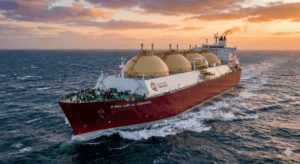 The Golden Pass LNG terminal is a liquefied natural gas terminal and regasification facility in Sabine Pass (Port Arthur), Texas. It is among the largest LNG facilities in the world. It can accommodate up to 15.6 million metric tons (MT) of LNG per year, the equivalent of approximately 2 billion cubic feet of natural gas per day (Bcf/d). QatarEnergy, Qatar’s state-owned petroleum company, owns 70% of the Golden Pass LNG project. ExxonMobil owns the other 30%. Sabine Pass sees a tremendous amount of Marcellus/Utica molecules flowing to the region via a couple of pipelines, namely Transco (which flows M-U molecules). Hence, our interest in this major natural gas user’s start-up. The good news is that a ship has docked to load the very first official LNG export cargo.
  On Monday, President Donald Trump invoked the Defense Production Act (DPA) to channel federal funding toward domestic energy projects, specifically targeting liquefied natural gas (LNG), petroleum, coal power, and grid infrastructure. Empowering the Energy Department to bypass regulatory and financial hurdles, the move aims to curb rising electricity and gasoline costs ahead of the midterm elections while meeting surging power demands from the AI industry.