
Energy Services | Equitrans/EQT Midstream | Industrywide Issues | North Carolina | Pipelines | Regulation
FERC Signals Approval for MVP Southgate Pipe to NC in Draft EIS
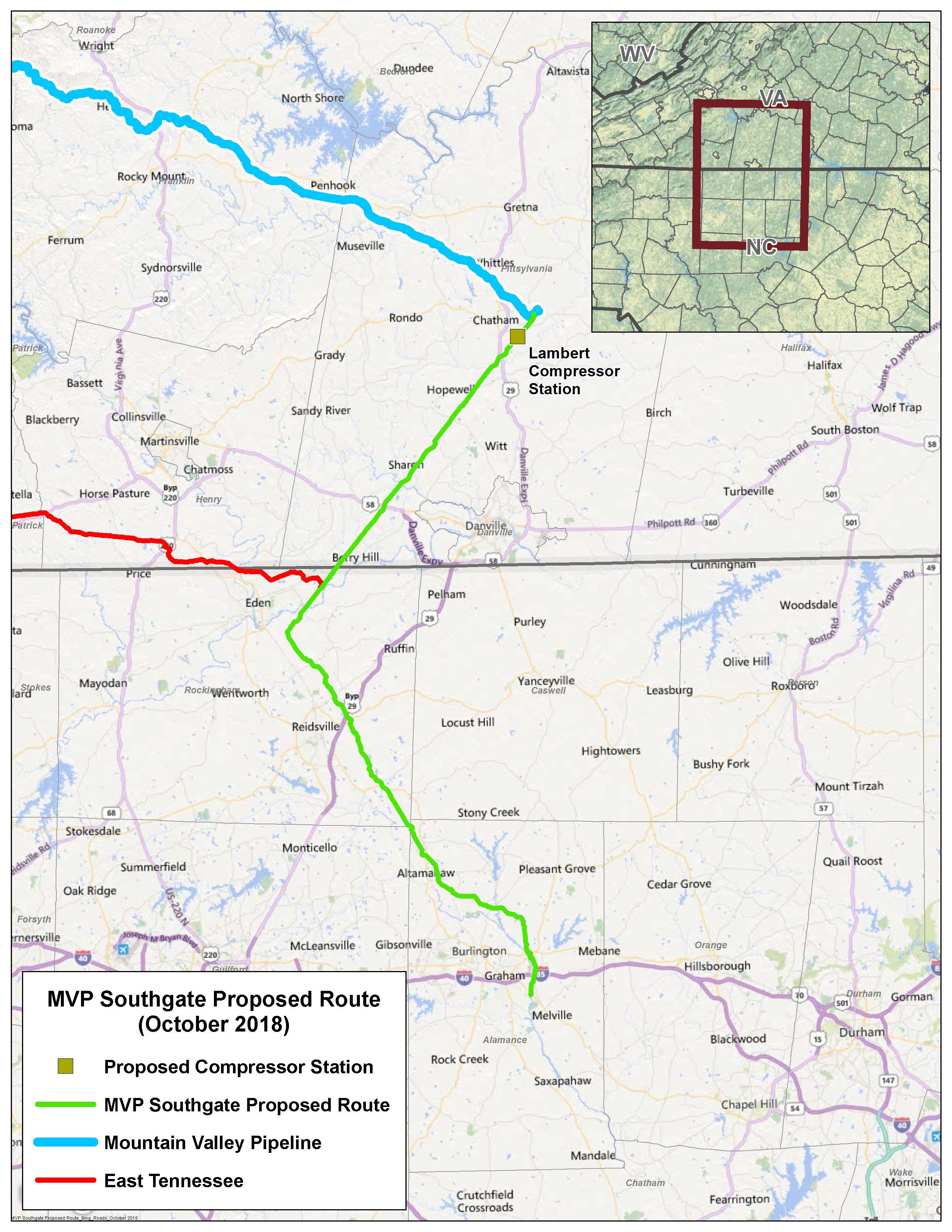
Although some of the 300-mile Mountain Valley Pipeline (MVP) that stretches from Wetzel County, WV to the Transco Pipeline in Pittsylvania County, VA is on hold due to court delays over stream crossing permits, work continues on the project. The original project is now 80% built and will go online in 2020 according to Equitrans CEO Thomas Karam. Equitrans filed plans with the Federal Energy Regulatory Commission (FERC) last November to extend the pipeline *another* 70+ miles south–into North Carolina–called the MVP Southgate project (see EQT Makes it Official, Files with FERC to Extend MVP into NC).
Read More “FERC Signals Approval for MVP Southgate Pipe to NC in Draft EIS”

 The actions of one man seeking access to confidential risk assessments and plans for the Mariner East pipelines in the Philadelphia area will, if successful, put information into the public domain that terrorists can potentially use. Note we don’t believe it is the intent of this man to grant access to sensitive information to terrorists. But that is the consequence, the outcome, the result of his actions–if a court now reviewing the case grants his request.
 Canada’s National Energy Board (NEB) has approved TC Energy’s agreements with natural gas retailers in Eastern Canada, to flow Western Canadian gas to Canada’s East Coast and New England. TC Energy (formerly called TransCanada) cooked up a plan to expand an existing pipeline in New England and connect it to a point in Quebec to flow gas from the opposite side of the continent, Western Canadian natural gas (over 1,000 miles away), into New England and from there back up into Canada (see
  Columbia Gas of Massachusetts (NiSource) continues to recover (physically and reputationally) from a series of explosions last September in its local delivery pipelines north of Boston (see
  MARCELLUS/UTICA REGION: Long Island town to vote on alternative natural gas providers; NETL leads research to improve production efficiency of Marcellus shale; OTHER U.S. REGIONS: Sasol says new Louisiana cracker starting up; Unitil foresees growth in natural gas as electric usage drops; PSEG officially opens natural gas power plant in Bridgeport; NATIONAL: U.S. LNG exports to Europe increase amid declining demand and spot LNG prices in Asia; Natural gas truck sales are on the rise; INTERNATIONAL: 2020s will see a new LNG market maker; Nord Stream 2 pipeline fights new EU gas rules.
 The same U.S. Fourth Circuit Court of Appeals judges who quoted from Dr. Seuss’ book “The Lorax” in a previous decision against Dominion Energy’s Atlantic Coast Pipeline (ACP) have, once again, delivered another blow to ACP. In a very poor decision issued on Friday, the clown judges overturned reissued permits from the U.S. Fish and Wildlife Service (FWS) for the project, claiming the permits don’t do enough to protect bumble bees and bats.
 Cabot Oil & Gas is the only Marcellus/Utica driller that is profitable quarter after quarter and year after year. So the market pays attention to what Cabot does, because they’ve figured out how to make money in a low commodity price environment. Last Friday Cabot released second quarter numbers. CEO Dan Dinges talked about the balance of 2019 and even a bit about what to expect in 2020.
 Production for Range Resources was up a healthy 10% year over year in second quarter 2019, according to Range’s 2Q19 update issued late last week. Range produced 2.3 billion cubic feet equivalent per day (Bcfe/d) in 2Q. For the first half of the year Range brought online 39 Marcellus/Utica wells and plans to bring online another 49 wells in the second half of 2019. The company is on track to spend roughly $750 million on drilling in 2019.
 In March we told you about National Fuel Gas Company’s (NFG) FM100 Project in northwestern Pennsylvania that will beef up and extend an existing pipeline network to flow an extra 330 million cubic feet per day (MMcf/d) of Marcellus gas to Williams’ mighty Transco Pipeline (see

 Public Service Enterprise Group (PSEG), headquartered in Newark, NJ, says it will shutter all but its three of its natural gas-fired electric plants by 2046, in a misguided effort to reduce “climate-warming emissions to net zero by 2050.” But they’ll do it *only* if the government adopts an economy-crushing, totally regressive “carbon tax” (to punish the use of natural gas). PSEG’s ultimate goal is to force their customers to use less electricity. That’s their big solution. Use less, and they’ll charge you more for what you still use. The end result of dumping gas-fired plants is predictable–grid unreliability and rolling blackouts.
 Yesterday the new EQT management team, in particular CEO Toby Rice, held a conference call with stock analysts to discuss the company’s second quarter financial and operational update. We learned a number of things from the call and materials published by EQT: A number of new faces have appeared in senior management; the company remains committed to sister company Equitrans and its Mountain Valley Pipeline project; and EQT’s second-quarter net income jumped more than 700% from a year ago–something previous CEO Rob McNally can take credit for.