
Reversed REX Pipeline Goes from 1.8 Bcf to 2.0 Bcf
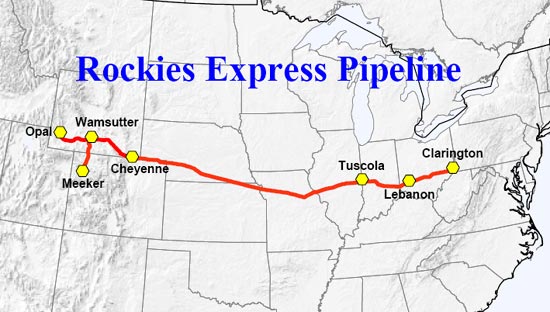 The Rockies Express Pipeline (REX), originally built from Colorado and Wyoming to Monroe County, OH to bring natural gas from west to east, last year reversed the flow for a large and important section of the pipeline. On August 1, 2015 the section of REX from Monroe County, OH to Mexico, MO reversed the flow and began to carry 1.8 billion cubic feet per day (Bcf/d) of Utica and Marcellus Shale gas to the Midwest, including to the greater Chicago area. REX has been hard at work on plans to expand capacity even more by beefing up compressor stations along portions of the pipeline. REX filed a plan with FERC to add another 800 million cubic feet per day (MMcf/d) of capacity along the same portion of the reversed pipeline. In late November, the Federal Energy Regulatory Commission (FERC) gave REX the go-ahead to start additional compressors added at three locations along the route (see REX Pipe Begins Flowing Extra 800 MMcf/d Marcellus/Utica Gas West). NGI is reporting that the first 200 MMcf of the additional 800 MMcf is now flowing along the pipeline…
Read More “Reversed REX Pipeline Goes from 1.8 Bcf to 2.0 Bcf”

 It’s been a while since the last episode of As the (Midstream) World Turns. In our last episode, we left beleagured Williams conducting a board of directors “refreshment” program (i.e. purge)–to clean out the old and bring in some new blood. A brief history to catch you up in case you missed our previous episodes: Following an aborted merger with Energy Transfer Equity, six of Williams’ board members tried to engineer a palace coup to depose current CEO Alan Armstrong. The coup failed and the board members quit in July (see
  Seventy Seven Energy (SSE) is the former Chesapeake Oilfield Operating company, the oilfield services subsidiary of Chesapeake Energy that Chessy spun out into its own company in July 2014 after it couldn’t find anyone to buy it (see
  EQT is feeling bullish about natural gas drilling in the northeast for 2017. The company has just released its 2017 operational forecast. What do we notice? First off, they plan to spend $1.5 billion next year, most of which ($1.3 billion) will be used to drill and complete new wells. That’s a whopping 50% increase from spending $1 billion this year. The next thing we notice is what type of wells they intend to drill: 119 Marcellus wells (76 in PA and 43 in WV); 81 Upper Devonian wells, which will be drilled on the same pads as deeper Marcellus wells, but only in PA; and 7 “deep Utica” exploratory wells. EQT also reworked a midstream deal with Williams in the Ohio Valley. Below are the exciting details of what’s ahead for EQT in 2017, including a second announcement from EQT Midstream about what’s ahead for the pipeline subsidiary, including details on how much they plan to spend on the Mountain Valley pipeline project in the coming year…
 One of the many companies in the Marcellus industry targeted by Pennsylvania’s former Attorney General, Kathleen Kane, for extinction was Minuteman Environmental Services, a PA company that served the shale industry with several different businesses (see
  When it comes to gas-to-liquids (GTL), MDN has observed (as we stated in a story yesterday, see
  Some holdout landowners in Medina County, OH continue to oppose the coming NEXUS Pipeline, even after their suggested alternative routes (around their county) have been rejected by the Federal Energy Regulatory Commission (FERC). A few holdouts are vowing to continue the fight “until all of our resources and options are exhausted,” which may be very soon. Earlier this month FERC issued a positive Final Environmental Impact Statement (see
  Last week MDN brought you news about Kinder Morgan’s Broad Run Expansion Project will expand transportation capacity of natural gas on the existing Tennessee Gas Pipeline system. Antis tried to stop the project, but FERC rejected their pleas (see
 The worldwide Baker Hughes rig count was up by 5 in November, from 920 in October to 925 in November. That reverses a brief slide back in October when rigs worldwide slide back by 14. However, the rig count in the U.S. went up for the fifth month in a row. The average U.S. rig count for November was 580, up 36 from the 544 counted in October. That’s a two month increase of 71! The Marcellus/Utica rig count was up for the fourth month running. In November the M/U rig count went up by 4 (second month in a row it’s gone up 4) with 2 additions in PA (now 27 rigs) and 2 in OH (now 16 rigs). WV stayed even running with an average of 10 rigs…
 Calling all vendors (i.e. supply chain companies) and workers who want a piece of the action in building the Dominion’s $5 billion, 594-mile Atlantic Coast Pipeline–a natural gas pipeline that will stretch from West Virginia through Virginia and into North Carolina. Dominion is currently holding in-person “construction expos,” as well as hosting an online form for those where those with an interest in selling to or working for the project can register that interest. Yesterday Dominion held a construction expo in Bridgeport, WV. Today they’re holding one in Elkins, WV. And over the next week or so they will hold more construction expos–across Virginia and even in North Carolina. Dominion is looking for suppliers for things like gravel and concrete, vehicles, construction supplies, welding and more. Here’s the low-down on how you can sign up to help build the Atlantic Coast Pipeline…
 On Monday MDN reported that the future site for an ethane cracker in Belmont County, OH is now cleared and ready for construction to begin (see
 As we do every month, MDN tracks how many rigs oilfield services company Patterson-UTI Energy reports operating–as a proxy for when/if the drop in rig counts for the Marcellus/Utica will turn around. Patterson operates a number of rigs in the northeast, as well as other areas of the continental United States (and Canada). Month by month Paterson’s rig count has declined over the past year plus–until June (see