
FERC Expected to Approve NEXUS Today; Surveyors have Armed Guards
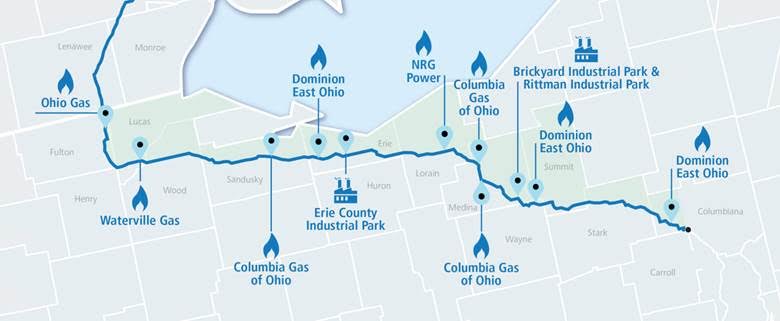
Word on the street is that the Federal Energy Regulatory Commission (FERC) will announce a decision today to approve the NEXUS Pipeline–a $2 billion, 255-mile interstate pipeline that will run from Ohio through Michigan and eventually to the Dawn Hub in Ontario, Canada. It is a critically needed pipeline to move Utica and Marcellus Shale gas from an over-saturated market in the northeast to markets in the Midwest and Canada. If the decision doesn’t come today, it will come very soon. As MDN reported yesterday, the small city of Green, OH (population 26,000) has put NEXUS on notice that if its surveyors show up and landowners refuse access, those surveyors will be arrested if they “trespass” on the landowner’s property (see Green, OH Threatens NEXUS Surveyors with Arrest for Trespassing). Other news agencies are reporting that surveyors are about to show up with armed guards. Into this mess may come an approval for the project. If NEXUS gets approved, it will have the right to use federal eminent domain laws to build the pipeline, regardless of landowner desires. Does eminent domain also include surveying? One would think so since surveying is part of the construction process. Green’s bluster may amount to nothing if the project receives a final approval today. Below are several stories about surveying for NEXUS, as well as a look at the FERC commissioners who will make the final decision on NEXUS…
Read More “FERC Expected to Approve NEXUS Today; Surveyors have Armed Guards”
 The world’s third largest oilfield services company, Baker Hughes, has struggled to stay afloat given the radical reduction in revenue they get for the services they offer. BH’s recent third quarter update showed the company lost $430 million, which is down from losing $912 million in 3Q15, a positive sign we suppose (see
  Word has leaked out that WGL Holdings, the umbrella company that owns Washington (DC) Gas Light Company and WGL Midstream, is considering selling itself to utility giant (and Spanish-based) Iberdrola. The deal, if it happens, has implications for the Marcellus. Earlier this month MDN reported that WGL Midstream, which already is a 7% owner in the Mountain Valley Pipeline project, had upped its ownership stake to 10% (see
  In May, U.S.-based oilfield services company FMC Technologies announced they will merge with their much larger quasi-competitor, France-based Technip, in an all-stock deal that will create a new company called TechnipFMC worth $13 billion (see
  It’s now apparent that the fix has been in from the beginning–that New York’s corrupt Gov. Andrew Cuomo, colluding with New York’s corrupt Attorney General, Eric Schneiderman, were on a mission to block the construction of the federally approved Constitution Pipeline, due to run from Susquehanna County, PA into Upstate New York (to Schoharie County). Before Cuomo decided to take the breathlessly lawsless act of blocking the pipeline by denying stream-crossing permits (being challenged in court), the Constitution asked for permission to begin clearing trees along the pipeline’s path. In January 2016, Schneiderman immediately objected (see
 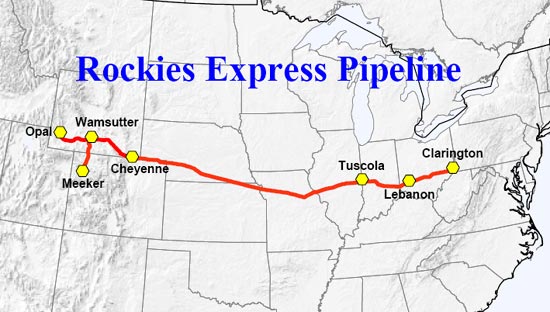 The Rockies Express Pipeline (REX), originally built from Colorado and Wyoming to Monroe County, OH to bring natural gas from west to east, last year reversed the flow for a large and important section of the pipeline. On August 1, 2015 the section of REX from Monroe County, OH to Mexico, MO reversed the flow and began to carry 1.8 billion cubic feet per day (Bcf/d) of Utica and Marcellus Shale gas to the Midwest, including to the greater Chicago area. REX has been hard at work on plans to expand capacity even more by beefing up compressor stations along portions of the pipeline. Their efforts have paid off. REX previously filed a plan with FERC to add another 800 million cubic feet per day (MMcf/d) of capacity along the same portion of the reversed pipeline. Yesterday the Federal Energy Regulatory Commission (FERC) gave REX the go-ahead to start additional compressors added at three locations along the route…
 The city of Green in Summit County, OH has put NEXUS Pipeline on notice that if surveyors show up to survey in the city and if those surveyors don’t have permission from the landowner, or a judge’s order, those surveyors will be arrested and charged with trespassing. Apparently Green hasn’t gotten the memo that pipelines are the safest form of transportation on earth–period. NEXUS, as well as other pipeline projects, face a classic Catch-22 situation. In order to get the Federal Energy Regulatory Commission to grant a certificate to build the pipeline, the pipeline company must first conduct initial surveys to plan the route. With a certificate from FERC in hand, the pipeline then has the power of eminent domain to use on recalcitrant landowners to build the pipeline across their land. The open question is whether or not the pipelines can use eminent domain to conduct the survey ahead of a full FERC certificate. That’s the Catch-22. Surveying doesn’t do a single thing to a property, other than a few guys and gals running around for a short time looking through a transit and taking measurements. It’s a shame that landowners, in some cases, won’t even allow that. So Green has put NEXUS and the world on notice that the city and its residents don’t want to participate in the riches that come from shale. Fine. Let them eat dirt…
 Sunoco Logistics Partners, the builder of the Mariner pipeline projects, has fought a long and hard legal battle to be recognized as a public utility in Pennsylvania–especially with regard to the next big project in the lineup, the Mariner East 2 pipeline. ME2, as it’s called, is a $2.5 billion, 350-mile natural gas liquids (NGL) pipeline that will run from eastern Ohio through the state of Pennsylvania to the Marcus Hook refinery near Philadelphia. From the beginning anti-pipeline fanatics have tried to derail the project by claiming it is not a public utility (with the right of eminent domain) as defined by PA’s statutes. In July 2014 two administrative law judges working for the PA Public Utility Commission (PUC) said ME2 is not a public utility (see
 Seems like GE Oil & Gas is putting its fingers in every U.S. o&g pie it can. In October GE announced it would pursue Baker Hughes for a merger/buyout (see
  Philadelphia Energy Solutions (PES) has been on a mission to expand their operation at the Southport Marine site in Philadelphia by leasing an additional 200 acres to build a terminal for shale oil imports and exports. Believe it or not, a plan to lease the extra space has been going on for more than two years (see
  Are those war drums we hear beating? Perhaps! If you are involved in the oil and gas industry in just about any capacity, it’s hard to miss the story of the Dakota Access Pipeline (DAPL) and the paid criminal protesters who are trying to stop it (see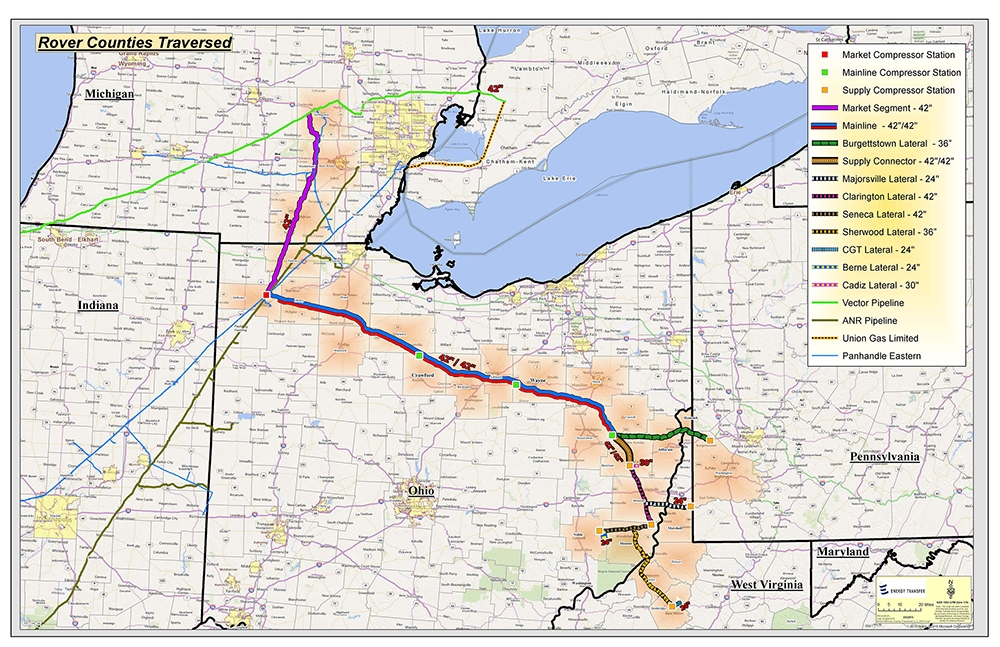
 Not even a year go–in December of last year–one of the biggest and brightest stars in the midstream firmament for the Marcellus/Utica, MarkWest Energy, sold itself to Marathon Petroleum (see
 In early November Canadian midstream giant TransCanada announced they were going on a fundraising bender to get money to pay for their recent $10 billion acquisition of Columbia Pipeline (see