 1/24/18 Note: We have edited this post to be less incendiary and more respectful of the opposing viewpoint.
Yesterday the Federal Energy Regulatory Commission (FERC) rejected a request by Constitution Pipeline to overrule the (very corrupt) New York Dept. of Environmental Conservation and allow construction of the pipeline to commence (see our lead story today: Death of the Constitution Pipeline? FERC Refuses to Overrule NY DEC). As we report in that story, Williams is not (yet) giving up the hope and dream of building the Constitution. However, given that tree clearing for the pipeline would have to begin now, and be done by the end of March (in order to save the bats–don’t ask), another year will go by before the Constitution could even begin construction. And it will take a year to build. That’s IF Williams prevails in court. In the meantime, businesses in New York State are DESPERATE to receive shipments of natural gas. Major employers in the Southern Tier of New York had planned to tap into the Constitution and use cheap, abundant, clean-burning Marcellus Shale gas from Pennsylvania, saving them money and lowering emissions. Without the Constitution, what can these employers do? Yes, they can leave the state (and some already have). But there is a solution. NG Advantage is planning to build a “virtual pipeline” in the Town of Fenton, on the outer edge of Binghamton, NY (Broome County). A virtual pipeline is a compressor plant (series of compressor plants) that grabs gas from a pipeline–in this case the Millennium Pipeline–and compresses it and loads it onto special tractor trailers that then deliver the gas to industrial customers like manufacturing plants, hospitals, and even small regional gas distribution systems servicing residential homes. NG’s project got derailed last year when a group of residents living nearby sued, stopping the project in its tracks (see Broome Virtual Pipe Project in Limbo, Fenton Board Refuses to Act). The residents claim three trucks per hour going through side streets will negatively alter the neighborhood. It’s bogus. NG is undaunted. They have patiently, calmly and repeatedly reached out to the community to answer questions and address concerns. NG has more than bent over backwards in an attempt to work with community. NG followed the judge’s directive and refiled the project with the Town of Fenton for a second time. There is a Fenton zoning board hearing at 6 pm on Tuesday, Jan. 23 at the Port Crane Fire Department to consider NG’s refiled request. Residents who are opposed are already gearing up to pressure board members. Pro-gas folks need to show up in large numbers to show the zoning board there is support for this vital project. Let’s not let the other side win this one! Jobs in, indeed the future of, the Southern Tier depend on it…
Read More “Following Constitution Pipe Decision, NY Virtual Pipe Now Vital”

 The U.S. Department of Energy’s Office of Fossil Energy has just released an interesting report that shows the number and volume of LNG (liquefied natural gas) exports from Feb. 2016 (when U.S. LNG exports began) to Dec. 2017. It’s really quite fascinating. For example, which country do you think we have (so far) shipped more LNG to than any other country? Someplace in Europe? Maybe Japan or China? Nope. The #1 one trading partner that received our LNG for 2016-2017 was…Mexico! That’s right, Mexico. Even though we have all sorts of natural gas pipelines crossing the border into Mexico. Apparently those pipelines don’t connect with large parts of the country, so LNG tankers meet the need instead. Number two on the list of countries receiving our LNG exports: South Korea. Followed by China (#3), Japan (#4) and Chile (#5). The report also breaks down deliveries by other criteria. For example, even though Mexico was #1 on the list for our exports, if you break our exports down regionally, Asia/Pacific received most of our exports, while Latin America (including Mexico) was the #2 region. Or how about this: Free Trade Agreement (FTA) countries vs. non-FTA countries. Would it surprise you to learn that non-FTA countries got more of our exported LNG (52.7%) than FTA countries (43.3%)? The reason MDN readers should be interested in LNG exports is because exports are a huge future market for Marcellus/Utica gas. Be sure to spend some time with this important report…
 It’s fun to watch the left eat its own. That’s exactly what’s happening in Boston. We’ve provided a fair bit of coverage on the issue of lack of pipelines in New England and the fallout from it. Because of lack of natural gas pipelines, both natural gas AND electricity prices in New England are sky high. Natgas is used to generate most of New England’s electricity. When it gets cold out, residents and businesses use more natgas for heat, causing a shortage of natgas, further causing insane price hikes. At some point, there just won’t be any more gas at any price–and that’s when rolling blackouts begin. It will happen sooner than you think. Important politicians in New England, like U.S. Senator Elizabeth “Pocahontas” Warren and Attorney General Maura Healey (both from Massachusetts) have actively worked to block new natgas pipelines. The result? LNG tankers with illegal Russian gas are supplying a good share of the region’s natgas supplies during cold snaps. It’s disgusting. It’s so disgusting, even the far-left libs who write and edit the Boston Globe can’t stand it anymore. The Globe published an editorial yesterday titled “Our Russian ‘pipeline,’ and its ugly toll,” taking Healey and the enviro left to task. Yeah, it’s fun to watch the left eat its own!…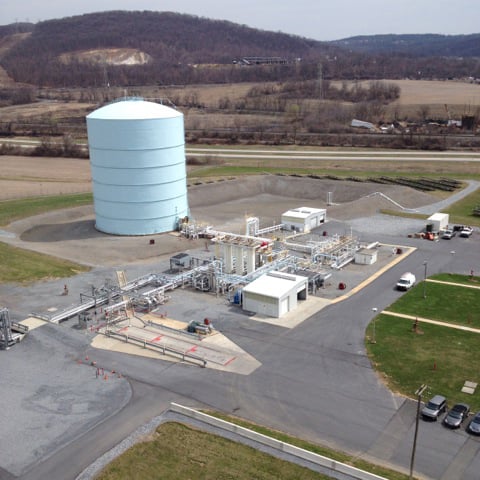
 On Monday, Dominion Energy CEO Tom Farrell reported that the company’s Lusby, Maryland Cove Point LNG export facility will become operational and begin to export LNG in “early March” (see
  The more we read about and dig into the story of Russian gas coming to Boston, the angrier we get. Just yesterday we told you that a rumored second shipment of Russian gas may be heading to Boston (see
 Earlier this month MDN brought you news that Dominion’s Cove Point LNG export facility along the shore of Maryland has delayed its official start-up until perhaps as late as April (see
  Last week MDN brought you news that Dominion’s Cove Point LNG export facility along the shore of Maryland has delayed its official start-up until perhaps as late as April (see
 This story continues to grate on our nerves–the fact that mainstream media is covering up a MAJOR scandal. What scandal? The scandal of Russian LNG banned from the U.S. coming to the U.S. (to Boston) because it was offloaded in the UK and reloaded on a different ship, to “whitewash” the gas (see