
Marc/Utica Gas Trucked to Jacksonville, FL for Use in LNG Ship
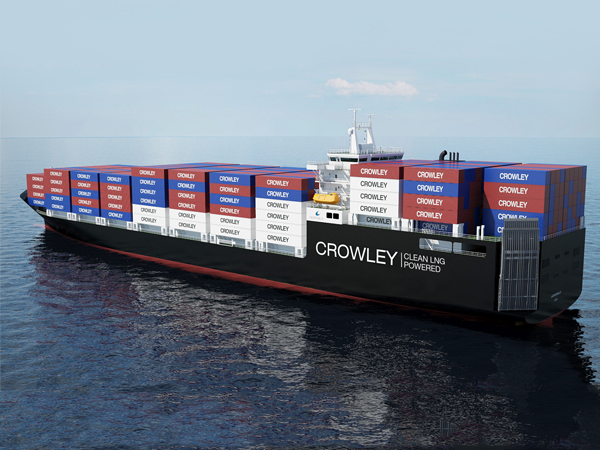
There is a trend underway for ships to use LNG (liquefied natural gas), which cuts down on pollution from using diesel and other fuels. Good trend! There is a term associated with LNG used in ships you may not be familiar with: LNG bunkering, which is the practice of providing LNG to a ship to use for its own consumption. It’s not a no-brainer to fuel up an LNG ship. It takes special equipment. Last Wednesday Eagle LNG officially opened its Maxville (suburb of Jacksonville), Florida liquefaction facility to first liquefy then transport LNG to Crowley’s new LNG bunkering facility at the Port of Jacksonville (Jaxport) where the LNG will be used to fuel Crowley’s El Coqui, the world’s first LNG-powered ship designed to carry both containerized and roll-on/roll-off cargo. First liquefy the natural gas, then get it to the fueling station (bunkering) that loads it onto the ship. The cool thing is that some of the natural gas arriving at Eagle LNG’s facility is coming from the Marcellus/Utica region, “trucked” to Jacksonville…
Read More “Marc/Utica Gas Trucked to Jacksonville, FL for Use in LNG Ship”
 The main economic development agency in Otsego County, NY, known as Otsego Now, is working on a plan to build a “decompressor” in the Oneonta area to help with natural gas supplies. The proposed facility is described as “a decompression station for compressed natural gas deliveries by truck to supplement resources.” Here’s the problem. On really cold and really hot days, there’s not enough natural gas in the region, and some large users of gas (they get gas from local utility NYSEG), actually have to stop using gas and switch to oil as a backup. It’s nuts. Apparently NYSEG (New York State Electric & Gas, owned by Spainish-based Iberdrola) isn’t in the mood to upgrade a local pipeline that brings gas to the area. So to overcome lack of gas, the local econ development people are trying to chase down grants to build a decompression station, to accept CNG from a virtual pipeline (trucked in CNG), converting the compressed gas back to normal pressure so it can flow through NYSEG’s less-than-adequate pipelines in the area to large gas users that need it…
 Yesterday a bunch of dignitaries gathered in Lusby, Maryland to celebrate the launch of Dominion’s Cove Point LNG facility with a ribbon-cutting ceremony. Yes, the facility has been up and running since April (see
  MDN has tracked the progress of an LNG export plant planned for the eastern shore of Nova Scotia, called Bear Head LNG, for the past several years (see our

 One of the arguments/concerns used to defeat a facility near Binghamton, NY that would fill trucks transporting CNG to large customers not lucky enough to be located close to a natgas pipeline is that the trucks used to haul the CNG are “bomb trucks.” Just waiting to explode if they should be in an accident. And you know that sooner or later there will be an accident. NG Advantage had big plans to build a virtual pipeline (gas compression & trucking facility) on the outskirts of Binghamton, in the Town of Fenton. The facility would use gas from the Millennium Pipeline to fill trailers outfitted with a series of CNG canisters. We sat through several information sessions where the safety of those trailers was explained. We looked at one of the rigs, up close and personal. We recall one woman from Hillcrest screeching “It’s so BIG!” upon seeing the tractor trailer–which is much shorter than a standard tractor trailer rig. We heard NG explain that if a truck should be so unfortunate to be in an accident, the safety design would automatically release the gas, which dissipates into the atmosphere immediately–making an explosion or fire extremely unlikely. But facts make no difference in a heated, emotional debate. NG isn’t the only company attempting to service businesses in Upstate with CNG, to compensate for Cuomo’s ban on safe pipelines. Another company, Xpress Natural Gas (XNG), has a virtual pipeline operation based just south of Binghamton in Susquehanna County, PA. Things are so much easier in PA (sigh). An XNG truck was traveling through Otsego County, NY, when the truck overturned on a rural roadway. We thought, this is it. Major explosion, right? Scorched earth everywhere. Ball of fire. Driver burned to a cinder. But no, none of that happened. In fact, NOTHING HAPPENED. The truck overturned, and there it sat until it was pulled back upright again. Perfectly safe, as designed. Which illustrates and exposes the lies so often spread about virtual pipeline operations…
 The Goldboro LNG export facility in Nova Scotia continues its march (shuffle?) toward construction. As we reported in February, Pieridae Energy (the builder) has enlisted the help of Morgan Stanley and Société Générale to help raise $10 billion to build it (see
 How much American-extracted natural gas should get exported? That question is the focus of a newly published study, titled “Macroeconomic Outcomes of Market Determined Levels of U.S. LNG Exports” (full copy below). The study is the fifth in a series commissioned by the U.S. Dept. of Energy (DOE). The study/research, performed by NERA Economic Consulting (NERA), looks at the impacts on the U.S. for various export scenarios. Export a lot? A little? Somewhere in between? There are 21 proposed LNG export facilities in the pipeline right now, requesting permission to export to “non-FTA” (non-Free Trade Agreement) countries. DOE wants to make the right decisions about how many of them to approve. This study and its numbers will help guide their decision-making. The study is now available for public review and comment, until July 27…
 Cove Point LNG, built by Dominion Energy, began exporting Marcellus Shale gas in April (see
  On April 22, the LNG tanker Sakura left Dominion Energy’s Cove Point LNG export facility loaded with Marcellus molecules, heading for Japan (see
  Here are some numbers that are, frankly, hard for us to wrap our heads around. LNG Allies, a nonprofit trade group, recently issued a study they conducted showing that LNG exporters will add between $716 billion and $1.267 trillion in cumulative “direct, indirect, or induced value added” to the U.S. economy by 2050. Yes, trillion, with a “t”. During the same period of time, the study says value added to the economy from supplying the natural gas to those LNG plants (that is, all of the drilling and fracking), will be worth $948 billion to nearly (gasp) $2 trillion! No wonder President Trump is pushing hard to get more LNG export plants online. Here’s a quick overview, followed by a copy of the study/slide deck…