
Judge Hears Arguments For/Against Broome Virtual Pipe, Delay Stays
 Yesterday both sides were in court in Broome County, NY to put forward their best arguments for why a natural gas transfer station (i.e. virtual pipeline) project in the Town of Fenton, near Binghamton, should (or should not) get built. We’ve covered this story from the beginning–because we like virtual pipelines which get natural gas to customers who aren’t blessed to live near a pipeline, and because we live about 10 miles from the proposed site. NG Advantage wants to build a virtual pipeline operation in a suburb of Binghamton. The location NG picked, after considering up to six other locations in the region, was selected because of it’s proximity to major highways, proximity to the Millennium Pipeline, and availability of high-power electric lines. A virtual pipeline is nothing more than a compressor plant (series of compressor plants) that grabs gas from a pipeline, in this case the Millennium, and compresses it and loads it onto special tractor trailers that then deliver the gas to industrial customers like manufacturing plants, hospitals, and even small regional gas distribution systems servicing residential homes. The location NG selected, in the Town of Fenton (within spitting distance of residential communities Hillcrest and Port Dickinson) was approved by the Town of Fenton after a detailed review. The area NG selected is zoned industrial and is, in fact, a former dump site. However, residents from nearby neighborhoods in Hillcrest and Port Dick were not aware of the project (so they claim) and when construction began to clear the dump site, and residents learned what was going to be built at the site, some of them demanded court action to oppose it. Two court cases have been filed and a local judge has temporarily stopped construction at the site. Yesterday that judge heard arguments for and against. NG Advantage CEO Rico Biasetti was encouraged by the judges questions…
Read More “Judge Hears Arguments For/Against Broome Virtual Pipe, Delay Stays”
 For the past few years, MDN has tracked the progress of an LNG export plant planned for the eastern shore of Nova Scotia, the Bear Head LNG project (
 In May 2015, MDN brought you news that UGI Energy Services, a subsidiary of northeast PA utility giant UGI Corporation, announced they will spend $60 million to build a new LNG production plant in Wyoming County, PA (see
  Recently Broome County (NY) Executive Jason Garner sounded the alarm about county finances. He compared Broome County’s economic situation to the Titanic. The New York State Comptroller’s office issued a report in September 2016 that said Broome County has been in fiscal stress over the past three years. Thank you Gov. Cuomo for banning fracking–the one thing that could have pulled us out of the hole. With all of the bad news, you would think Broome County would be a cheerleader for a proposed “virtual pipeline” project from NG Advantage, planned for the Town of Fenton in a Binghamton suburb. In fact, Fenton approved the project (after a detailed review), and construction began in June (see
  NG Advantage wants to build a “virtual pipeline” operation in ultra-liberal Broome County, NY, in a suburb of Binghamton. The location NG picked, after considering up to six locations in the region, was selected because of it’s proximity to major highways, proximity to the Millennium Pipeline, and availability of high-power electric lines. A virtual pipeline is nothing more than a compressor plant (series of compressor plants) that grabs gas from a pipeline, in this case the Millennium, and compresses it and loads it onto special tractor trailers that then deliver the gas to industrial customers like manufacturing plants, hospitals, and even small regional systems servicing homes. The location NG selected, in the Town of Fenton (within spitting distance of Hillcrest and Port Dickinson) was approved by the Town of Fenton after a detailed review. The area they selected is zoned industrial and is, in fact, a former dump site. However, residents from nearby neighborhoods (Hillcrest and Port Dick) were not aware of the project (so they claim) and when construction began to clear the dump site, and residents learned what was going to be built at the site, some of them demanded court action to oppose it. So far we’ve had two court cases asking county-level court (called “Supreme Court” in NY) to stop the project, which it temporarily did (see
 This week has been “Energy Week” at the White House, and yesterday President Trump (we just love saying that, “President Trump”) announced six new initiatives not to just make America energy independent, but to make America energy dominant. We love that too! Energy DOMINANT. Throughout the world. Number one. One of the six initiatives in Trump’s plan was the announcement that Sempra Energy is in negotiations with South Korea to sell them our LNG (liquefied natural gas, see more on that below). That’s a good thing! No doubt some of the gas heading to the Korean peninsula will come from the Marcellus/Utica. Another of the six initiatives announced yesterday is approval for two applications to export LNG from Louisiana. And a yet another initiative involves more offshore drilling for oil and gas. So half of the initiatives announced somehow impact or relate to natural gas (two of which also impact Marcellus/Utica). Here’s the full list of six initiatives announced yesterday in a speech by President Trump…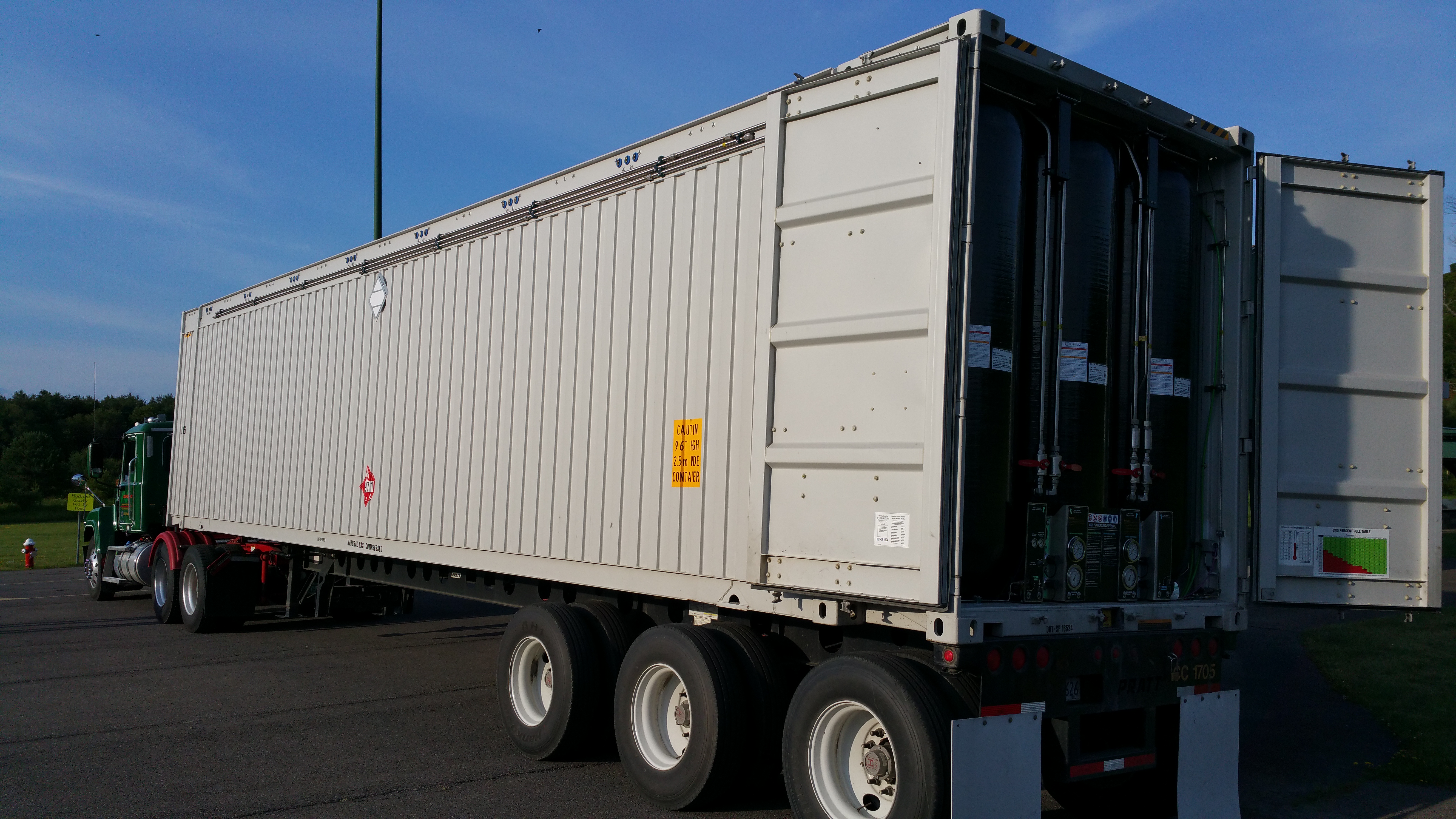
 Air Products owns a manufacturing plant located on the outskirts of Wilkes-Barre, PA. If you’ve ever heard of the Air Products business, you may conjure up an image of small cylinder tanks of helium or other “rare” gases sitting inside a chain fence. Yes, Air Products sells gases by the tank, but they also manufacture the mother of all gas tanks in their Wilkes-Barre facility–huge rocket-looking “production trains” or “heat exchangers,” which are pieces of equipment that turn natural gas into liquefied natural gas, or LNG. The heat exchangers manufactured by Air Products in Wilkes-Barre are two-thirds of a football field long (180 feet), used by plants all over the world to condense natural gas into a liquid. We’ve written about Air Products a few times, theorizing some of the heat exchangers they manufacture are being used by plants to liquefy Marcellus/Utica gas (
 The Maine Public Utilities Commission (PUC) recently declined to help fund a new LNG peakshaving facility in the state, concluding it would not reduce consumer natural gas and electricity prices. Er, a, what’s an LNG peakshaver anyway? Good question! According to industrial engineering company Fives, “LNG peak shaving units are used for storing surplus natural gas, so as to be able to meet the requirements of peak consumption later during the different seasons. Gas distribution companies and local administrations use this application to be more flexible in their consumption of natural gas. Thanks to these Liquid Natural Gas (LNG) peak shaving units, they will be able to face periods of peak consumption during cold winter times and extreme summer heat. Peak shaving can also be used to keep natural gas prices from soaring during periods of high gas consumption.” That helps. They are small LNG plants that kick in when demand for natural gas exceeds supply. There are 44 such peakshaving tanks at 29 locations in the northeast. Last September the Maine legislature authorized the PUC to spend $25 million on leasing capacity at a peakshaving plant, if they could find the right plant to do it. A number of projects were submitted, and the PUC said nyet–they don’t like any of them and don’t think a peakshaver will be needed going forward…