
PA Court Says Snyder Bros Wells are Strippers, No Impact Fees Due
 In 2014 MDN brought you the interesting story of strippers in the Marcellus–stripper wells, that is (see High-Priced Strippers in PA: Semantic Gymnastics with Impact Fee). Synder Brothers is an oil/gas producer in Pennsylvania. Most of the wells they drill are vertical-only wells. Among them are 24 wells from 2011 and 21 wells from 2012 that are vertical only–but all targeting the Marcellus. According to the definition of a stripper well under the Act 13 law passed in 2012, a well qualifies as a stripper well if it doesn’t produce over 90 thousand cubic feet (Mcf) of natural gas per day for at least one month. Synder Bros. says although their wells may have produced over 90 Mcf in some months, they didn’t produce that much in at least one month during the years in question. Ergo, their wells qualify as stripper wells and not liable to pay an impact fee. The PA Public Utility Commission (PUC), charged with evaluating what does and does not qualify, said nope–your wells target the Marcellus formation and produced above 90 Mcf for “at least” one month out of the year, therefore must pay the impact fee. So the PUC sued Snyder Bros., intending to collect $500,000 in unpaid fees PLUS a $50,000 fine for inconveniencing the PUC (see PA PUC Sues Snyder Bros to Collect $500K in Unpaid Impact Fees). In January of this year, more than a year after first hearing the case, PA Commonwealth Court wanted to hear it all over again (see High-Priced PA Strippers Go Back to Court, Impact Fee Semantics). The court has finally ruled: the law clearly means if production is less than 90 Mcf in any single month, that well is a stripper. Snyder Bros. doesn’t have to pay the $500K impact fee on those wells…
Read More “PA Court Says Snyder Bros Wells are Strippers, No Impact Fees Due”
 As MDN reported, last week U.S. District Judge Robert Mariani ruled against a Wayne County landowner in a lawsuit that challenged the right of the Delaware River Basin Commission (DRBC) to stop fracking in the Delaware River Basin (see
  Good news for Pennsylvania drillers: the PA Dept. of Environmental Protection (DEP) finally, after years of review, granted permission to two different companies to operate two new wastewater injection wells in the Keystone State. One well is located in Elk County, the other in Indiana County. With these two new injection wells coming online, the state will have a total of eight operating injection wells (vs. hundreds in Ohio). You may have seen news about the newly authorized injection wells from other news sources yesterday. But you read MDN for “the rest of the story.” And here it is, something you won’t find anywhere else (until other news sources read MDN): As soon as the DEP issued the permits for the injection wells, the DEP filed lawsuits against the two townships where the injection wells will be located, because both of those townships–Highland Township in Elk County, and Grant Township in Indiana County–had previously passed so-called Home Rule Charters in an attempt to prevent the injection wells from being located in their towns. The DEP has sued each of them (copy of the Highland lawsuit below) to correct laws that attempt to prevent the DEP from doing its job in authorizing the injection wells. We have the full news of the DEP’s decision to permit the injection wells, along with details about the lawsuits, below…
 Last week MDN brought you the news that a federal judge had dismissed a case brought by the Constitution Pipeline against the New York Dept. of Environmental Conservation (DEC) over the issue of denying water crossing permits for the project (see
  In May 2016 a landowner in Wayne County, PA–in the Delaware River Basin–filed a lawsuit against the Delaware River Basin Commission (DRBC) asking a judge to declare the DRBC does not have jurisdiction to prevent construction of a natural gas well (see
  Radical green agitating groups, including the Sierra Club, Lancaster Against Pipelines, Lebanon Pipeline Awareness, Allegheny Defense Project, Clean Air Council, Concerned Citizens of Lebanon County, and Heartwood, have filed a lawsuit in the liberal U.S. Court of Appeals for the District of Columbia in an attempt to block construction of the $3 billion Atlantic Sunrise Pipeline project in Pennsylvania. Instead of waiting for the Federal Energy Regulatory Commission (FERC) to consider a so-called re-hearing of their decision to authorize Atlantic Sunrise, a group of radical green organizations are jumping the queue and going directly to court, demanding that a judge stop construction until a quorum is in effect at FERC. Yes, it’s all complicated. We’ll break it down for you. What you need to know up front is that more Big Green money is behind the lawsuit to stop Atlantic Sunrise…
 As we reported yesterday, a federal judge dismissed a lawsuit filed a year ago by THE Delaware Riverkeeper against the Federal Energy Regulatory Commission (see
  Ryan Regec owns 78 acres in Schuylkill County, PA (eastern part of the state). He plans to subdivide the property into smaller properties and sell the building lots–but the Atlantic Sunrise Pipeline is coming through a portion of the property, and Mr. Regec says that means he can’t subdivide and sell it the way he planned. Regec has, in the past, allowed surveyors from Atlantic Sunrise on his property–but recently has refused. Atlantic Sunrise (i.e. Williams) took him to court to force access to complete their surveys, and Williams just won. A judge for the U.S. Middle District Court in PA issued an order allowing Atlantic Sunrise access. A spokesman for the pipeline says the pipeline will only cut through a small portion of Mr. Regec’s 78 acres. Regec claims his subdivision plans will be destroyed. Who’s right?…
 Last year an elaborate midstream drama unfolded before our very eyes. Energy Transfer Equity (ETE) pushed and prodded and poked and cajoled and insisted, and finally with the help of an inside corporate raider, forced Williams to agree to a buyout/merger (see
  It took a whole year, but a federal court has just thrown out a frivolous lawsuit filed by Maya van Rossum, THE Delaware Riverkeeper, which attempted to defund the Federal Energy Regulatory Commission (FERC). Last year MDN reported on the lawsuit filed by Maya and company–a lawsuit which aimed to shut down the entire agency by defunding it (see
  MDN has previously highlighted the importance of last year’s Ohio Supreme Court decision with regard to the Ohio Dormant Mineral Act (DMA). In September 2016 the OH Supreme Court ruled in three DMA cases, saying all of the other cases come under those three (see
  A disappointing setback for the much-needed Constitution Pipeline–a $683 million, 124-mile pipeline due to run from Susquehanna County, PA to Schoharie County, NY carrying Marcellus gas. As you may recall, in April 2016, New York’s anti-drilling governor, Andrew Cuomo, decided he would cave to pressure from radical environmentalists and block the building of the federally-approved Constitution Pipeline (see
  What if a landowner leased his or her land decades ago and a driller drilled a conventional natural gas well on the property, and that well has produced commercial volumes of natural gas for years–and still does. And what if the lease gives that driller the right to drill (or not drill) in any given rock lawyer. And what if that driller is content to simply let that conventional well keep producing and not drill further down, into the now commercially viable Utica (or Marcellus) shale layer? Does the landowner, whose land is located where the Utica/Marcellus exists, have any case for taking back the rights to the deeper shale layers the conventional driller refuses to go after? That’s a case that has now worked its way all the way to the Ohio Supreme Court. The question turns on whether or not “reasonable development” in a lease includes unexplored, deep formations…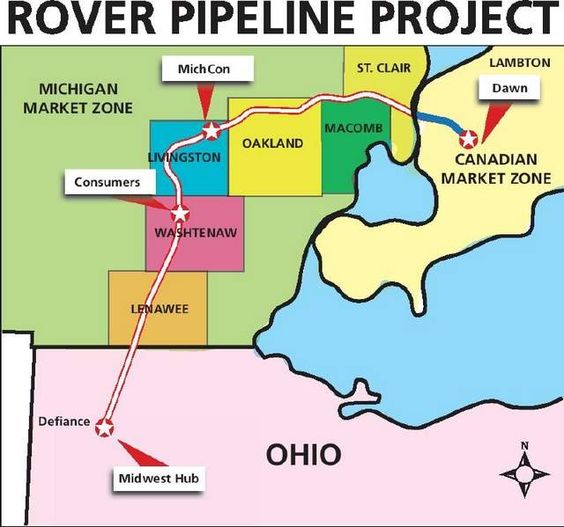
 New York’s corrupt Attorney General, Eric Schneiderman, is getting desperate. We want to go on record as one of the first to say he’s sowing the seeds of his own destruction. Schneiderman is a train wreck waiting (and about) to happen. We refer, of course, to Schneiderman’s eerie similarity to Captain Ahab in Moby Dick in attempting to hunt down ExxonMobil, Schneiderman’s great white whale. Recently Schneiderman, in cooperation with a sycophantic mainstream media, released information that former CEO Rex Tillerson (now Secretary of State) had a second email account. But unlike Hillary Clinton, Tillerson’s second account was not on a private server and was not used (as Schneiderman alleges) to secretly discuss how Tillerson “knew” burning oil and other fossil fuels causes mythical man-made global warming. Schneiderman’s action in running to the press to “reveal” a “secret” email account is a faint–a way to misdirect people from the real story, which is that Schneiderman continues to refuse to disclose his own emails that prove this whole Exxon witch hunt began when Schneiderman colluded and closely coordinated with the Rockefeller Brothers Fund, Rockefeller Family Fund, and billionaire green activist Tom Steyer. A log of emails shows coordination just prior to the launch of the #ExxonKnew campaign for which Schneiderman is the point man. He’s desperate to avoid releasing his own emails–emails that will implicate him…
 A group of approximately 250 Ohio landowners, represented by an Ohio eminent domain law firm, is doing its best to stop Energy Transfer’s Rover Pipeline project dead in its tracks. Rover is playing beat the clock to finish tree clearing following a Federal Energy Regulatory Commission (FERC) final approval of the project on Feb. 3 (see