Industrywide Issues

  • |

    IHS Markit Says October Saw Historic Drop in US NatGas Production

    ihs-markitIHS Markit, an information and analytics company that keeps a close eye on the energy industry, says its analysis shows natural gas production in the U.S. went down “nearly 2%” in October from September. It doesn’t sound like much, but it’s a big deal. Production levels in South Texas and the Northeast, according to VP Jack Weixel, “fell off a combined 1.3 Bcf/d from September to October.” That is the largest regional month over month decline IHS Markit has seen since it began tracking these numbers. What does it mean? Typically it means higher prices are coming–less supply, the same or increasing demand equals higher prices (classic economics 101 stuff). However, there are so many complex and contributing factors, it’s not as simple as less supply = higher prices. Not anymore! Here’s what IHS Markit is saying…
    Read More “IHS Markit Says October Saw Historic Drop in US NatGas Production”

  • | |

    U.S. Ethane, Including Marcellus/Utica, Now Supplies 4 Continents

    ethane-crystalOne of the more interesting stories over the past year has been the export of Marcellus/Utica ethane to other countries, for use in their ethane cracker plants. Just last month we told you how northeast ethane gets transported to Texas, then loaded on Samsung ships and sails off to India (see Marcellus/Utica Ethane Heads to India via Texas on Samsung Ships). We spotted another article about U.S. ethane, who sells it and who (in the world) buys it. We don’t know for sure, but we’re guessing something approaching half of the ethane that gets exported now comes from our region–so the article below that details where the ethane ships from, and who buys it, is actually the story of Marcellus/Utica ethane…
    Read More “U.S. Ethane, Including Marcellus/Utica, Now Supplies 4 Continents”

  • | | |

    Dakota Access Pipeline Radicals Protest in…Scranton?

    enviro naziDon’t say we didn’t warn you. On Oct. 20 MDN reported on the link between so-called protesters (i.e. criminals) who have gathered in North Dakota to protest a federally-approved oil pipeline called the Dakota Access Pipeline (see Dakota Access Pipeline Protesters Turn Violent; Coming Here Next?). We told you about their violent behavior, papered over by national media as “peaceful protests by a bunch of earth-loving Soux Indians.” Hogwash. Most of the people “protesting” are from out of state, and are being funded by Big Green donors–sent there to perpetrate violence. And guess what? That’s just what they do (see Police Remove Pipeline Protesting THUGS from Private Land in ND). So what was/is the connection with the Marcellus/Utica? Some of the Dakota “protest” leaders, drunk on their “success” have publicly stated they’re coming here next. And come they have this past weekend to Scranton, PA…
    Read More “Dakota Access Pipeline Radicals Protest in…Scranton?”

  • | | | | | | |

    PA Senators File to Join Case Against DRBC Fracking Moratorium

    lawsuitIn May MDN told you about a group of brave landowners in Wayne County, PA who have had their property rights stolen by the Delaware River Basin Commission (see Wayne County, PA Landowner Sues DRBC Over Fracking Ban). They filed a lawsuit against the DRBC asking a judge to declare the DRBC does not have jurisdiction to prevent construction of a natural gas well. Several northeastern PA counties (unfortunately) are located in the Delaware River Basin and the DRBC has steadfastly refused to allow them to drill any shale wells, citing concerns that the Delaware River supplies fresh water to millions downstream–even though they can’t explain how that water might get contaminated. A few months later, the DRBC’s best friend and patron, THE Delaware Riverkeeper, sued to join the lawsuit to help defend the inept DRBC (see Delaware Riverkeeper “Intervenes” to Protect its Patsy – the DRBC). Last week three PA senators filed to join the lawsuit on behalf of the landowners that they represent. Predictably, THE Delaware Riverkeeper wants to prevent the senators from joining the lawsuit…
    Read More “PA Senators File to Join Case Against DRBC Fracking Moratorium”

  • | | | | |

    FirstEnergy Selling 4 NatGas-Fired Electric Plants in PA

    for-sale-sign.jpgThe energy industry in our country is complicated and takes a while to wrap your brain around just how it works. Especially the utility industry. Companies that produce and then distribute electricity (and natural gas) are in some cases regulated by the government–meaning what they charge is strictly controlled–and in some cases not regulated. Some local utilities produce the electricity, via a nuclear plant, or coal-fired generating plant, or natural gas-fired plant, as well as distribute that electricity to customers. Other utilities just distribute the electricity. And still others just produce the electricity. Sometimes producing electricity is regulated by the government (i.e. price controlled) and other times it is not. Is your head spinning yet? FirstEnergy, based in Akron, OH, is one of the nation’s largest investor-owned electric systems, serving customers in Ohio, Pennsylvania, New Jersey, West Virginia, Maryland and New York. FirstEnergy owns a variety of regulated and non-regulated power generation plants. Last Friday the company announced it will sell six power generating plants in PA, four of them natural gas-fired plants. The plants being sold are non-regulated. This is part of FirstEnergy’s strategy to become a 100% “regulated” utility in the next 18 months. Which plants are going on the auction block?…
    Read More “FirstEnergy Selling 4 NatGas-Fired Electric Plants in PA”

  • |

    Hi-Crush Intros New Sand Delivery System

    hi-crushHi-Crush Partners, headquartered in Houston, TX, is a frac sand company. Even though the company is based in TX and has sand mines in Wisconsin, it owns and operates the largest frac sand distribution network in the Marcellus and Utica Shale region. Last week Hi-Crush announced the first successful test and roll out of something they call PropStream–a new and better way to get sand to the well site and into the well itself. Hi-Crush has also formed (with investors) a new subsidiary company called PropX to manufacture the equipment used by the PropStream system…
    Read More “Hi-Crush Intros New Sand Delivery System”

  • |

    Texas Pipeline Reversals Needed to Get M-U Gas to Gulf Coast

    reversalWe’ve written about various pipelines either planned or under construction that will, by joining with other pipelines, haul Marcellus/Utica natural gas (and/or natural gas liquids) all the way to the Gulf Coast. However, the pipes hauling our gas to the Louisiana/Texas borders are one thing. But then the gas has to go the final leg of the journey through Texas (or Louisiana) to the Gulf Coast area where it gets used in petrochemical plants, like crackers or liquefied and exported as LNG. A recent RBN Energy blog post points out the big pipes hauling our gas to Texas and Louisiana are, in many ways, the easier projects to build. Getting it “the last mile of the way” to the Gulf Coast is the more difficult task. It involves reversing pipelines and tieing systems together. Here are six projects in the works to accomplish the mission of getting our gas all the way to the Gulf Coast…
    Read More “Texas Pipeline Reversals Needed to Get M-U Gas to Gulf Coast”

  • | | |

    Report: What if Fracking was Banned, as Hillary Wants?

    Chamber of CommerceThe U.S. Chamber of Commerce recently launched a “What If…?” series to counter the radical “keep it in the ground” movement–a movement that irrationally hates the use of fossil fuels. In August the Chamber released their first such report, titled “What If…Energy Production was Banned on Federal Lands and Waters?” (see Chamber Report Details Why ‘Keep it in the Ground’ a Disaster). In Sept. they released their second report (see Report: What If America’s Energy Renaissance Never Happened?). In Oct. they released the third report (see Report: What If the U.S. was Forced to Pay EU Energy Prices?). Last Friday the Chamber released the fourth report in the series, very timely considering the election tomorrow. The newest in the series is titled, “What If…Hydraulic Fracturing Was Banned?” (full copy below). Under a Hillary Clinton presidency, that’s a very real possibility. Clinton said during the Democratic debates not many months ago: “By the time we get through all of my conditions, I do not think there will be many places in America where fracking will continue to take place” (see A President Hillary Clinton Would Ban Most Fracking). Either she didn’t really mean what she said and she lied, or she did mean it. We tend to think it’s the later. So what would happen if fracking were essentially banned nationwide? According to research by the Chamber, by 2022 the country would lose 15 million jobs now created by fracking (in addition to the 94 million workers without jobs now), and everyone would pay twice (or more) than they do now for electric & gasoline. Not a pretty picture…
    Read More “Report: What if Fracking was Banned, as Hillary Wants?”

  • | |

    EIA: Horizontal Fracked Wells Superior Performers

    EIAWe laugh every time we read about peak oil and peak natural gas theorists, and mainstream “reporters” from places like the New York Times trumpeting that any day now natural gas is going to peter out. It’s just a flash in the pan. “Everybody” knows that shale wells are weak, pathetic performers than run out of juice almost as fast as their drilled. We’ve read stories about how shale drilling is a ponzi scheme. We’ve read stories that very soon we’ll run out of new places to drill, and then it’s all over. Except…except it’s all not true. None other than the U.S. Energy Information Administration has just posted a brief article that details, using real research, that horizontally drilled shale wells are MORE productive over the long-term than conventional wells. That is, they are more productive for longer than a conventional well. But that won’t stop the peakers and ponzi schemers from pedaling their pap…
    Read More “EIA: Horizontal Fracked Wells Superior Performers”

  • | | | | | |

    Atlas Energy Not Liable in PA Rig Worker’s Death

    Gavel-falling.jpgThis is an important story for both drillers and rig workers, potentially answering the question of who can and can’t be sued if something goes wrong when drilling a well. In 2006 Atlas Resources leased land in Greene County, PA to drill shale wells. In 2007 Atlas hired Gene D. Yost & Son, Inc. to drill wells for Atlas, including on the land leased in Greene County. Yost was the subcontractor, employing people to do the work using Yost’s equipment. As workers were removing drill pipe, preparing to shut in the well, there was an accident which appears to be operator error. One man, Rock A. Doman, was killed. The Doman family later filed a wrongful death lawsuit against Atlas Energy for negligence. After years of litigation and court findings, an appeals court ruled last week that Atlas is, in fact, a “statutory employer” under PA law, meaning they are immune from such lawsuits. That is, because Atlas hired another company for that company’s services, they (Atlas) cannot be held responsible for what the company they hired theoretically did or did not do. In this case, Yost’s “negligence” (if indeed there was any negligence) is not transferable to Atlas…
    Read More “Atlas Energy Not Liable in PA Rig Worker’s Death”

  • | | | |

    MarkWest Says Cracker Plants are “the End Game”

    end-gameThis story reaches back just a bit, but we found it interesting and instructive. On Thursday, Sept. 29, MarkWest Energy gave a tour of its facilities in eastern Ohio. Ethane was one of the big topics of discussion. During that discussion, MarkWest’s vice president of operations, Dave Ledonne, said this about the announced Shell and hopefully soon-to-be announced PTT Global ethane cracker plants: “The cracker plants are the end game. They are what we really need.” What did he mean?…

    Read More “MarkWest Says Cracker Plants are “the End Game””

  • | | | | |

    Expert Says OH DMA Decision “Significantly Changed” Mineral Rights

    game-changer.jpgMDN has been reporting on the Ohio Dormant Minerals Act (DMA) for years. In a nutshell, there are two DMAs in Ohio–one passed in 1989 that went into effect in 1992, and another in 2006 which added certain additional procedural requirements to the 1989 version. The DMA in its various versions provides for mineral rights that had previously been separated from surface rights to transfer back to the surface owner under certain conditions. The problem, for drillers and for landowners in Ohio, is in knowing which set of DMA rules to use (1989 or 2006) in determining who owns the mineral rights. A number of DMA cases went before the Ohio Supreme Court. In May, Ohio attorney David Wigham (Roetzel & Andress law firm) said there are signs that the Supremes were about to release a massive, all-in-one-go ruling on the DMA (see OH Attorney Predicts DMA Ruling to Come Soon, Settle Now). He was right. In September they did rule in three cases, saying all of the other cases come under those three (see Important: OH Supreme Court Finally Rules on Dormant Mineral Act). Following that ruling, we brought you insights on what it all means from international law firm Jones Day (see One More Look at Important OH Supreme Court DMA Decision). Since the series of DMA decisions are so important to both drillers and landowners, we thought we would bring you follow up analysis from the lawyer who predicted it was coming–David Wigham. In speaking about the decision, Wigham says, “[T]he landscape regarding title and ownership to mineral interests in Ohio has significantly changed”…
    Read More “Expert Says OH DMA Decision “Significantly Changed” Mineral Rights”

  • | |

    THE Delaware Riverkeeper to Convene Hearing on “FERC Abuse”

    abuse-of-power.jpgThough often we’re irritated, sometimes we simply marvel at the arrogance of organizations like THE Delaware Riverkeeper. They honestly think they know better than you what kind of energy you should have the right to buy. The people who run the organization (Maya van Rossum, who is THE self-appointed keeper of the Delaware River Basin), irrationally hate all fossil fuels. Even though Maya & company use those fossil fuels every day of their lives. In fact, even though their lives DEPEND on fossil fuels. van Rossum and those who follow her philosophies have settled on a new strategy to try and defeat the use of fossil fuels: stop all new pipeline development. Period. The only way they can do that is to bully and intimidate federal and state agencies–like the Federal Energy Regulatory Commission (FERC) and the Pennsylvania Dept. of Environmental Protection (DEP). Currently it’s FERC in Maya’s cross-hairs. Maya and THE Delaware Riverkeeper are convening a meeting in Washington, D.C. at the National Press Club (nice place, we’ve eaten there) called “People’s Hearing Investigating FERC.” You read that right. In an attempt to bully and humiliate the hard-working people at FERC, Maya plans to initiate a media circus to pressure FERC into denying, among other projects, the PennEast Pipeline. She’s billing the event as a hearing for those who “have experienced abuse at the hands of FERC and the pipeline industry.” We’re mulling over the possibility of a hearing into those abused by Maya and THE Delaware Riverkeeper. We thing we’d have a pretty strong case…
    Read More “THE Delaware Riverkeeper to Convene Hearing on “FERC Abuse””

  • |

    EIA Natural Gas Oct 2016 Monthly Report

    EIAThis past Monday, Oct. 31, our favorite government agency (the U.S. Energy Information Administration) issued their Natural Gas Monthly report. The report covers data received up through August 2016. Even though the data is a couple of months old, it is instructive (and interesting). EIA says the month report, “highlights activities, events, and analyses of interest to public and private sector organizations associated with the natural gas industry. Volume and price data are presented each month for natural gas production, distribution, consumption, and interstate pipeline activities. Producer?related activities and underground storage data are also reported.” We found the report interesting as we scanned through it and thought you would too…
    Read More “EIA Natural Gas Oct 2016 Monthly Report”

  • | | | | | |

    OH Supreme Court: Royalty Deductions Decided Case-by-Case

    Gavel-falling.jpgLast year the Ohio Supreme Court accepted a case that will sound familiar to readers of MDN. The case, known as Lutz v. Chesapeake Appalachia, is about whether or not drillers (Chesapeake in this case) is allowed to deduct certain post-production costs from landowner royalty checks. That debate currently rages in Bradford County, PA–as well as other locations across the country. In the Ohio case, the high court was asked to decide whether Ohio follows the “at the well” rule, which permits the deduction of post-production costs, or if the state follows the “marketable product” rule, which limits the deduction of post-production costs under certain circumstances. Drillers and landowners have a lot riding on the decision. The Supremes came down off Mount Olympus yesterday to render their verdict (full copy of the decision below). The court said in so many words, “We’re not deciding.” In other words, each royalty case should be litigated individually, case-by-case, in a trial court. There is no one-size-fits-all with respect to deducting expenses from royalty checks. Each case will depend on how the contract is written, and the success of lawyers litigating it…
    Read More “OH Supreme Court: Royalty Deductions Decided Case-by-Case”

  • | | |

    Spectra Energy Changes Strategy re New England Pipeline

    MAP-Access-Northeast-V1-02-11-2015
    Click for larger version

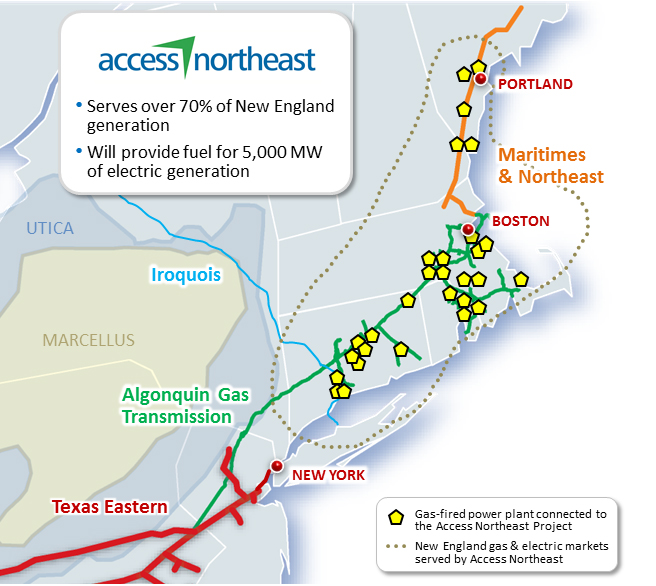
    Spectra Energy’s Access Northeast Pipeline project, a roughly $3 billion project to connect four existing pipeline systems (with enhancements): Texas Eastern, Algonquin Gas Transmission, Iroquois and Maritimes & Northeast, has suffered a string of setbacks. Spectra’s original strategy was to bring natural gas to New England by cutting deals with electric companies who need the gas to produce cheaper electricity at their natgas-fired power generation plants. However, the green environmental Nazis came out in force against the plan, (sadly) aided and abetted by Spectra’s competitors, and those plans are now in ruins with three states blocking any such plans (see MA Supreme Court Ruling Endangers New England Gas Pipelines; NH Regulators Veto Access Northeast Pipeline Contract; and CT Latest New England State to Give Up on NatGas Cooperation). Spectra is not yet ready to give up. They’re changing strategies. Spectra says there are still some electric power generators on board (those that don’t need regulatory approval), and to make up the difference, Spectra is now targeting local natural gas distribution companies (LDCs) as potential customers. Spectra needs customers to sign on the dotted line–committing to long-term contracts–before they can raise the funding and build the project. This change in strategy means the project now won’t go online until 2019. Will the change in strategy actually work?…
    Read More “Spectra Energy Changes Strategy re New England Pipeline”