
Gaslighting Mass. Governor Says She’s Never Blocked Pipelines
 In 2022, then-Massachusetts Attorney General (now Governor) Maura Healey bragged she had “stopped two gas pipelines from coming into this state” and that she opposes new natgas infrastructure in the state. Her claim is captured on video. She now says she has “never stopped gas pipelines from entering the state” and that natural gas is an essential energy source in Massachusetts. Healey is taking fire from both sides for gaslighting (lying about) her opposition and now supposed support for natural gas pipelines. Read More “Gaslighting Mass. Governor Says She’s Never Blocked Pipelines”

 We’re not big fans of the American Petroleum Institute (API), which tends to do the bidding of the Big Oil companies that fund it. Big Oil’s aims are sometimes at odds with those of smaller, independent oil and gas producers—the innovators who discovered shale drilling. Yet there are state chapters of the API that do a good job. One of them is the Pennsylvania API chapter. The executive director of PA API, Stephanie Catarino Wissman, recently published an excellent article in Broad+Liberty that calls for fast-tracking the effort to pass federal permit reform so Pennsylvania can get back to building.
  In August, the Federal Energy Regulatory Commission (FERC) reissued a certificate for the Northeast Supply Enhancement (NESE) project, a billion-dollar-plus project designed to increase Transco pipeline capacity and flows of Marcellus gas heading into New York City and other northeastern markets by an extra 400 MMcf/d (see
  Radical environmentalists once again have their knickers in a twist. When don’t they? In August, the Federal Energy Regulatory Commission (FERC) reissued a certificate for the Northeast Supply Enhancement (NESE) project, a billion-dollar-plus project designed to increase Transco pipeline capacity and flows of Marcellus gas heading into New York City and other northeastern markets by an extra 400 MMcf/d (see
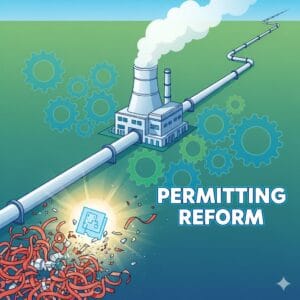
  One of the environmental left’s favorite tactics to defeat fossil fuel projects is to challenge every single infrastructure project (pipeline or otherwise) connected to fossil energy at the Federal Energy Regulatory Commission (FERC). As soon as a company files an application to build a new project, and FERC approves it, Big Green will challenge it, first at FERC, and eventually via the courts. FERC has an internal rule, called Order No. 871, that states a company cannot begin construction (even though FERC has approved the certificate) until all such legal challenges are resolved, which can take YEARS. Which is the point—delay, and eventually, some of the projects will give up and won’t build. Run out the clock. Two days ago, FERC issued a new rule eliminating Order No. 871 rule, meaning construction can now begin months and years sooner, even while appeals continue. The enviro-left just lost one of its most potent weapons.
  We finally have all five members in place for the Federal Energy Regulatory Commission (FERC). Yesterday, the U.S. Senate, despite the best efforts of Democrats to further delay confirmation votes for *any* Trump appointments, voted to confirm a slate of over 100 new appointments, including two new members of FERC, on a party-line vote of 51-47. In June, President Trump nominated Laura Swett of Vison & Elkins to replace Republican Mark Christie, who had been elevated to Chairman under Trump (see
  In April, MDN told you about a new greenfield expansion of Kinder Morgan’s Elba Express pipeline into South Carolina to serve growing demand for natural gas in the state (see
  Energy companies are set to invest nearly $50?billion over the next five years in building or expanding 8,800 miles of U.S. natural gas pipelines to meet soaring domestic consumption, record LNG exports, and growing data center demand, greatly aided by regulatory changes under President Trump. Surging gas production, particularly in the Permian Basin as a byproduct of crude oil output, has outpaced pipeline and processing capacity, resulting in occasional negative Waha prices and production slowdowns. Major operators, such as Kinder Morgan and Enbridge, face record backlogs but continue to expand, especially in Texas and the Gulf Coast, with future gas growth tied to sustained oil prices.
 DT Midstream, Inc. announced yesterday that it has closed a successful binding open season (signup period) to award expansion capacity on its Guardian Pipeline. DT awarded capacity to five shippers totaling 328 MMcf/d (million cubic feet per day, equivalent to 328,000 dekatherms per day) with a targeted in-service date of November 1, 2028. Guardian is an approximately 260-mile interstate pipeline with a current capacity of approximately 1.3 Bcf/d (billion cubic feet per day) serving key Wisconsin demand centers. And yes, Guardian flows at least some Marcellus/Utica molecules.
 Here’s a court case that slipped under our radar. Antero Resources Corporation challenged the Federal Energy Regulatory Commission’s (FERC) approval of a two-tier fuel rate structure imposed by Tennessee Gas Pipeline Company (TGP) following an expansion project. Antero had contracted with TGP to secure firm transportation capacity by funding the construction of new compressor stations, which are energy-intensive and require substantial fuel to operate. The tariff approved by FERC stipulated that Antero would always be charged the highest marginal fuel rate, as if its gas were the last and most expensive to transport through the pipeline. In contrast, other shippers paid an average fuel rate, leading to Antero paying two to three times the fuel rate of other shippers on the same pipeline segment.
  Speaking at the Sept. 30 Northeast Energy and Commerce Association 2025 Fuels Conference, gas pipeline executives expressed optimism that shifting federal and state politics in New England are creating opportunities for natural gas infrastructure expansion. Panelists emphasized the need to alleviate regional gas constraints to support the growth of electric generation and data centers. Speakers also highlighted the complementary role of LNG infrastructure, the challenge of financing new pipelines, and urged Massachusetts to reconsider strict decarbonization targets to ensure energy reliability.
  The Tennessee Valley Authority (TVA) is the sixth-largest power supplier and the largest public utility in the country. In 2021, MDN told you that TVA is spending over $1 billion to replace six coal-fired plants with natgas-fired turbines (see
  It took over two years, but NextEra Energy finally sold its ownership interest in Meade Pipeline Co LLC to investment company Ares Management Corporation for $1.1 billion. You may recall that NextEra acquired Meade Pipeline for $1.37 billion in 2019 (see