
Big Green Says NY Gov. Hochul is “Smoothing the Path” for Gas Pipes
 Last week, we told you that, although she has not publicly admitted it, New York Governor Kathy Hochul has approved the Northeast Supply Enhancement (NESE) pipeline project (see NY Antis Launch Pledge to Vote Against Hochul if She OKs NESE Pipe). We presented our evidence for that approval. Needless to say, her approval of NESE and another Williams pipeline project, the Constitution Pipeline, is NOT sitting well with the radical environmental movement. They’ve picked up on what we have said for some time: That Hochul did, indeed, do a deal with President Trump and will allow both pipeline projects to get built. Indeed, her team is currently working on reviews and approvals. Read More “Big Green Says NY Gov. Hochul is “Smoothing the Path” for Gas Pipes”
 In yet another sign that Williams’ Northeast Supply Enhancement (NESE) pipeline project is a done deal and moving forward, the National Oceanic and Atmospheric Administration (NOAA) granted the project permission to “disturb” (harass) 15 varieties of whales, seals, porpoises, and dolphins, as it builds a 24-mile pipeline on the floor of the bay. “Uh, excuse me, Mr. Whale? Could you please swim about a mile over in that direction for the next few days?” Environmentalist wackos are having a cow, or maybe it’s a whale, at the news.
  This story is funny. At least, we find it amusing. An extremely radical organization (essentially a Communist organization) calling itself New York Communities for Change (NYCC), launched a petition for signers to say that if New York Governor Kathy Hochul approves the plan to build the Northeast Supply Enhancement (NESE) pipeline project, they pledge to vote against her in the upcoming primary in 2026. The petition “quickly garnered supporters” with over 1,000 signatures. There are 5.9 million registered Democrats in the state, so 0.00017 of the Dems (assuming only registered Dems signed), or seventeen hundred-thousandths of the Dem primary voting population, will vote against her. Which is ZERO percent. But that’s not even the funniest part of this story. The funniest part is that she’s already approved it!
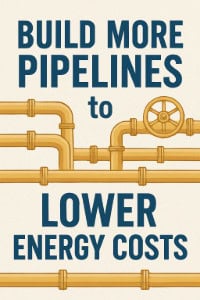 EQT Corporation CEO Toby Rice, along with two other speakers (one from Enbridge and one from investment firm Engine No. 1) spoke on a panel at last week’s Bloomberg event called “Barrel of Tomorrow in the Age of AI” held in Houston. Rice and the others had some interesting comments about the current high price of electric and heating bills in the U.S. and how to decrease them. Their recommended solution to lower energy costs for U.S. residents is to build more natural gas pipelines. Rice also provided insight into the breakeven price that “marginal” producers need to break even and generate returns.

 We’re happy to see Mountain Valley Pipeline (now majority-owned by EQT) continues to vigorously pursue court action against so-called protesters who illegally blocked work during construction. These “protesters” (from out-of-state, possibly paid by Big Green groups to be there) thought they would skip out on taking responsibility for their actions. But MVP continues to hold their feet to the metaphorical legal fire, as well they should. MVP filed a civil lawsuit against four protesters for contributing to significant delays and costs. They must be held to account for their actions. On Tuesday, MVP asked an appeals court in West Virginia to reinstate its dismissed (on a technicality) civil case in county circuit court.
  The New York State Public Service Commission (PSC) is meeting today and will vote on whether to approve National Grid’s natural gas plan, which includes using more natural gas from the Williams Transco pipeline. More gas would be delivered to National Grid via the proposed Northeast Supply Enhancement (NESE) pipeline project that will add a new 23-mile pipeline from the shore of New Jersey into (on the bottom of) the Raritan Bay, running parallel to the existing Transco pipeline before connecting to the Transco pipeline offshore from Long Island. The odious National Resources Defense Council (NRDC) convened a Zoom call featuring dingbat actor Mark Ruffalo to trash-talk the project ahead of the vote.
  Under orders from the Biden White House in 2022, Federal Energy Regulatory Commission (FERC) Chairman Richard “Dick” Glick tried to permanently enshrine global warming considerations as a requirement to approve all new pipeline projects (see
  On September 8, Blackhill Energy informed the Pennsylvania Department of Environmental Protection (DEP) of an “inadvertent return” that occurred during horizontal drilling for the Brad-Tenn Loop Pipeline in Granville Township, Bradford County. Blackhill reported that while drilling beneath Route 6 and Sugar Creek, they experienced a pressure issue. The company discovered that 18,000 gallons (approximately 430 barrels) of nontoxic bentonite drilling mud had been lost. The company stopped drilling ops at that point and reported it to the DEP.
  Two pipeline kingpins are engaged in a deathmatch with the Federal Energy Regulatory Commission (FERC) to get their competing pipeline projects approved. One is Williams’ Transco Southeast Supply Enhancement Project (SESE), the other is EQT’s MVP Southgate project. Both projects would be built in the same general area, starting at the same point near Chatham, Virginia, and ending near Eden, North Carolina. Both claim they have customers ready to take their gas. In a recent FERC filing, Williams said that its project could easily handle Southgate MVP’s capacity by adding meter tubes and regulation at an existing station (see
  It took eight years and untold legal fees (on both sides) before a tiny 3.4-mile, 8-inch natural gas pipeline under the Potomac River was finally built and went online in July (see
  Despite a “public outcry” (of 13 people), the Chesapeake City (Virginia) Council voted 6-3 in July to approve a compressor station for Virginia Natural Gas (see