
Sunoco Seeks to Use Alternate Pipe Near Philly to Get ME2 Flowing
 Years ago when Sunoco Logistics Partners (aka Energy Transfer Partners) originally proposed and planned the Mariner East 2 twin pipelines from the edge of eastern Ohio through the entire length of Pennsylvania to the Marcus Hook refinery near Philadelphia, the completion date promised was the end of 2016. Little could Sunoco foresee the multiple lawsuits, regulatory hearings and illegal protest actions that would conspire to throw the project off schedule for more than a year and half. When pipeline companies plan such multi-billion dollar projects, they first get customers (drillers) to sign on the dotted line, guaranteeing there will be enough product (and revenue) to make the project worthwhile. Drillers *did* sign on the dotted line, and they’re still waiting. Waiting and now pressuring Sunoco to get the darned thing up and running. The pipeline itself is 98% complete–in the ground and connected. But an all-important 2% is still not complete, most of it in the Philly suburbs–Delaware and Chester counties. Sunoco continues to have problems with underground horizontal directional drilling and with ongoing litigation by towns in the Philly area. What to do, with customers breathing down your back? Sunoco has come up with an ingenious solution that is sure to send the crazies into orbit. Sunoco is asking the federal Pipeline and Hazardous Materials Safety Administration (PHMSA) for permission to use part of an existing 12-inch pipeline in that area that previously carried refined petroleum products (things like gasoline, heating oil, and jet fuel), repurposing the pipeline to carry NGLs (ethane, propane, butane, etc.). This is only a short-term fix until the last bits of the full ME2 is up and running…
Read More “Sunoco Seeks to Use Alternate Pipe Near Philly to Get ME2 Flowing”
 In May 2015, the Obama rogue Environmental Protection Agency (EPA) along with the Obama U.S. Army Corps of Engineers (USACE) released a finalized rule clarifying what “Waters of the United States” (WOTUS) means vis a vis what can be regulated under the federal Clean Water Act (see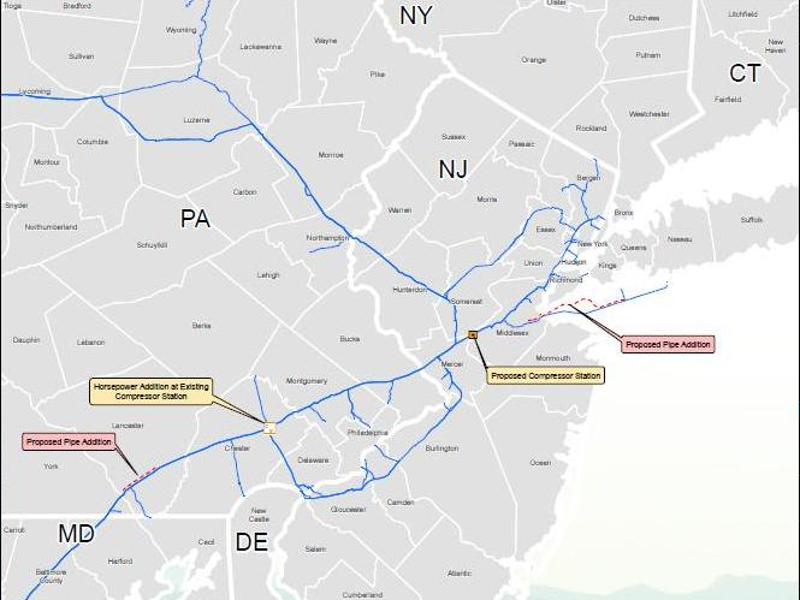
 Rover Pipeline has violated one of the sacrosanct rules of life (and of pipeline construction): “Say what you’ll do, then do what you say.” Rover told the Federal Energy Regulatory Commission it would restore areas previously dug up to lay the pipeline by certain dates (primarily June 30th). In return, based on those promises from Rover, FERC allowed the company to begin service on certain sections of the $3.7 billion, 711-mile natural gas pipeline that runs from PA, WV and eastern OH through OH into Michigan and on to Canada via the Vector Pipeline. Rover has been pressuring FERC to allow two of the laterals–the Burgettstown and Majorsville laterals, that reach into western Pennsylvania–to begin service (see
  MDN told you last week that Sierra Club lawyers are attempting to bamboozle a court into halting construction of the Mountain Valley Pipeline (MVP) in Virginia, as they were able to do in West Virginia (see

 Platts is reporting U.S. natural gas production hit a new, all-time high last week, mainly due to a surge in natgas production in the Texas Permian. Although Marcellus/Utica production “pulled back modestly” this past week, if you look at the entire month of June, we hit new all-time highs for production yet again. However, it wasn’t just the good news of new record production that caught our attention in the Platts update, but this statement: “Looking ahead, it’s possible that Northeast production growth could flounder this summer, thanks to continued in-service /delays on Rover Pipeline’s upstream supply laterals.” Rover is desperately trying to get FERC to grant permission to open the Majorsville and Burgettstown laterals, as we pointed out yesterday (see
  The World Gas Conference, held every three years in different locations around the globe, was held this week in Washington, D.C.–the first time back in the U.S. in 30 years. We’ve reported various stories from that event. Here’s another such story that caught our interest. Pipeline companies, specifically TransCanada and Enbridge (both based in Canada but with huge pipeline networks in the U.S.) told conference attendees that the pipeline industry needs help from Washington–from either the Federal Energy Regulatory Commission, or Congress, or both to fight back against the increasing efforts of Big Green groups opposed to fossil fuels. Fight back how? By adopting new regulations (FERC) or new laws (Congress) that favor pipeline infrastructure. Our interpretation of what they said: It’s time to stop allowing a small group of wacko radicals block energy progress in this country…
 Yesterday, Dept. of Energy Secretary Rick Perry leveled a warning to Andrew Cuomo and the leaders of other states blocking natural gas pipelines: You will face a “real reckoning” of high energy costs and vulnerabilities (i.e. blackouts) because of your actions. Perry stopped short of saying Washington and the Trump Administration would use Executive Orders to unblock some of the blocked pipeline projects (which is a disappointment). But Perry alluded to that possibility when he said, “We have to have conversation as a country, is that a national security issue that outweighs the political concerns in Albany, N.Y.?” Cuomo should be concerned. We’re holding out hope that Trump will issue an Executive Order for both the Constitution Pipeline and Northern Access Pipeline projects, overruling Cuomo. It’s refreshing to see our side take the fight to the irrational radicals who oppose fossil fuel energy…
 Spectra Energy’s Algonquin Incremental Market (AIM) pipeline project is an $876 million expansion of the existing Algonquin pipeline system designed to carry 342 million cubic feet of natural gas per day to New England states that badly need the gas. On March 3, 2015 the Federal Energy Regulatory Commission (FERC) issued their final approval for the project, allowing it to go forward. Construction began in 2015 and, following extreme opposition from New York State over a small portion of the project, it finally went online in in 2016. New York’s radical, anti-drilling governor, Andy Cuomo, tried to stop the Algonquin using the flimsy excuse that some of the drilling for the pipeline would happen a half mile from a nuclear power plant–a plant that’s shutting down anyway (see
  Shell delivered some good news at last week’s Northeast U.S. Petrochemical conference in Pittsburgh: The Falcon ethane pipeline will get built next year (see
  Many (most?) electric generating companies in the U.S. are regulated–highly regulated. They’re guaranteed a certain, predictable level of (low) profits. But in return for guaranteed profitability, every single thing they do is monitored and authorized in triplicate, with one or another government agency reviewing anything and everything that happens. It’s the deal they’ve struck with the regulatory devil. Vectren is one such regulated utility in the great state of Indiana. Vectren operates the F. B. Culley Generating Station, a 369 megawatt (MW) coal power plant located in Warrick County, Indiana. They plan to close the coal-fired plant in 2023. In its place, they want to build a 900 MW natgas-fired plant and a 50-acre solar farm. Building the gas plant and solar farm would cost Vectren (meaning ratepayers) $940 million. The cost is passed on to ratepayers because Vectren is regulated. That’s the way it works. The bargain struck with the devil. The gas-fired plant will be cleaner than coal, more efficient, cheaper to operate, and better for the environment. We suspect Utica/Marcellus gas would help feed the plant. And yet, anti-fossil fuel wackos oppose the plan to switch to cleaner-burning natgas. Would they prefer no electricity?…
 Perhaps the proposed legislation by PA Rep. Dan Moul (Republican from Gettysburg) to gut not only the DRBC (Delaware River Basin Commission) of its power to regulate groundwater, but also to gut the SRBC (Susquehanna River Basin Commission), is not so far off the mark after all (see
  Seems like a week doesn’t go by that MDN isn’t asked (by someone from Pennsylvania), “Is there any hope of building the Constitution Pipeline through New York?” Our standard response is this: The only way it gets built is (a) NY elects a new governor favorable to the industry–about a 1% chance of that happening, (b) President Trump issues an Executive Order overriding Cuomo’s blockade of Constitution (and other pipeline projects)–maybe a 10% chance of that happening, or (c) the Federal Energy Regulatory Commission (FERC) reconsiders a decision to not overrule NY’s move to block the project–maybe a 15% chance. The U.S. Supreme Court in April refused to consider the Constitution Pipeline case, closing that door (see