
Manchin Tells Pittsburgh Crowd He Wrote the IRA in Secret

Former U.S. Senator Joe Manchin (D/I-WV) closed out THE SUMMIT: Appalachia in Pittsburgh on July 28 with something you don’t often get from a retired politician — a confession. Speaking aboard the Gateway Clipper riverboat to a room full of producers, midstreamers, bankers and landmen, Manchin ditched his prepared remarks entirely (“I can’t give a speech. I can talk.”) and walked the crowd through how the Inflation Reduction Act (IRA) really got written, why he regrets the name, why he thinks the hyperscalers spent two years chasing a “facade,” and what it will actually take to get permitting reform across the finish line. MDN was an advertising partner for the event and obtained the transcripts with the organizer’s permission. This is the first of four articles chronicling the event. Check back each day this week as we publish the rest of the series, including a post tomorrow about EQT correcting the record. Read More “Manchin Tells Pittsburgh Crowd He Wrote the IRA in Secret”
 Last week, the Pennsylvania Marcellus lost one rig, now down to 16 active rigs after running 17 rigs for 12 weeks in a row. Bummer. Ohio lost a rig two weeks ago and didn’t pick it back up last week, remaining at 10 active rigs for the second week. And West Virginia picked up Ohio’s lost rig two weeks ago, boosting its number to 9 active rigs, maintaining that number last week. All told, the M-U operated 35 rigs last week, which is 21 fewer than our biggest rival (for money and attention), the Haynesville, which operated 56 rigs last week.
 The Marcellus/Utica region received (as near as we can tell) 15 new drilling permits last week, July 27 – August 2, down 4 from two weeks ago. The reason for our hesitation is that the Ohio Department of Natural Resources didn’t issue a report for last week. They sometimes are tardy in their report filing, catching it up in the next week’s report. The drillers who received new permits included: Seneca Resources (6), Expand Energy (6), JKLM Energy (2), and Jay-Bee Oil & Gas (1).
 Peregrine Energy Partners, the Dallas-based royalty buyer we’ve been tracking since 2019, is back in the Marcellus/Utica with its checkbook open. Yesterday (Aug. 4), the company announced it closed five separate mineral and royalty deals — two of them right here in the M-U — totaling roughly 3,680 net royalty acres and interests in more than 1,240 producing wells. The first Appalachian deal is a cash-flowing overriding royalty portfolio in Susquehanna County, PA, covering about 936 gross acres and 86 producing horizontal Coterra Energy (now Devon Energy) wells, with more than 50 DUCs and PUDs behind them in both the Upper and Lower Marcellus.
 Back in January 2022, we brought you what looked like a milestone: the WV Dept. of Environmental Protection had issued a construction permit for a big Marcellus gas-fired power plant next door to the Longview coal plant in Maidsville, Monongalia County (see
 There’s terrific news brewing in Grant County, West Virginia — with an asterisk roughly the size of a cooling tower. Word circulated over the weekend that Dominion Energy plans to build a brand-new natural gas-fired power plant at its Mt. Storm complex, the same site where three coal-fired units have been cranking out electrons since 1965. The key detail: the gas plant would run alongside the coal units, not replace them. That’s more power, not swapped power. We like that math.
 In February, FirstEnergy subsidiaries Mon Power and Potomac Edison announced they had selected a 35-acre site in Maidsville (Monongalia County), West Virginia, for a new 1,200-megawatt natural gas power plant (see
 There’s been a change in the Marcellus/Utica. Despite fewer visible rigs and water trucks across Pennsylvania, the Marcellus Shale isn’t declining—it’s maturing. Counting wells or permits no longer measures success, because fifteen years of learning have made modern wells dramatically more productive. Longer laterals, better geologic mapping, and refined completion techniques enable operators to produce more gas from fewer wells, reducing land disturbance, road construction, and traffic while improving economics. This shift from expansion to optimization arrives as demand surges from manufacturing, LNG exports, and AI data centers. For Appalachian communities, the takeaway is clear: the Marcellus isn’t slowing down—it’s getting better.
 Northeast natural gas demand could rise by up to 10 Bcf/d by the early 2030s, supported by power generation, LNG, industrial growth, and advancing pipeline projects. Tudor, Pickering, Holt & Co. (TPH) says regional operators increasingly expect 5–8 Bcf/d of growth by 2030, although the firm models only 3 Bcf/d. The interesting aspect of TPH’s prediction is *where* the increase in gas supply will come from, and which drillers will most likely provide it.
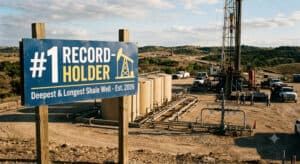 EQT Corporation, the largest driller in the Marcellus/Utica (based on M-U production), recently achieved two records with the same Marcellus well. EQT drilled not only the “deepest” shale well in the continental U.S. (by “measured depth”), but also the longest horizontal shale well (by lateral length). EQT’s Longwell 9H well, located in Wetzel County, West Virginia (near the Pennsylvania border), eclipses a record set by Expand Energy in 2025 in Marshall County, WV.