
WV Chemical Trade Group Hints Many New Downstream Projects Coming
 We spotted an editorial in the Charleston (WV) Gazette-Mail written by Kevin DiGregorio, executive director of the nonprofit Chemical Alliance Zone (CAZ). According to the CAZ website, the organization “works with partners across West Virginia to boost and maintain investments and jobs in the chemical industry and related industries, including natural gas, manufacturing, and technology in general. We create, initiate, and facilitate business opportunities, leading to opportunities for you, your business or organization, and the State of West Virginia.” In other words, Mr. DiGregorio and the CAZ are at the nexus of many deals to bring petrochemical businesses to the Mountain State. So if anyone should know what may be “up the sleeve” and soon to be revealed, it’s Mr. DiGregorio. He hinted at it in his column. Writing that everyone has heard about the potential for a Braskem ethane cracker plant in Parkersburg (a project that appears to still be alive), Mr. DiGregoorio then says, “What you haven’t heard are all of the other potential (and confidential) projects that many of us are working on that might lead to new facilities and high-paying STEM (science, technology, engineering, mathematics) jobs that take advantage of methane and NGLs (ethane, propane, butane) to make various chemicals and plastics.” Wow! He seems to be saying there are a lot of projects in the works for WV in the downstream–those businesses that use the output from the shale industry…
Read More “WV Chemical Trade Group Hints Many New Downstream Projects Coming”
 While we wrote about a Penn State research study today that appears legitimate, but seven years too late (see New Penn State Frack Wastewater “Study” Beats a Dead Horse), there is another recently published Penn State study that is also legit that is not yet a huge issue, but certainly has potential to be a big deal. Penn State’s College of Agricultural Sciences has found that invasive, non-native plants are making significant inroads with shale gas development in Pennsylvania, with negative consequences for PA forests. How so? The invasive, non-native plants are hitching a ride on gravel and equipment used to create roadways in forested areas, and once those plants take root, they crowd out local, native plants. The study, titled “Unconventional gas development facilitates plant invasions” and published in the Journal of Environmental Management, concludes that more monitoring and early detection can help put a lid on the problem…
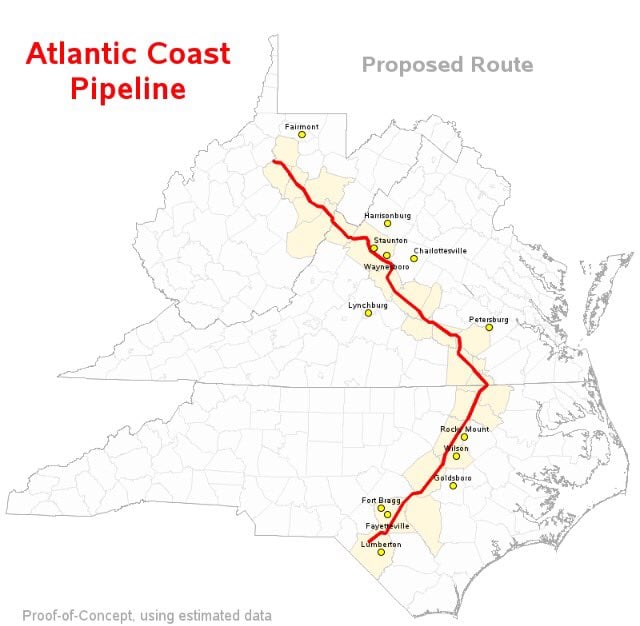 This past week, the North Carolina Dept. of Environmental Quality (DEQ) held two public hearings on Dominion’s proposed $5 billion, 594-mile natural gas pipeline that will stretch from West Virginia through Virginia and into North Carolina. One hearing was in Fayetteville, the other in Rocky Mount. Both had more people opposed to the project than for it, although the Fayetteville hearing saw a strong showing of people in favor of the project. The Fayetteville public hearing was held Tuesday, and Rocky Mount on Thursday. Here’s the coverage we could find of the two hearings…
 The Potential Gas Committee (PGC), a private non-profit organization loosely affiliated with the Colorado School of Mines, performs a comprehensive study of potential supplies of natural gas in the United States every two years. In April of 2013 MDN reported the committee’s findings of just how much gas is down there (see
  Rockwater Energy Solutions is a “leading provider of comprehensive water management solutions to the North American unconventional oil and gas industry” and the only company that provides complementary chemistry products and expertise in connection with its water solutions. Rockwater operates in the Marcellus/Utica region, among other shale plays. Select Energy Services is a billion dollar oilfield services company with three main divisions: water services, rentals, and wellsite completions. They operate in every major shale play in the country, including the Marcellus/Utica. Earlier this week the two companies announced they are merging in an all stock swap deal. It looks to be a true blending of the two companies, and not one company taking over the other. When the merger is done (later this year), John Schmitz, currently Chairman & CEO of Select, will become the full-time Executive Chairman and Holli Ladhani, currently the Chairman, President & CEO of Rockwater, will become the President & CEO of Select. The water parts of both businesses will be combined and branded with the Select name, but Rockwater branding will continue (as a division) for the chemicals business unit. Here’s the announcement of an impending marriage–made in heaven?…
 We’ve been listening to fake news about a supposed connection between Russia and the Trump campaign for so long now, we’re ready to puke. It’s a totally fabricated story without even an allegation of wrongdoing. Fake news outlets like CNN run this garbage endlessly (so we’ve been told, we NEVER watch CNN). So perhaps you can forgive us for not highlighting and bringing you this news before now. There IS a Russia scandal–a serious one. But it has nothing to do with Donald Trump. The real Russia scandal is that Putin and Russia have been funneling millions of dollars to U.S. Big Green groups, like the Sierra Club and League of Conservation Voters Education Fund, in an attempt to smear and block fracking in the U.S. Russia is funding these efforts not because they care a scintilla about the the environment (come to think of it, the Sierra Club doesn’t care about the environment either, not really). No, Russia is funding anti-fracking efforts by Big Green as a way of eliminating competition for Russian oil and gas. If they can throw some money at the nutjobs in our country, and if those nutjobs can convince unthinking masses to go along, problem solved for the Russkies. Here’s the lowdown on the REAL Russia scandal…
 The “best of the rest” – stories that caught MDN’s eye that you may be interested in reading. In today’s lineup: MPLX’s expanded plan for piping Marcellus/Utica NGLs; Vermont clamps down on windmills; gas industry worried that Trump push for coal may affect gas-fired plants; US House votes to streamline pipeline reviews; why Millenials won’t work in the oil patch; America needs more pipelines; the EPA is everywhere; LNG drives US energy dominance; and more!
 Earlier this week MDN brought you the news, via a Wall Street Journal article, that EnerVest, a huge private equity firm with its fingers in many shale (and conventional) pies across the U.S., has gone bust (see
  In September 2016, MDN brought you the sad news that the former head of external affairs and government relations for Competitive Power Ventures (CPV), Peter Kelly, was indicted for bribing New York Gov. Cuomo’s long-time top aide Joseph Percoco to get state approvals for CPV’s $900 million Valley Energy Center natural gas-fired electric generating plant in Orange County, NY (see
  Once again it’s necessary to counter the false narrative in Pennsylvania media that “Pennsylvania is the only state without a severance tax” and “a severance tax will magically fix our over budget mess.” Last week MDN brought you news that 12 so-called Republicans in the PA House were behind an effort to force a vote on a severance tax (see
  Anti fossil fuelers believe they have a new angle in their years-long war to prevent Sunoco Logistics Partners from building the Mariner East 2 twin pipelines across the state: drilling mud spills. When a pipeline company installs a new pipeline, the vast majority of pipe is laid in trenches. However, there are places (creeks, rivers, wetlands, roadways) where you can’t just dig a trench to lay the pipe. In those cases, you drill underground horizontally, something called horizontal directional drilling (HDD). When you drill through rock, you need drilling mud to cool the drill bit as it chews away. Drilling mud is typically bentonite, a non-toxic clay substance used to manufacture things like toothpaste, cosmetics and kitty litter. The only threat from bentonite is that it can smother aquatic life if enough is spilled. Or it can foul a water aquifer–making the water in your well cloudy for a period of time, until it settles. Such an instance recently happened in Chester County, when Sunoco’s drilling for ME2 fouled an aquifer, causing well water for some 15 homes to become temporarily unusable (see
  For the past two years running, the Delaware River Basin Commission, a cooperative organization with five members–Pennsylvania, New York, New Jersey, Delaware and the U.S. Army Corps of Engineers–has received more than half a million dollars per year from PA as its dues to support the anti-drilling organization. The problem is, PA pays its full share, but states like NY and NJ consistently short-change the DRBC. PA Gov. Tom Wolf is a big DRBC fan. Wolf supports the DRBC’s ongoing ban of drilling in the Delaware River Basin–which unfairly denies landowners in Wayne and Pike counties (PA) from benefiting from Marcellus Shale drilling–Wolf’s own constituents. However, the DRBC’s gravy train from PA is now over. Gov. Wolf recently allowed the PA budget to pass, without his signature. Part of the budget bill whacks PA’s contribution to the DRBC to just $217,000 this year–less than half of what is has been getting. The effort to whack the DRBC came from PA representatives in northeastern PA, tired of the ongoing drilling ban. Looks like layoffs are coming to the DRBC. They don’t do a heck of a lot, so why not? Time to toss the bureaucrats out on their rear-ends…
 We spotted an outrageously fake news story published in something called the Public News Service that quotes an organic farmer in northern Ohio who is opposed to the NEXUS Pipeline–a pipeline that won’t even cross her property. NEXUS is a $2 billion, 255-mile interstate pipeline that will run from Ohio through Michigan and eventually to the Dawn Hub in Ontario, Canada. It is a critically needed pipeline to move Utica and Marcellus Shale gas from an over-saturated market in the northeast to markets in the Midwest and Canada. It is a joint venture between DTE Energy and Spectra Energy. The Ohio organic farmer claims a NEXUS compressor station a mile from her property “will create a toxic cloud” and ruin her crops. She also claims “toxins” leak from pipelines, and that compressor stations “contain dangerous cancer-causing chemicals.” Yes, any time you want to oppose something, throw out the “c” word, to make sure they get good and scared. Other problems caused by pipelines: livestock illness and death; spontaneous explosions; fires; mini-earthquakes. To which we say, what a load of organic bullcrap…
 A recent story in the Pittsburgh Post-Gazette points out the ups and downs of working in the oil and gas business. It is a cyclical business–with booms followed by busts. Always has been, always will be. When the shale industry took off some 10 years ago in PA, the industry couldn’t find enough people to fill the open positions. Then came a crash in prices two years ago, and along with it, massive layoffs. Not only in the Marcellus/Utica, but nationwide. According to Halliburton, a company that routinely hires tens of thousands, and then lays off tens of thousands, at the end of each cycle, when new hiring begins, some 30% of those who previously lost their jobs say “no thanks” to the industry when the help wanted signs go up again. Can you blame them? Thing is, we’re now beginning a new upswing in the hiring cycle. So the question is, will there be enough workers for the Marcellus/Utica region?…
 Here at MDN we’ve always found the issue of using eminent domain for pipeline projects to be thorny. We see both sides of the issue, although we tend to favor the sacredness of one’s property. We tackled the issue back in May (see
  A very small group of anti-fossil fuelers recently gathered in Samson County, NC to spread lies about the Dominion’s Atlantic Coast Pipeline (ACP) project. ACP is a $5 billion, 594-mile natural gas pipeline that will stretch from West Virginia through Virginia and into North Carolina, bringing Marcellus and Utica Shale gas to the south. The meeting, which local media said had “more than 20” people in attendance, seemed to be mostly representatives from outside Big Green groups pedaling the same tired old lies about pipelines in general, and ACP in particular. Try as they might to spin the meeting as some sort of “movement” among the little guy, the picture accompanying the Dunn (NC) Daily Record can’t cover up the fact there were perhaps a dozen people in the audience–and it looked pathetic…