
Westmoreland Zoning Challenge re H&H Wells Closer to Resolution
 Huntley & Huntley has plans to drill shale wells in Upper Burrell Township (Westmoreland County), PA. As MDN reported in June, a landowner in Upper Burrell filed an appeal against Upper Burrell’s zoning ordinance that allows drilling in rural, agricultural districts (see Westmoreland Zoning Challenge Heads to Court, Delays H&H Drilling). H&H plans to drill a well near where this woman lives, and she’s arguing such drilling will violate the state’s environmental rights clause and (more importantly), “devalue her property.” The case was supposed to go to township’s Zoning Hearing Board, but all of the (many) lawyers involved agreed to instead move it to county court, making the process faster and less expensive. The only potential problem with that is the judge may decide to hold off on a decision until two similar cases are heard and decided by the PA Supreme Court. However, the judge is not waiting. A recent media report states the judge will make a decision in the case “next month” (meaning in August) about whether or not the town can issue conditional use in agricultural-residential zoning districts…
Read More “Westmoreland Zoning Challenge re H&H Wells Closer to Resolution”
 Thumbing their collective noses at Ohio RINO Gov. John Kasich, in May Republican legislators in the House added a “little-noticed provision” in the state budget deal that will give the legislature, and not the governor, the power to select members of the Ohio Oil and Gas Commission (see
  Once again, the radicals behind the Pennsylvania-based Community Environmental Legal Defense Fund (CELDF), operating in Ohio, have suffered a humiliating defeat. This time in liberal Athens, Ohio. For three years running, the CELDF and their local useful idiots have been pedaling a so-called Community Bill of Rights ballot measure–which is nothing more than an anti-fracking law. No, there is no drilling in or under Athens, but such a law would send a loud and clear signal that Athens is closed for business when it comes to the oil and gas industry–an industry that pumps millions into the local economy (even without drilling in the area). For the third year running the CELDF drones filed a petition to include the “Bill of Rights” measure on the November ballot–and for the third year in a row, the County Board of Elections voted NOT to allow it–unanimously…
 A young, brainwashed 17-year old woman was one of the headline speakers at a recent anti-Rover Pipeline rally in Michigan–apparently because she’s an Indian (i.e. Native American). However, her heritage really has nothing to do with her opposition to the Rover Pipeline. Her opposition is rooted in what we would call a break with reality–a psychosis. At a rally held in Dexter Township, MI near where Rover is scheduled to be built, the teenager said this to the “about 100” assembled: “‘We’re fighting extraction industries all across the country. It’s not just here. It’s not just Standing Rock,’ said…an Ypsilanti resident, urging other protesters to divest from fossil fuel companies and take their money out of big banks and put it in local banks and credit unions so they’re not supporting the extraction industry.” We hate to burst the young protester’s bubble, but “extraction industries” are the reason she even exists. “Extraction industries” not only provide energy (oil, gas coal), but “extraction industries” mine the metals that make up the innards of her expensive cell phone. “Extraction industries” provide the raw materials to produce plastics, which is in just about everything everyone touches these days–including the clothes on her back and the sneakers on her feet. To call for divestment, and to oppose “extraction industries” is a call to crawl back into a cave and die a very young death. It is, in a word, insane…
 The Gas Technology Institute (GTI), based in Illinois, is doing the Marcellus/Utica region a huge favor. GTI has launched a pre-employment training program to introduce folks to natural gas pipeline operations. The four-week program provides a basic understanding of natural gas, the utility and pipeline industry, and different equipment, procedures and operations used. The program is aimed at students, veterans, displaced coal workers and others with an interest in getting a job with utilities, midstream (i.e. pipeline) companies and their contractors. Here’s the best part: The program is fully funded, so there is no tuition cost for those who qualify. The program is delivered via classroom at three participating colleges: Westmoreland County Community College and Butler County Community College (both in PA), and Washington State Community College (in OH). Here’s the lowdown..
 The “best of the rest” – stories that caught MDN’s eye that you may be interested in reading. In today’s lineup: M-U rig count unchanged; PTT Global has spent $130M so far on Ohio cracker project; trade unions working overtime to recruit new apprentices; mineral rights can make you rich; Russian hackers target US energy networks, maybe; shale drillers go back to work; frack sand swings from shortage to oversupply; UK vandals damage shale rig; China going full steam ahead with shale drilling; Saudi prince warns of coming oil shortage that “US shale can’t fix”; and more!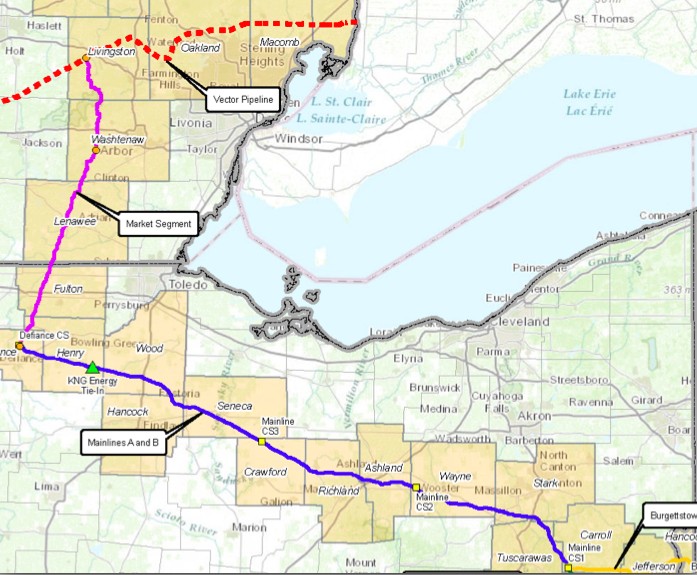
 NG Advantage wants to build a “virtual pipeline” operation in ultra-liberal Broome County, NY, in a suburb of Binghamton. The location NG picked, after considering up to six locations in the region, was selected because of it’s proximity to major highways, proximity to the Millennium Pipeline, and availability of high-power electric lines. A virtual pipeline is nothing more than a compressor plant (series of compressor plants) that grabs gas from a pipeline, in this case the Millennium, and compresses it and loads it onto special tractor trailers that then deliver the gas to industrial customers like manufacturing plants, hospitals, and even small regional systems servicing homes. The location NG selected, in the Town of Fenton (within spitting distance of Hillcrest and Port Dickinson) was approved by the Town of Fenton after a detailed review. The area they selected is zoned industrial and is, in fact, a former dump site. However, residents from nearby neighborhoods (Hillcrest and Port Dick) were not aware of the project (so they claim) and when construction began to clear the dump site, and residents learned what was going to be built at the site, some of them demanded court action to oppose it. So far we’ve had two court cases asking county-level court (called “Supreme Court” in NY) to stop the project, which it temporarily did (see
 It’s been a while since we’ve updated you on a little-known (but rapidly becoming better known) company called JKLM Energy. In May 2016, the last time we wrote about JKLM, we told you the company had successfully drilled and was flowing gas from Potter County, PA’s first Utica Shale well (see
  Here’s not something you read every day, especially in Lebanon County, PA where local media seems only too interested in covering negative stories about pipelines: “What I have heard has all been positive – that the workers were willing to go beyond anything that might be expected of them and do little special things for the landowners.” That statement is from a town official in Lebanon County, talking about Mariner East 2 pipeline construction workers who are busy in the Lebanon County installing the first of two ME2 pipelines. Of course, not everyone is happy. But then, not everyone is always happy with anything–even a sunshiny day! Here’s what’s happening in Lebanon County with ME2…
 While the construction of the Mariner East 2 natural gas liquids (NGL) pipelines in Lebanon and Lancaster Counties appears to be sailing along with very few issues (see today’s companion story), the project did hit a small bump in the road in nearby Chester County, PA. A dozen families reported their water wells became cloudy–or lost pressure–after underground horizontal directional drilling (HDD) by Sunoco Logistics Partners in attempting to install pipes underground in places where digging trenches will not work. The company put up five families in local hotels for several nights. Sunoco also provided bottled water for all of the affected families. The working theory is that bentonite clay (i.e. drilling mud) is the source of the cloudiness. Fortunately, bentonite is non-toxic and used to manufacture many products, including toothpaste and kitty litter. The incident, while troubling and inconvenient for the families involved, has not set back the project–at all. Drilling and construction of the pipeline resumed on Saturday…
 In April MDN told you that the Virginia Dept. of Environmental Quality (DEQ) had succumbed to political pressure from the MANY lib Dems in the state that oppose benign pipeline projects, like the Atlantic Coast Pipeline (ACP) and Mountain Valley Pipeline (MVP), and changed their minds about the process they will use in issuing water quality certifications under Section 401 of the federal Clean Water Act (see
 Events related (or of interest) to the Marcellus and Utica Shale, primarily pro-drilling events.