
Saudis, Others Cuts All Ties with Qatar – LNG Opportunity?
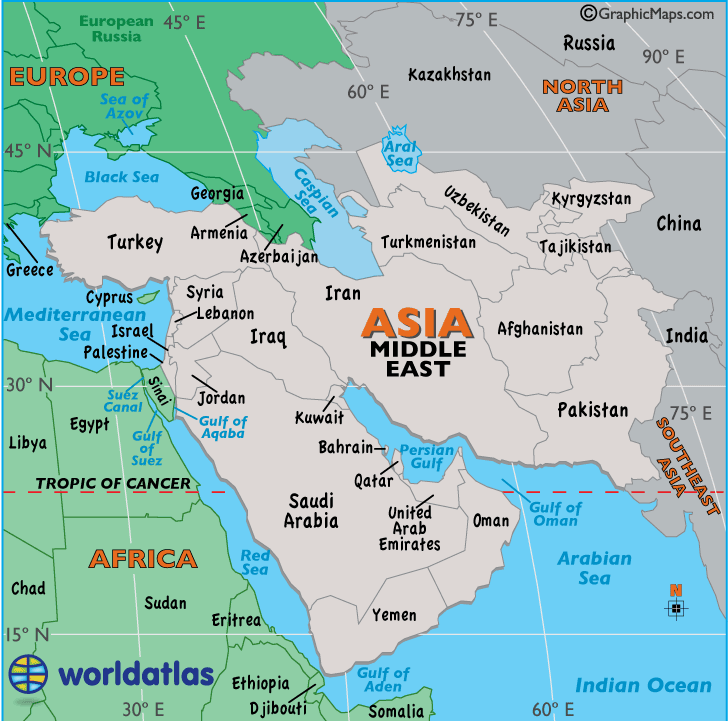
The following story intrigued us, not the least of which because it has the potential to affect the Marcellus/Utica region. Out of the blue, Saudi Arabia, the United Arab Emirates, Egypt and Bahrain have all “cut ties” with the country of Qatar. That includes shutting down pipelines that flow LNG and natural gas out of Qatar. Why? Because, they claim, Qatar supports “extremism”–by which they mean terrorism. This is truly rich. All of the countries cutting ties have their own issues in supporting terrorism. So if they accuse “one of their own” for doing the same thing, how much worse must be Qatar? There is another interesting aspect to this story–related to the idiot Al Gore. Gore and a couple of his ultra-rich buddies started a cable television channel in 2005 called Current TV. The channel flopped, big-time. So Al and his buddies sold it in 2013–to Qatar. Well, actually it was sold to Al Jazeera, the official Qatar state-run media agency, owned by the ruling family of Qatar. Qatar didn’t want the channel, which they immediately threw in the trash. They wanted access to all of the cable systems the channel was running on for their Al Jazeera station. Yeah, you don’t hear about it much, but Al Gore sold his TV channel to terrorist-friendly Qatar–for $500 million. Back let’s get back to the Marcellus. Both Egypt and the UAE are “highly reliant on Qatari gas via pipeline and LNG.” With those lines now cut for the foreseeable future, it opens up a new market for Marcellus/Utica gas to be exported to Egypt, the UAE and perhaps others… Read More “Saudis, Others Cuts All Ties with Qatar – LNG Opportunity?”
 Events related (or of interest) to the Marcellus and Utica Shale, primarily pro-drilling events.
 The “best of the rest” – stories that caught MDN’s eye that you may be interested in reading. In today’s lineup: Robert Mead named president of Appalachian chapter of NARO; WV leaders praise withdrawal from bad Paris climate deal; are “super rigs” the driver behind the new shale boom?; Sabine Pass LNG exports hit record high in May; what the pipeline industry needs to learn…and soon; fracking saves Americans $180B a year on gasoline; first commercial carbon-capture plant goes online–249,999 to go; Panama Canal Authority to raise rates on LNG ships; and more!
  Earlier this week MDN reported on the recent West Virginia Supreme Court decision to reverse it’s earlier decision and allow EQT (and by extension, other drillers) to deduct some post-production expenses from royalties paid to landowners (see
  Jefferson County, OH is not the first (or even second or third) county you think of when you think “Utica drilling.” But that may soon change. Jefferson shares borders with other counties that are heavily drilled–Carroll, Harrison and Belmont. There has been some drilling in Jefferson in the past, but with the slowdown over the past few years, not much has happened. But according to Ascent Resources and Chesapeake Energy, their respective companies are putting a renewed focus on the county in the coming months. Which is good news indeed. Couple that with a possible ethane cracker plant coming to Belmont County, and (according to the Chamber of Commerce), Jefferson is heading for “a brighter future” thanks to the Utica industry…
  We’ve spilled plenty of digital ink covering the Rover Pipeline and its recent troubles with “inadvertent returns” (i.e. leaks) of non-toxic drilling mud, called bentonite (see
  Air Products owns a manufacturing plant located on the outskirts of Wilkes-Barre, PA. If you’ve ever heard of the Air Products business, you may conjure up an image of small cylinder tanks of helium or other “rare” gases sitting inside a chain fence. Yes, Air Products sells gases by the tank, but they also manufacture the mother of all gas tanks in their Wilkes-Barre facility–huge rocket-looking “production trains” or “heat exchangers,” which are pieces of equipment that turn natural gas into liquefied natural gas, or LNG. The heat exchangers manufactured by Air Products in Wilkes-Barre are two-thirds of a football field long (180 feet), used by plants all over the world to condense natural gas into a liquid. We’ve written about Air Products a few times, theorizing some of the heat exchangers they manufacture are being used by plants to liquefy Marcellus/Utica gas (
 For some time, MDN has had an eye on a trend we find exciting: “virtual pipelines,” by which we mean facilities located along a pipeline that compress natural gas, load it onto tanker trucks, and then distribute that gas to businesses that are not fortunate enough to be located near a natgas pipeline. With irrational opposition to pipelines rampant, virtual pipelines are a good alternative. We recently highlighted a new project coming in our own area of Broome County, NY (see
  What if there was a small device, about the size of a paperback novel, that could sniff the air and detect fugitive methane, escaping into the atmosphere? And what if that small device was operated with rechargeable batteries, and the batteries recharged every day using solar energy? And what if that device could also then transmit data about the air quality via the internet to servers back at HQ? And what if it could operate remotely, like at an abandoned well site? Dream no more. Such a device exists. We first heard about PixController’s Optical Methane Emissions Detection System (OMEDS) when it won a $25,000 prize from the 2015 Shale Gas Innovation Contest (see
  We all know that currently, New York State is closed for business when it comes to shale drilling (see
  We wonder how many people actually watched President Trump’s address yesterday, announcing his decision to pull out of the horrible (and so-called) Paris climate treaty? Did *you* watch it? Or did you rely on the non-stop “hate Trump” mainstream media tirade that reported, endlessly, that we’re now all fried and the future of Mom Earth is over. What…utter…garbage. If you listened to President Trump, as we did, you would have learned that if we had stayed in this VERY bad deal, the United States would have been punished economically–transferring billions of our taxpayer dollars to other countries for generations to come. All in the name of supposedly stopping global warming. China and India would get to add as many coal-fired electric plants as they want–while we would have to close ours down, essentially shifting our jobs to other countries. The deal was bad from the beginning. Even if we had stayed in and even if all countries lived up to their obligations under the treaty, the projected difference in lowering global temps by 2100 would have been 0.17 Celsius–little more than one-tenth of a degree. After spending hundreds of billions of dollars. THIS PLAN WAS INSANE from the start. But you won’t learn that from mainstream media. We’ve found a few responses to Trump pulling out of Paris, from people who DO believe in global warming, but have the guts to tell the truth about the disastrous Paris deal and why it’s a GOOD THING Trump pulled out of it…
 What role should appointed (i.e. not-elected) Environmental Protection Agency (EPA) boards have with respect to environmental regulations in our country? It’s a valid question and timely, given the recent negative news coverage over EPA Administrator Scott Pruitt’s action in not automatically reappointing some board members. The way the press howls about it you would think board members have a Divine Right to be on those boards. Did you know there are 20 such “advisory boards” at the EPA? And did you know that many of the board members receive EPA grants–in the millions of dollars? This is the swamp Trump repeatedly referred to when campaigning. It’s downright corrupt. And yet when Pruitt tells board members that will have to stoop to the level of reapplying if they want to stay on a board, establishment Washington has a cow. The EPA, as we’ve written about for years, has profound impact on the oil and gas industry–hence our interest. MDN friend Steven Heins, an energy and regulatory consultant and former vice president of communication for Orion Energy Systems, has written a guest post for MDN musing over the EPA’s advisory boards and the role of the public and private sectors with regard to environmental issues…
  On Tuesday Alpha Natural Resources (ANR) announced it was divesting “substantially all of the assets” in two different operations in West Virginia, one of those being a natural gas operation with “120 producing natural gas wells in five counties.” Which got us digging. We recalled that ANR went bankrupt last year and ended up selling 27,400 acres of Marcellus/Utica Shale leases to Vantage Energy for $339.5 million (see
  Technically, this is not a Marcellus/Utica story, but it is (and should be) of interest to those of us who concentrate on the Appalachian region. The very first application has been filed in Illinois for a permit to drill and frack a shale well. Woolsey Operating Co., headquartered in Kansas, has filed a high volume horizontal hydraulic fracturing (HVHHF) application with the Illinois Dept. of Natural Resources (DNR). The DNR has assigned the application Review Number HVHHF-000001 — the very first. Which is momentous. We’ve only seen two mainstream news sources (from Illinois) pick up on what is really big news. No national news sources have covered it–yet. The press release from the DNR provides some details, like the location of the proposed well (southern Illinois, in White County). What the announcement and news stories don’t say is which rock layer will the shale well target? MDN found the answer by reviewing the application…
 Here’s one that flew mostly under the radar. The Pennsylvania Dept. of Environmental Protection (DEP) has just granted final approval for the state’s ninth wastewater injection well to begin operation. The DEP approved Sammy-Mar, LLC’s Povlik #1 injection well, located in Huston Township, Clearfield County, more than two years after the federal Environmental Protection Agency had approved it. Huston Township in Clearfield County, unlike Highland Township in Elk County, and Grant Township in Indiana County, did not oppose the well. You may recall the DEP approved injection wells in Elk and Indiana counties in March, and had to sue the towns involved over their illegal home rule laws that sought to keep the wells out (see