
Maryland’s Traitorous “Republican” Gov Caves, Supports Frack Ban
 There were early signs that Maryland’s newly elected “Republican” governor was weak on the subject of fracking, as we pointed out in 2015 when we said that then-new Gov. Larry Hogan, who was elected on a platform of supporting shale drilling, had decided to let a two-year moratorium on shale drilling become law without his signature (see Maryland’s Pusillanimous Gov Allows Frack Moratorium to Become Law). We should have know then that Hogan has no political courage. Recently environmental nutjobs in Maryland have turned up the heat, demanding a total and complete fracking ban by passing a law. The House passed a bill to ban fracking (see Maryland Democrat Lawmakers Continue to Torpedo Fracking). The bill has, so far, been stalled in the Senate. But maybe not for long. On Friday, Gov. Hogan, a spineless “Republican,” said he now supports a complete and total ban on fracking, forever, in his state. He’s “concerned” that if the Senate puts the measure out for a public vote/referendum, fracking in the state might actually happen one day. That’s called governing against the will of the people Mr. Hogan. That’s something Democrats do, not Republicans. What a disappointment this one-term governor has turned out to be…
Read More “Maryland’s Traitorous “Republican” Gov Caves, Supports Frack Ban”
 Earlier this month MDN brought you a list of the existing and/or planned natural gas-fired electric generating plants in Ohio (see
  What if a landowner leased his or her land decades ago and a driller drilled a conventional natural gas well on the property, and that well has produced commercial volumes of natural gas for years–and still does. And what if the lease gives that driller the right to drill (or not drill) in any given rock lawyer. And what if that driller is content to simply let that conventional well keep producing and not drill further down, into the now commercially viable Utica (or Marcellus) shale layer? Does the landowner, whose land is located where the Utica/Marcellus exists, have any case for taking back the rights to the deeper shale layers the conventional driller refuses to go after? That’s a case that has now worked its way all the way to the Ohio Supreme Court. The question turns on whether or not “reasonable development” in a lease includes unexplored, deep formations…
 For some time we’ve tracked the progress of an LNG export plant planned for the eastern shore of Nova Scotia, the Bear Head LNG project. Of all the Canadian LNG export projects, Bear Head seems to have the most momentum. The project has received most of the necessary permits it needs to proceed. But it’s not been without its bumps along the way (see
  The International Energy Agency (IEA) works to ensure reliable, affordable and clean energy for its 29 member countries and beyond. IEA’s mission focuses on four main areas of focus: energy security, economic development, environmental awareness and engagement worldwide. A somewhat self-important group that issues reports periodically–particularly on mythical man-made global warming. The core of the man-made global warming argument is that mankind is burning fossil fuels, releasing loads of extra carbon dioxide into the atmosphere. The CO2 in the atmosphere acts as a canopy to trap the earth’s heat and to (someday soon) catastrophically warm the planet, killing off species, causing sea levels to rise, melting polar ice caps. Except none of that is actually happening (the Emperor has no clothes). Which we keep pointing out over and over. We won’t head down that rabbit trail again right now. CO2 levels are important for the eggheads at IEA. In conducting research for the next release of the IEA’s World Energy Outlook report (for 2017), researchers at the agency say worldwide CO2 levels were “flat” in 2016, even though economic activity (or the use of energy) increased. One of the major points in the IEA’s preview of what’s to come in the World Energy Outlook report is this: “The biggest drop [in CO2] came from the United States, where carbon dioxide emissions fell 3%, or 160 million tonnes, while the economy grew by 1.6%. The decline was driven by a surge in shale gas supplies and more attractive renewable power that displaced coal. Emissions in the United States last year were at their lowest level since 1992, a period during which the economy grew by 80%.” Translation: Shale gas is good for global warming, if you believe in global warming…
 The “best of the rest” – stories that caught MDN’s eye that you may be interested in reading. In today’s lineup: Range Resources hosts local students; oil, gas & the WV legislature; natgas line through Polk County, FL creates little fuss; using American shale as foreign policy tool; frack sand operators ebullient over demand; big draw down on propane supplies; federal o&g leases could pay for Republican health plan; drilling begins in Argentina shale; shale’s Mr. Fix-It: Saudi Arabia; Beijing shuts down last coal-fired power plant, switches to natgas; and more!
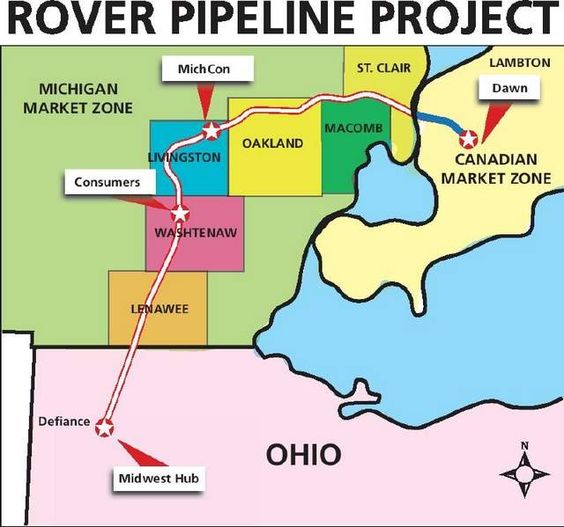
 A somewhat misguided couple who own land in Harrison County, OH and object to Rover putting a pipeline through their land have decided to break the law. Contractors working for Energy Transfer to clear trees and dig a trench to lay pipeline across their land have been working on their land, on an off, for the past three weeks. Sheila Bittinger and her husband Stanley say they’ve had enough and the couple parked several vehicles across the entrance to their property to prevent any more work on the pipeline. It sounds as if they want to get arrested and that they know this particular bit of “civil disobedience” will result in absolutely nothing. But they’re doing it all the same. If you watch the video (below) you get the impression these are honest, country folks who feel like they’ve gotten a raw deal. We wonder if these landowners have been manipulated by slick lawyers who see a big payday coming from a lawsuit against Rover Pipeline…
 EXCO Resources was once a sizable player in the Marcellus. They still have 145,000 net acres in the Marcellus, with 124 horizontal Marcellus wells drilled and in production. However, EXCO, as we pointed out a year ago, has abandoned the Marcellus at this point (see
  There is a concerted effort by a small group of fossil fuel haters to strip away the Constitutional property rights of all Marylanders by passing a permanent ban on fracking in the state. They’ve already convinced the Maryland House to pass a ban bill. The haters spew outright lies about fracking and attract local media outlets with gullible reporters who never question their outlandish claims. While they make false claims about fracking, that it pollutes water, air and in general kills everything, make no mistake–the root of their objection is that fracking extracts fossil fuels which, in the religion of environmental extremists, causes man-made global warming. That is what animates them. Unfortunately, as we have previously observed, Christian pastors from liberal denominations are claiming that the issue of fracking is a “moral” issue, a “good vs. evil” conflict (see
  New York’s corrupt Attorney General, Eric Schneiderman, is getting desperate. We want to go on record as one of the first to say he’s sowing the seeds of his own destruction. Schneiderman is a train wreck waiting (and about) to happen. We refer, of course, to Schneiderman’s eerie similarity to Captain Ahab in Moby Dick in attempting to hunt down ExxonMobil, Schneiderman’s great white whale. Recently Schneiderman, in cooperation with a sycophantic mainstream media, released information that former CEO Rex Tillerson (now Secretary of State) had a second email account. But unlike Hillary Clinton, Tillerson’s second account was not on a private server and was not used (as Schneiderman alleges) to secretly discuss how Tillerson “knew” burning oil and other fossil fuels causes mythical man-made global warming. Schneiderman’s action in running to the press to “reveal” a “secret” email account is a faint–a way to misdirect people from the real story, which is that Schneiderman continues to refuse to disclose his own emails that prove this whole Exxon witch hunt began when Schneiderman colluded and closely coordinated with the Rockefeller Brothers Fund, Rockefeller Family Fund, and billionaire green activist Tom Steyer. A log of emails shows coordination just prior to the launch of the #ExxonKnew campaign for which Schneiderman is the point man. He’s desperate to avoid releasing his own emails–emails that will implicate him…
 Yesterday President Trump released a detailed budget proposal which includes reducing the way-overbloated (and insidiously bureaucratic) Environmental Protection Agency budget by 31%. The budget would also ax some 3,200 EPA employees–about 21% of the 15,000 employed at the agency. It is sheer brilliance and long overdue. The EPA, under Barack Obama, sought to enforce national regulation of the oil and gas industry–something not permitted under the Constitution. It’s about time the agency was right-sized and its mission reigned in. Of course the reaction by the left has been predictable–from apoplexy to terror (snowflakes always melt so quickly). Here’s how the EPA budget news is being spun by mainstream media…
 Pennsylvania moved to the head of Marcellus pack when it comes to production reporting back in 2015. Until January 2015, drillers in PA were required to file production numbers with the Dept. of Environmental Protection (DEP) every six months, in October 2014 the Republican state legislature passed a bill that then-Gov. Tom Corbett signed into law moving reporting from every six months to every month (see