Turbine Shortage Has AI Data Centers Going Old School with Steam
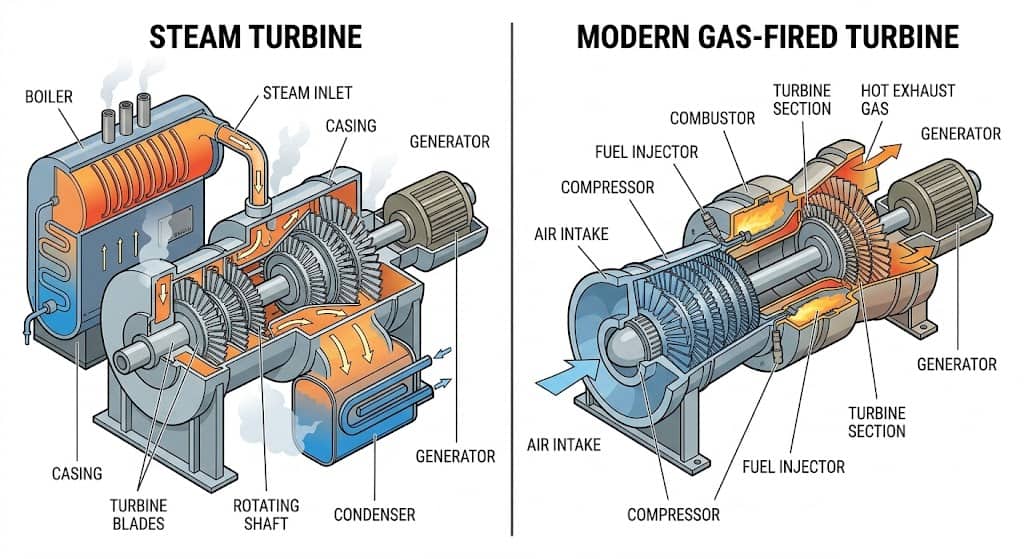
Last month we told you about Akron-based Babcock & Wilcox (B&W) reserving a gigawatt’s worth of steam turbines for gas-fired data centers (see Akron’s B&W Buys 1 GW of Turbines for Gas-Fired Data Centers). The idea is now getting wider attention. In the past week, both POWER Magazine and ZeroHedge ran stories saying AI developers who can’t get a gas turbine for years are going old school: burn natural gas in a boiler, make steam, and let the steam spin a turbine. Is it a full-blown trend? Not yet. But it’s catching on, and it’s a setup that burns more gas per megawatt-hour than a modern power plant. We have no complaints about that. Read More “Turbine Shortage Has AI Data Centers Going Old School with Steam”
 MARCELLUS/UTICA REGION: Contract for up to 45 CNG buses from Central Ohio Transit Authority; Pennsylvania has the energy…will regulation send investment elsewhere?; OTHER U.S. REGIONS: Corpus Christi LNG expansion makes facility the second-largest in the United States; Superior officers find graffiti after fire at Enbridge, Inc. building; NATIONAL: U.S. natural gas futures settle moderately higher; What the data center revolt is really about; CO2 enrichment ahead – de-decarbonization; U.S. LNG terminals increase toward winter levels; Artificial Intelligence is artificial when Washington tries to write technology regulation; INTERNATIONAL: Oil jumps on Saudi and Libya outages.
 The fall “turn down the valves” season for Marcellus/Utica gas has arrived, and it showed up about a week early. Last Friday (Sept. 11), the spot price at Texas Eastern M-2 (aka Tetco M-2), the key pricing point for gas produced in southwestern Pennsylvania, West Virginia, and Ohio, averaged $1.435 per MMBtu (million British thermal units, roughly 1,000 cubic feet of gas). That’s 6.5 cents below the $1.50 mark that EQT, the region’s biggest driller, has flagged as its trigger for curtailing (temporarily cutting back) production. So, are shut-ins coming? History says probably, at least for a while.
 Yesterday the U.S. Environmental Protection Agency (EPA) finalized a rule that rips out the heart of the Biden administration’s 2024 power plant carbon regulations. Gone is the requirement that new “base load” natural gas-fired power plants and long-lived coal plants capture 90% of their carbon dioxide (CO2) by 2032. EPA says the repeal will save $310 billion. At the same time, EPA proposed scrapping every remaining greenhouse gas standard for power plants, which it says would save another $370 million. For the Marcellus/Utica, where a parade of big gas-fired power plants is lining up to feed AI data centers, this is very good news.
 Remember Synapse Energy Economics? That’s the Massachusetts consulting outfit that, back in 2023, was paid by two Big Green groups to produce a “report” claiming Pennsylvania’s RGGI carbon tax would lower your electric bill (see
 NextEra Energy and Dominion Energy, which want to combine into the country’s biggest electric utility in a $67 billion deal, launched a full-blown charm offensive (i.e., piles of money) aimed at Virginia yesterday. The two companies unveiled what they call a “transformational” benefits package that doubles bill credits for homeowners (from two years to four), promises 1,000 new direct jobs, and throws in a brand-new office tower in downtown Richmond, paid for by NextEra shareholders. Why all the sweeteners? Because Virginia Gov. Abigail Spanberger says she is “deeply skeptical” the deal is good for her state, and she has formally inserted herself into the regulatory review. Here’s what’s in the new package, how it’s being received, and why it matters to Marcellus/Utica drillers.
 We told you back in July that the two landowners fighting the 2,180-megawatt (MW) Canadys Station gas-fired power plant in South Carolina’s Lowcountry were teeing up an appeal straight to the state Supreme Court (see
 A Syracuse University professor has published a paper in the Journal of the American Planning Association (JAPA) urging towns to treat AI data centers the way they treated fracking a decade ago. Syracuse’s PR department is billing it as “new research” that shows communities how to handle data centers. There’s just one problem. It isn’t really research—by the author’s own admission, no new data was collected. And several of the “facts” about fracking it leans on are flat wrong, especially about Pennsylvania.
 Back in March, MDN told you that New Fortress Energy (NFE) had entered a voluntary UK Restructuring Plan — the British cousin of a U.S. prepackaged bankruptcy (see
 Pittsburgh-based Alcoa says it’s “very close” to selling its shuttered Massena East aluminum smelter in New York’s North Country to a data center developer. Here’s the part that other reporting left out: the buyer has been sitting on that site since 2017, wants to build a 635-megawatt (MW) computing campus there — and Gov. Kathy Hochul froze the whole thing two months ago with her data center moratorium (see
 National Fuel Gas Company (NYSE: NFG) released its 2025 Corporate Responsibility Report last Wednesday, and the most newsworthy part never made the press release. Buried on page 22 — and repeated on page 25 — is NFG’s announcement that it has discontinued its consolidated absolute greenhouse gas emissions reduction target. The company is keeping its segment-level methane intensity targets and will keep publishing absolute emissions numbers. But the corporate-wide “cut total tons” pledge is gone.
 The streak is over. After three straight reports at 588, the national rig count finally moved, adding three to reach 591. Oil rigs went up. Gas rigs went up. And here at home? Nothing. The Marcellus/Utica sat at 33 for a second consecutive week, which is what “unchanged” looks like when you’re already at your lowest number in two years. Meanwhile WTI crossed $100 a barrel and our gas slid to $2.83. Read those two numbers together and you’ve got the whole week.
 Energy Transfer, one of the biggest midstream players in the country and a familiar name to Marcellus/Utica landowners thanks to the Revolution and Mariner East systems, announced last week that it is pulling its primary stock listing off the New York Stock Exchange and moving it to the brand-new Texas Stock Exchange (TXSE) in Dallas. Three affiliated companies are going with it. Together the four represent close to $100 billion in market value — the largest chunk of listing business the NYSE has ever lost to a startup rival. Before you declare the end of Wall Street, though, there’s an asterisk the size of Texas attached to this one.