
DTE Energy Wants Ratepayers to Pay if NEXUS Pipe is Unprofitable
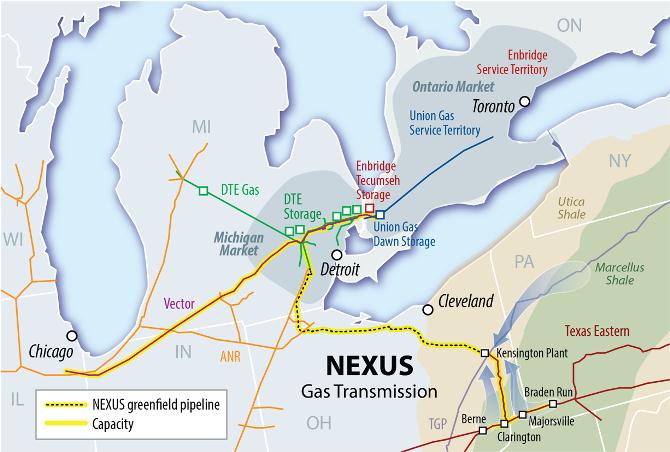
DTE Energy is a Detroit-based energy company involved in the development and management of energy-related businesses and services nationwide. Its operating units include an electric utility serving 2.2 million customers in Southeastern Michigan, and a natural gas utility serving 1.2 million customers in Michigan. DTE’s businesses include power and industrial projects, natural gas pipelines, gathering and storage, and energy marketing and trading. DTE has its fingers in a lot of energy pies. DTE is one of the main customers for the 255-mile, $2 billion NEXUS interstate pipeline that will run from Ohio through Michigan and eventually to the Dawn Hub in Ontario, Canada (see Spectra Energy Files Formal FERC Application for NEXUS Pipeline). DTE is also one of the backers/partners in NEXUS–providing money for the project. Spectra Energy will be the managing partner that actually builds and maintains NEXUS. DTE has asked Michigan regulators for a guarantee that it can pass along NEXUS costs to gas and electric ratepayers IF the utility’s gas supply costs from NEXUS prove to be unprofitable. That doesn’t sit well with many people, including Michigan’s Attorney General…
Read More “DTE Energy Wants Ratepayers to Pay if NEXUS Pipe is Unprofitable”

 Anti-fossil fuel crazies have found a new cause: force investors to dump their investments in the oil and gas industry. The crazies hope by doing so that public companies like Exxon Mobil will crash and burn–and remove fossil fuels from the energy mix. It’s an LSD hallucination–but there you go. (Note: Many in the fossil fuel divestment movement are burned out hippies.) The crazies have tried this with a number of liberal colleges. The dolts who run Syracuse University fell for it (although they didn’t have much in the way of fossil fuel investments anyway), while New York University rejected calls to divest, calling such a strategy irresponsible (see
  In 2013, Dominion announced a 20-year deal to export 100% of the output from their planned Cove Point, MD LNG plant. All of the Marcellus gas from Cove Point will get exported to both India and Japan (see
  As a counter to onerous new regulations being pedaled by the out-of-control Obama Environmental Protection Agency, the American Petroleum Institute recently issued a statement pointing out the government itself–the Dept. of Energy and the EPA–have authored research reports that extol the virtues of hydraulic fracturing–i.e. “fracking.” The API’s statement says that the environment *benefits* from fracking, rather than suffering. After all, Uncle Sam says so in its own research…
 The “best of the rest” – stories that caught MDN’s eye that you may be interested in reading. In today’s lineup: Marcellus production steady; Utica production up y/y; Hawaii’s move to LNG is slow; the Clinton/Sanders frack ban; this year’s election a referendum on energy; o&g reserves plunge 40 Tcf in a year; natgas predicted to hit $3.50/Mcf in 2017; PIPES Act sent to Obama; the rhyming cycles of oil and capital; and more!
 MDN has attended several Federal Energy Regulatory Commission (FERC) “scoping hearings” in the past (see
  In December MDN told you that Seneca Resources (a wholly owned subsidiary of National Fuel Gas Company) had cut a deal with energy investor IOG Capital to essentially fund Seneca’s Marcellus drilling program in Elk, McKean and Cameron counties in north-central Pennsylvania (see
  MDN has covered, endlessly, the story of opposition to any kind of pipeline in New England. That opposition is largely responsible for Kinder Morgan throwing in the towel on their planned Tennessee Gas Pipeline extension called Northeast Energy Direct, or NED (see
  Yesterday MDN’s favorite government agency, the U.S. Energy Information Administration (EIA), issued our favorite monthly report–the Drilling Productivity Report (DPR). The DPR is the EIA’s best guess, based on expert data crunchers, as to how much each of the U.S.’s seven major shale plays will produce for both oil and natural gas in the coming month. One observation from the June report: The worm has turned for natural gas production in the Utica Shale. Until this report, the Utica has stood alone among nation’s seven major plays in a trend of producing more natgas month over month. The EIA now predicts next month that trend will reverse and the Utica will begin to produce less natgas month over month. Not a lot less! Just 4 million cubic feet per day (Mmcf/d). But still, it’s worth noting. Another observation: When you combine all of the plays for both oil and natgas production, the rate of decrease for both is picking up. That is, month over month we’re now producing less and less of both oil and natgas from our shale plays. Which will likely be good for prices (less supply, the same or more demand equals higher prices). Here’s the latest from the EIA…
 In December MDN told you that Axiall Corporation, a large petrochemical manufacturer, had made a final investment decision to move ahead and build a $3 billion ethane cracker/petrochemical facility in Louisiana (see
  Listen up Pennsylvania communities with shale drilling: The PA Housing Finance Agency (PHFA) wants to hear from you with proposals for improving the “availability and affordability of housing in the Marcellus Shale region of the state.” The PHFA is back for a second year in a row with $5 million from impact fee revenue to spread around in communities affected by shale drilling (see last year’s story:
  The Shell ethane cracker plant “yes” announcement is still, a week later, reverberating across the northeast (see
  Last week BP released its annual Statistical Review of World Energy–the 65th edition! (We have a full copy embedded below.) A number of big energy companies, like Exxon Mobil, as well as government agencies, publish similar reports that characterize current and future world energy trends. However, one analyst we read says BP’s report is the best: “I have relied upon the BP World Energy report for years. It is not a report to be viewed with a partisan eye, but as merely one of the best, if not the best, energy trend device available anywhere. In comparison to government agencies like the U.S. Energy Information Administration (EIA) the global International Energy Association (IEA) or OPEC’s own World Oil Outlook, the BP report has proven itself to be far more valuable in finding investable trends. I would never recommend any oil sector without having the statistical evidence of the BP World Energy Report behind me.” In scanning a summary of this year’s report, one statistic stands out for us. Environmental radicals constantly prattle on that renewable energy sources could replace fossil fuels, if we only had the will to change. What utter rubbish, as proven by this stat: In 2015 renewable energy, mostly used to generate power, reached 2.8% of global energy consumption, up 2% in the last ten years. Did you get that? Only 2.8% of the energy used in the world is generated by wind, solar, etc. Fossil fuels are here to stay through not only our own lifetimes, but the lifetimes of our children and grandchildren. Someday maybe we’ll be famous for having been prescient in penning these words (we’ll be long dead and gone)–but mark our words, fossil fuels are not going away any time soon…
 We’re keeping a close eye on Siluria Technologies. In May we told you the company has pioneered a way to convert methane (i.e. natural gas) directly into ethylene, the raw material used to make plastics (see
  The odious and misnamed Food & Water Watch, a virulent anti-drilling organization, along with several other Big Groups, has just delivered a petition with the signatures of 90,000 wacko radicals to the Democrat National Committee to demand that the DNC add a fracking ban plank to the Party’s platform. Outlandish? Would never happen? Hey, radicals in Pennsylvania got the Dems there to adopt such a plank before the last gubernatorial election (see