
PIOGA Sets Record Straight on Latest Wolf Attack re Severance Tax
 The Pennsylvania Independent Oil & Gas Association (PIOGA) has been at the forefront in opposing an industry-killing severance tax proposed by new governor Tom Wolf (see PIOGA Leads the Charge to Defeat Wolf’s Severance Tax). We are now close to three months past the deadline for a new state budget–and Wolf continues to be obstinate. He offers a few crumbs and when Republicans don’t immediately cave on a massive, industry and jobs-killing severance tax, he jumps up and down like a spoiled three year-old saying he “got nothing” in return. What a putz. Here’s how the obsequious Pittsburgh Post-Gazette reports Wolf’s latest temper tantrum…
Read More “PIOGA Sets Record Straight on Latest Wolf Attack re Severance Tax”
 Fresh back from Shale Insight in Philadelphia, MDN editor Jim Willis is always pumped after hearing about the technology and safeguards and careful treatment the shale energy industry uses in extracting shale gas. These people are true professionals who care about the work they do–and they want to do it right. They care about the environment. They want to protect the land and our natural resources. They live in the communities where fracking is done. On the other hand, the people who profess to care about such things, anti-drillers, repeatedly prove themselves to be a) mind-numbed robots who believe whatever their movement leaders tell them, b) stark raving mad. Example: A group of extremists who happen to be “religious” have penned a letter to Pennsylvania Gov. Tom Wolf asking him to stop all fracking in the state because they fervently believe (wrongly) that fracking contributes to the mythological existence of man-made global warming. Mainstream media picks this garbage up and repeat it, like it’s a real news story…
 Let’s be honest, shall we? The Catholic Church has a Marxist as its leader in Pope Francis–which is a truly sad thing for a great and significant denomination. Pope Francis, nee Jorge Mario Bergoglio, is from Argentina and he supports Marxism, as many do in South America. Pope Francis hates capitalism and appears to be more interested in advancing socialist political policies here on earth than he does in serving Jesus Christ and saving souls. The current situation with Pope Francis distresses many Catholics we personally know. The Pope has thrown in his lot with climate change liars–those who say mankind is causing the earth to warm up–because the so-called climate change movement is the new home of anti-capitalists (i.e. Marxists, i.e. Communists). Scientific fact: global average temperatures haven’t risen now for 18 years. Yesterday, The Heartland Institute participated in a Constitution Day event in Philadelphia to call attention to the Pope’s coming visit to Philly (a visit made possible via fossil fuels) and the Pope’s error-filled teachings against fossil fuels and capitalism…
 A single professor from Duke University who lives by the motto “publish or perish” is out with yet another “study” published in a so-called peer reviewed journal. From time to time Avner Vengosh, professor of geochemistry and water quality at Duke University’s Nicholas School of the Environment, pops up to smear the Marcellus Shale. He was in league with the Izaak Walton League to attempt to tie Marcellus drilling to water contamination in Ten Mile Creek (see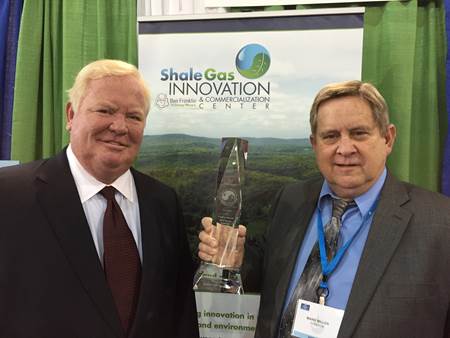
 MDN is proud to be supporting this year’s Pennsylvania Independent Oil & Gas Association (PIOGA) Eastern Oil & Gas Conference and Trade Show, which will take place Oct 27-28 at the Monroeville Convention Center just outside Pittsburgh. The event features a conference, trade show and networking events–a “must attend” event for those involved with oil and gas drilling in the PA (and associated industries). Below is the just-announced line-up for conference presentations. Oh! And be sure you don’t miss the Halloween-themed mixer Tuesday evening!…
 Even though MDN editor Jim Willis couldn’t attend many of the sessions on the first day of Shale Insight (booth duty calls), we do have a good roundup of news from others who attended the sessions…
 Following on our rumor from yesterday that Chesapeake Energy is looking to sell their dry gas Utica acreage (see
  On June 28, 2014 a fire at Statoil’s Eisenbarth eight-well pad in Monroe County, OH quickly spread and engulfed some 20 trucks on the pad site, along with other equipment, chemicals and supplies stored at the site. It was a devastating fire (see
  We previously told you about anti-fossil fuel groups in three Ohio counties–Athens, Fulton and Medina–who are being used by Big Green groups to attempt an illegal “community bill of rights” routine after the Ohio Supreme Court had already found local communities can’t ban fracking. They tried again and Ohio’s Secretary of State John Husted tossed the ballot measures (see
  In March MDN told you the sad story that Canadian waterless fracking company GASFRAC had been sold to an unnamed third party after going bankrupt (see
  On Tuesday the Pennsylvania Dept. of Environmental Protection held it’s first “listening session” to consider which creative ways they will cut the economic throat of the state by attempting to comply with nonsensical carbon standards set by our Dear Leader, Barack H. Obama, via his so-called Clean Power Plan (see
  The R Street Institute is a non-profit, non-partisan, public policy research organization (i.e. “think tank”) headquartered in Washington, DC with satellite offices in Florida, Texas, California, Alabama, and Ohio. After conducting an extensive review of existing published studies, R Street has found that while every form of energy has its negatives, including fracking, on the whole fracking for shale energy’s benefits far outweigh its negatives. Their findings are published in a new report titled “The Green Side of Fracking” (full copy below)…
 From time to time we highlight companies that get their line of credit/borrowing power reevaluated by their bankers. Usually we spot announcements from exploration and production (E&P) companies, otherwise known as drillers on MDN. Sometimes we spot such announcements for midstream (or pipeline) companies. The one we spotted from yesterday about made our eyes pop out–by far the biggest such line of credit we’ve seen for a company with major operations in the northeast shale area. Enterprise Products Partners, which built and operates the 1,230-mile Appalachia-to-Texas Express (ATEX) ethane pipeline from Ohio to the Gulf Coast, announced they got a bump up in their credit line of $500 million. They now have the power to borrow up to $5.5 BILLION (yes, with a “b”). They could buy a small country with that kind of money…
 ET Rover is a 711-mile Marcellus/Utica natural gas pipeline that will serve mostly U.S. customers and will cost $3.7 billion to build and run from PA, WV and eastern OH through OH into Michigan and eventually into Canada (see