
Upstream Goes Downstream: Equinor Buys Into Scranton Power Plant
 Norway’s Equinor — the company we all used to call Statoil — announced Monday it is buying a majority interest in the Lackawanna Energy Center (LEC), the big Marcellus-fired power plant in Jessup, PA, just outside Scranton. Equinor is paying $940 million for 87.71% of the Class A shares in the 1,483-megawatt plant, buying them from funds managed by Global Infrastructure Partners (GIP), which is now part of BlackRock. Invenergy, which built LEC and has run it since day one, stays on as operator. MDN has followed this plant since it was nothing but a proposal and a pile of angry town council meetings (see MDN’s LEC coverage), so this one hits close to home — literally, since the plant sits two counties from MDN world headquarters. Read More “Upstream Goes Downstream: Equinor Buys Into Scranton Power Plant”
 A Wall Street rumor landed Tuesday that most of the financial press covered as a Wall Street story. We’re going to cover it as a Susquehanna County story — because buried inside UGI Corporation, the Valley Forge-based utility holding company that private equity giant KKR reportedly wants to buy for $9 billion, sits one of the more important collections of gathering, storage and pipeline assets in the northeast Marcellus.
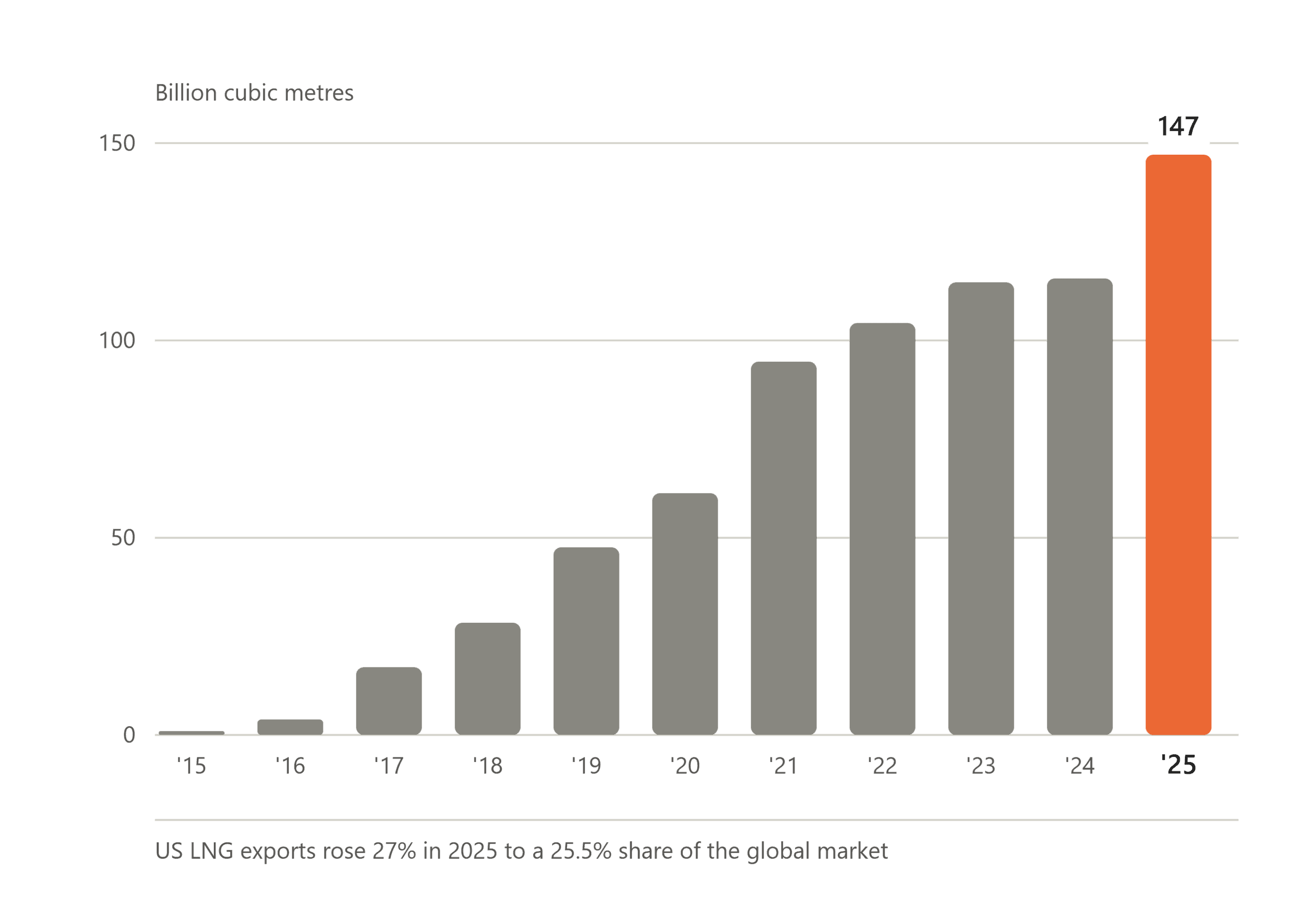
  Here’s a number every Marcellus and Utica landowner should tape to the refrigerator: $5. That’s where Colorado-based East Daley Analytics thinks Henry Hub natural gas prices are headed by 2031, and the reason is the LNG export buildout on the Gulf Coast, which the firm says will pull roughly 35 billion cubic feet of gas per day out of the U.S. supply pool by 2035. The catch — and it’s a big one — is that nobody has fully answered where all that gas comes from. East Daley published the analysis Aug. 18 in its Daley Note. Most of it is Gulf Coast and Permian Basin material. But bury the lede, and you miss what matters for the M-U audience.
 OTHER U.S. REGIONS: First ‘gas-plus-nuclear’ plant for data centers; NATIONAL: U.S. natural gas futures rise on near-term weather; Energy stocks soar to record; Battle over data centers is reminiscent of battle over electrification; Net zero is dead and gone; INTERNATIONAL: Oil hits three-week high on Iran standoff; Electricity policy is economic policy – the race for reliable power.
  It’s official. In June, we told you OpenAI was in “advanced negotiations” to lease the gargantuan 10-gigawatt (GW) data center campus rising on federal land in Piketon (Pike County), Ohio (see
  Devon Energy just told the market it’s willing to write big checks to get stranded natural gas to better markets. The gas in question is in West Texas, not Susquehanna County — and that says something about where the old Cabot Oil & Gas assets stand in the new Devon. On Monday, Devon announced a positive Final Investment Decision (FID — meaning the money is committed and the shovels are coming) on the Solitude Pipeline System, a WhiteWater-led joint venture building two 48-inch natural gas pipelines from the Permian Basin to Katy, Texas.
  In March, MDN told you that Butler County landowners were appealing after a federal judge tossed their royalty class action against XTO Energy (see
  Net Power, backed by the Rice brothers (of Rice Energy and EQT fame), has spent years chasing the holy grail of natural gas power: a plant that burns gas and emits essentially zero carbon dioxide. Last year the company backed off that goal and pivoted to post-combustion carbon capture (PCC), which grabs about 90% of the CO2 using off-the-shelf technology. Close enough, the market said. Last week, Net Power pivoted again — and this one’s a doozy. The first phase of its flagship West Texas project will now be built with no carbon capture at all. Just a gas plant. Meanwhile, the company took a $193.7 million charge to write its original Allam Cycle technology and its La Porte demonstration plant down to zero.
  The independent watchdog that grades the PJM electric grid put out its half-year report card last Thursday under the cheerful headline “Market Monitor Finds PJM Wholesale Electricity Markets Competitive.” Read down three paragraphs, and you find the opposite — the capacity market flunked, three years running, and the Monitor blames data centers. Buried further still is a number that ought to end a certain argument in Harrisburg for good: the biggest single driver of PJM’s price spike wasn’t natural gas. It was the wires.
  A free-market think tank in New Jersey has published a report that says out loud what MDN readers figured out years ago: the Garden State keeps its lights on with natural gas — a lot of it, Marcellus gas — while chasing a 2035 clean-electricity mandate propped up by offshore wind that does not exist and batteries that have barely been built. The report, Reliability Before Retirement: Reassessing New Jersey’s 2024 Energy Master Plan, comes from the Garden State Initiative (GSI), a Morristown-based nonprofit that pushes free-market policy in one of the least free-market states in America. Author Anurag Bhat is no fracking cheerleader — he’s a sustainability-credentialed analyst who co-wrote GSI’s 2025 critique of the same Energy Master Plan (EMP). Which makes the findings that much more useful to us.
  On July 1, MDN told you Golden Pass LNG had gone dark — three cargoes out the door and then, on June 29, almost no feedgas flowing into the plant at all (see
  Competitive Power Ventures (CPV) and EQT Corporation have signed a 10-year gas supply agreement that locks up the entire fuel appetite of the CPV Shay Energy Center, the $3 billion, 2,100-megawatt (MW) combined-cycle plant headed for Doddridge County, West Virginia. It’s the deal that turns Shay from a project on paper into a project with a fuel contract.
  Virginia’s environmental cops have hit Transcontinental Gas Pipe Line Company (Transco) with a $179,068.50 civil charge over erosion and sediment control violations on the Pittsylvania County stretch of the Southeast Supply Enhancement (SSE) Project — the single most important new outlet for Marcellus/Utica gas heading south.