
Enbridge Plans New 28-Mile Gas Pipe in Chatham & Lee Counties in NC
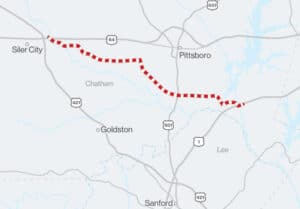
Enbridge Gas is developing a 28-mile natural gas pipeline to meet growing residential, commercial, and industrial energy needs in Chatham and Lee counties in North Carolina. The project, intended to connect Siler City to Moncure, is part of a larger state natural gas infrastructure buildout that Duke Energy says is crucial to meeting demand, especially from new data centers. With strong economic and population growth in the region, additional natural gas capacity is essential to support expanding communities and major industrial users, as well as to help ensure continued, reliable service for existing Enbridge Gas customers. This greenfield project is, of course, stirring up environmentalists who claim it will harm the environment (as well as cause mythical global warming). Read More “Enbridge Plans New 28-Mile Gas Pipe in Chatham & Lee Counties in NC”
 In April, MDN reported that anti-fossil fuel fanatics had not yet given up on trying to block construction of the Williams Northeast Supply Enhancement (NESE) pipeline, a $1 billion+ project designed to increase Transco pipeline capacity and flows of Marcellus gas heading into New York City and other northeastern markets. Even though there was an official groundbreaking ceremony at Brooklyn’s Floyd Bennett Field in New York City in April, antis are still doing their best to block this project. They pinned one of their last hopes on a relatively obscure state agency in New Jersey, pressuring it to refuse to issue a license for the project (see
  UGI Corporation’s UGI Energy Services and Prime Data Centers yesterday announced a strategic partnership to develop natural gas supply infrastructure in Pennsylvania’s northern tier for a proposed gas-fired power facility serving future hyperscale data center operations. Under the deal, UGIES will sell Prime some of its property while retaining about 15 billion cubic feet (Bcf) of underground storage capacity and related oil and gas rights. Prime’s gas demand is expected to exceed 100,000 dekatherms per day (100 MMcf/d) within three to five years. A major new customer for PA Marcellus gas!
  New research by the Commonwealth Foundation finds that Pennsylvania’s foolish pursuit of joining the Regional Greenhouse Gas Initiative (RGGI), a carbon tax scheme, led to a loss of $5 to $8 billion in energy sector investment over six years, stalling power projects and reducing electricity generation capacity. The state’s attempt to join RGGI, initiated by executive order under then-Governor Tom Wolf, was ultimately overturned by the courts and (eventually) by legislative action, citing it as an unconstitutional tax. Meanwhile, neighboring Ohio, not part of RGGI, saw an increase in energy projects, highlighting the differing regulatory environments.
  The European Union’s idiotic methane regulations begin in earnest next year. Domestic (European) oil, gas, and coal companies must monitor, measure, and report their emissions. The same restrictions will apply to energy imports from other countries, including imports from the U.S. (see
  NATIONAL: U.S. natural gas futures fall ahead of storage data; Alarmist fussing at NYT climate reporting; Rapid solar and wind growth sparks local backlash; INTERNATIONAL: Oil sinks on Iran peace proposal; Shipowners stay cautious on Hormuz despite peace deal hopes.

 DT Midstream (DTM) is an owner, operator, and developer of natural gas interstate and intrastate pipelines, storage and gathering systems, compression, treatment, and surface facilities, including major assets that are in (or flow molecules from) the Marcellus/Utica. Last week, the company issued its first quarter 2026 update. CEO David Slater announced two new projects to expand pipelines that carry Marcellus/Utica molecules. He also announced a project to build a new lateral to an Indiana power plant and a new interconnect that flows more M-U molecules into the NEXUS pipeline. Great things are happening at DTM!
  Three weeks ago, the Trump Department of Energy announced it is moving forward with funding for five of the original seven Biden-awarded hydrogen hub projects, spending $5 billion of the originally allotted $7 billion (see
  We had to do a double-take when we spotted an editorial, written by the editors of the liberal Bloomberg News service, running under the title, “Data Centers Aren’t the Enemy — They’re the Future.” Bloomberg’s editorial board argues that proposed restrictions or moratoriums on data centers would be a major mistake, given their growing importance to cloud computing, AI, and the broader economy. Do you like using Facebook? Do you search Google? Do you have an Amazon Alexa in your home that you use with voice commands? Do you talk to your cell phone with voice commands? That all comes from data centers (some of it AI). If you block data centers, you block the internet. It’s that simple.
  Devon Energy and Coterra Energy shareholders have approved all proposals needed to complete the companies’ previously announced all-stock merger, which is expected to consummate on May 7, 2026. More than 98% of the votes cast by Devon shareholders and more than 99% by Coterra shareholders supported the deal. Executives said the merger will create a larger shale operator with complementary assets, improved scale, enhanced margins, free cash flow growth, and stronger shareholder returns.
  Yet another rankly hypocritical move by the Democrats in the Pennsylvania legislature. Yesterday, every single Democrat in the PA House voted in lockstep (as they typically do, under the leadership’s complete control) to pass House Bill (HB) 2076, titled “Advancing Geothermal Energy Development.” The Dems were assisted by 16 Republicans who were (charitably) hoodwinked. No matter. The bill won’t pass in the Senate. But why point out this vote? Because the “advanced” geothermal energy that the House wants to promote and regulate uses the very same drilling rigs and fracking as is used to drill in the Marcellus shale, revealing the hypocritical lies of the Democrat left in demonizing fracking. But there’s another reason we’re highlighting this news: The environmental left (including House Democrats) is seeking to increase drilling setbacks in the state from 500 feet to 3,281 feet (and, in some cases, 5,280 feet). Do the House Dems realize the new setbacks would not only ban ALL shale fracking in the state but also all geothermal fracking?
  President Donald Trump’s proposal for a $33 billion, 9.2-gigawatt gas power plant in Ohio—funded by Japanese investment, including SoftBank—aims to address soaring energy demands from data centers (see