
PA Republicans Push Alternative to Wolf’s Insane Severance Tax
 In April MDN told you that Pennsylvania State Senators Camera Bartolotta (Washington County) and Pat Stefano (Fayette County) had beaten PA Gov. Tom Wolf at his own game by offering to pay for his so-called Restore PA plan, not by using a severance tax on shale production, but instead by allowing more shale drilling on PA state lands (see PA Senators Steal Wolf’s Thunder, Propose Drilling to Fund Goodies).
Read More “PA Republicans Push Alternative to Wolf’s Insane Severance Tax”
 In April, West Virginia Gov. Jim Justice, who is pro-coal (because much of his personal fortune comes from coal), took a swipe at shale drillers claiming shale is responsible for the poor condition of roadways in the Mountain State (see
  Pennsylvania Attorney General, Josh Shapiro, and the anti-drilling Pittsburgh Post-Gazette, continue their tag-team effort to criminalize and humiliate Range Resources. Shapiro, a sleazy politician, is investigating so-called environmental “crimes” committed by shale companies in a bid to boost his chances of being the next nominee to run for governor (see
 U.S. Senator John Cornyn, Republican from Texas, along with Republican Senator Bill Cassidy from Louisiana, along with (surprise!) two Democrat Senators, Chris Coons from Delaware and Kyrsten Sinema from Arizona, are all co-sponsoring a new bill called the Launching Energy Advancement and Development through Innovations for Natural Gas (LEADING) Act. While on the surface the bill seems to be addressing mythical man-made global warming, it’s true intent is to ensure loony birds in federal and state governments don’t outlaw the use of natural gas to generate electricity.
 MARCELLUS/UTICA REGION: PA Senators shop bill to give AG more environmental authority; Approve this natural gas pipeline: The New York metropolitan area’s economy will suffer greatly; TWA hotel doesn’t need city’s power grid. It has its own.; NATIONAL: Occidental to sell parts of Anadarko after debt-fueled acquisition; The next LNG boom will dwarf the last one; Fracking saves low-income Americans’ lives; What’s fueling our robust growth?; We shouldn’t be surprised renewables make energy expensive since that’s always been the greens’ goal; INTERNATIONAL: Replacing diesel with liquefied natural leads to a fuel economy of up to 60%.
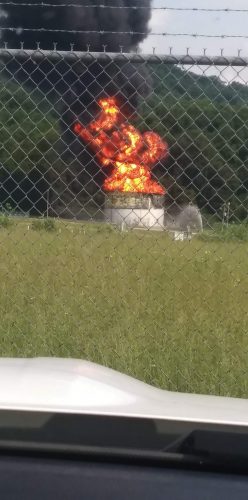 Lightning struck a 1 million gallon condensate tank owned by Dominion Resources near Friendly (Tyler County), WV on Saturday afternoon around 1 pm. The strike ignited the tank, creating a “massive” fire according to news accounts.

 We recently brought you several stories about New York Gov. Andrew Cuomo’s predictable (and foolhardy) rejection of the Williams Northeast Supply Enhancement (NESE) pipeline project to pipe more natural gas to a desperate New York City and Long Island (see
  Two weeks ago MDN reported that a New Jersey state commission, the Pinelands Commission, which has a power to block a pipeline through 10 miles of “protected” scrub pines and swamp lands, is currently paralyzed in their efforts to roll back permission previously granted for the pipeline project under Republican Gov. Chris Christie (see
  ExxonMobil recently signed an agreement with the U.S. Department of Energy’s National Renewable Energy Laboratory (NREL) and National Energy Technology Laboratory (NETL) to help fund both operations to the tune of $100 million over the next 10 years, looking to bring biofuels and carbon capture and storage to commercial scale across the transportation, power generation and industrial sectors. That is, to bring to market new tech that lowers carbon dioxide emissions. All in the name of stopping non-existent, man-made global warming.
 On Monday Toby and Derek Rice–the Rice brothers (formerly owners of Rice Energy that sold itself to EQT in 2017) sent an open letter to EQT shareholders and a “white” proxy card, asking shareholders to vote for the Rices’ picks as board members (see
  A new study just published in the peer reviewed journal Geophysical Research Letters by an international team of researchers finds that natural gas “has half the carbon footprint of underground coal mining.” The researchers looked at (did measurements of, actual real science) methane in the atmosphere by flying transects over the southwestern portion of Pennsylvania and adjacent portions of West Virginia and Ohio. Marcellus/Utica central. One of the researchers from Penn State said this about the findings: “Obviously, renewable energy would be better, but there is no debate, switching to natural gas is worth it in the short run.”
 During a President Trump trade trip to China in November 2017, Chinese officials signed an informal (non-binding) agreement to invest a whopping $83.7 billion in shale and petrochemical projects located in West Virginia (see